Artists To Know

Artists To Know: Discovered On Instagram

It’s been awhile since I’ve done an Artists To Know Segment, and inspiration is everywhere. Despite being a completely visual based person, I resisted getting an instagram for longer than most just because the idea of yet one more social media account to manage filled me with a sense of intense existential dread if I’m honest ;). Finally, I realized as an artist trying to showcase and sell work I needed one for the business aspect alone and relented. Now I don’t know how I lived without it! I have discovered so many new and inspiring artists from all over the globe, but if I had to narrow it down to just 5 for right now, here are my tops.

Joram Roukes

1

Roukes is a painter from the Netherlands whose work has been exhibited worldwide, and he is one of the only artists that work in more “chaotic” scenes whose pieces I’ve ever been deeply attracted to. In my own work I am so orderly and controlled, repeating a select amount of the same visual tropes within one piece with balanced space for the eye to rest … I’ve always tended to get stressed out by work filled with conflicting styles and a ton of disparate elements bundled all together, but I have loved every single piece of Roukes’s work that I have seen. The vibrant, unique color schemes and photo-realistic detail  that combine classical influences with modern experiences and street art are unlike anything else I’ve seen, and the thoughtful composition makes combinations of visuals that shouldn’t work together somehow work perfectly. Beginning as a graffiti artist, he now focuses on large-scale murals that combine his own experiences, global politics, and pop culture in a dark but also surprising and often comical way.

Natalia Berglund

483e368f-19d7-434b-8173-b524d6452213_rw_1920

Berglund hails from Belarus, but received her arts education in the United States. Her focus is in portraiture. Unique takes on the portrait tend to be my favorite type of art, so I was intrigued by her work the moment I saw it. Berglund has equal parts Eastern and Western visual and ideological influence, which gives her a different perspective based on her experiences. Much of her work is also influenced by traditional religious portraiture, but at the same time aims to challenge religious iconography, and both Russia and the United State’s representation of what it means to be a woman. Though the work above was what first that grabbed my attention, if you visit her portfolio you can see the wide range of styles she works in, and the strength and story that is apparent in each portrait. Her mission through her work is similar to what I hope to achieve, and I find her a huge inspiration.
Cristian Blanxer

p343_orig

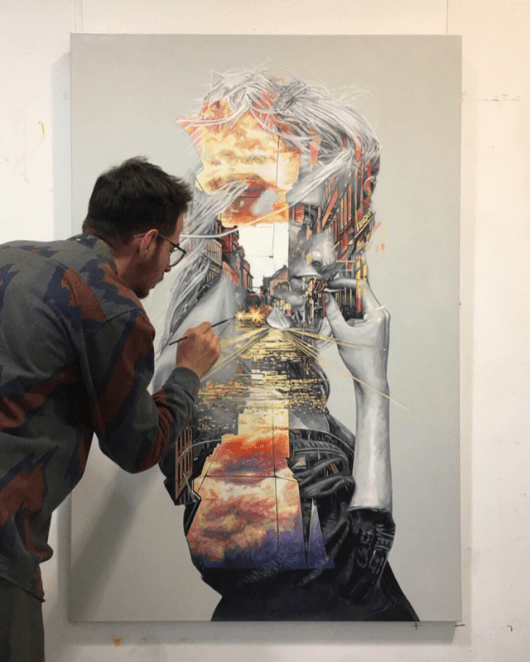
Blanxer is from Barcelona, and actually graduated from university only 2 years before I did, so what have I been doing with my life -_- (I kid, mostly.). He works in both exterior murals, covering buildings in large-scale artworks, and on canvas. His canvases still integrate the cityscape as he seamlessly combines reflective urban scenes with traditional portraiture. What amazes me is how nothing gets lost in the merger. He strategically places the human elements and the architectural elements in such a way that the viewer’s brain can fill in the blanks and complete both scenes. This series appears to me like the viewer is seeing what the subject of the portrait is looking at through their eyes reflected back over them, as if we are being allowed to gaze into their mind, and that is what makes his art so powerful to me.

Yellena James

biomorphic-art-yellena-james-1

James grew up in Bosnia, but moved to the US at 18. Her background is in both fine art and graphic design, but she says she has always preferred paint and ink to digital means of creation (yes!). In addition to her personal fine art she continues to design for well known brands like Anthropologie and Crate and Barrel among others, and has published an interactive art book about applying the geometry of nature to drawing practice. James creates imaginary ecosystems inspired by the natural geometry present in the world around us, and says the process of building details in each piece is a form of meditation for her. I find myself getting immersed in her colorful botanical illustrations, imagining myself as part of her magical worlds, and her work has an intensely calming effect on me. I’m calm about 5% of each day, so this is nice.
Ritchelly Oliveira

tumblr_p0pdny3bqu1qlp2xwo1_1280

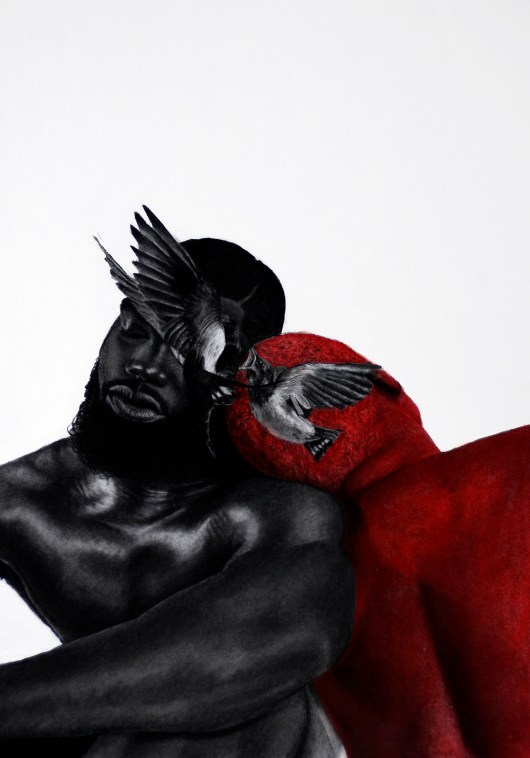
Oliveira is from Brazil, and is also mainly a portrait artist. I have a draw, I can’t help it! His drawn portraits are photo-realistic but incorporate surreal elements from nature or at times unfinished boundaries. There is a strong, silent emotion that resonates from his figures’ calm, reserved facades that is so moving, relateable, and true to life.

I hope at least one of these artists have left you feeling inspired, and if you ever have ideas of artists or types of art you’d like to see featured let me know!
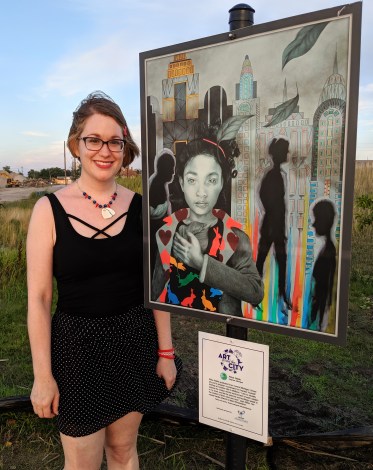
sign (1)As for what I’ve been up to in my own creative universe lately, I was chosen to be part of the 50 Artists of the Great Lakes Bay Region Exhibition, and will be showing my new piece Torn in Studio 23’s gallery in the Fall. A metal print of my prismacolor pencil and mixed media work Wonderland will also be on display along Bay City’s Riverwalk trail for the next 2 years. It’s a couple days from September, so I am also officially in production mode for my annual Halloween ACEOs, so look for those in my eBay shop with more still to come! Check back soon to see the collaborative projects I’ve been working on in the meantime alongside some portrait commissions and logo designs. I’m ready for a busy Fall <3.


Standard
New Work

I’m Not Dead, Here’s Some New Art!

noboringwalls2I’m back again! I’ve been pretty quiet on here and have been taking a bit of a project hiatus in general as I go through some life transitions and changes in a couple of areas, but have completed a few smaller stand alone projects. I talked about some of my anxiety struggles previously, so while dealing with that at a higher intensity especially over this Spring and Summer, I really needed to focus on art that was purely therapeutic; not a job or another task to complete or something with an intense deadline or something that was going to take months to complete. 

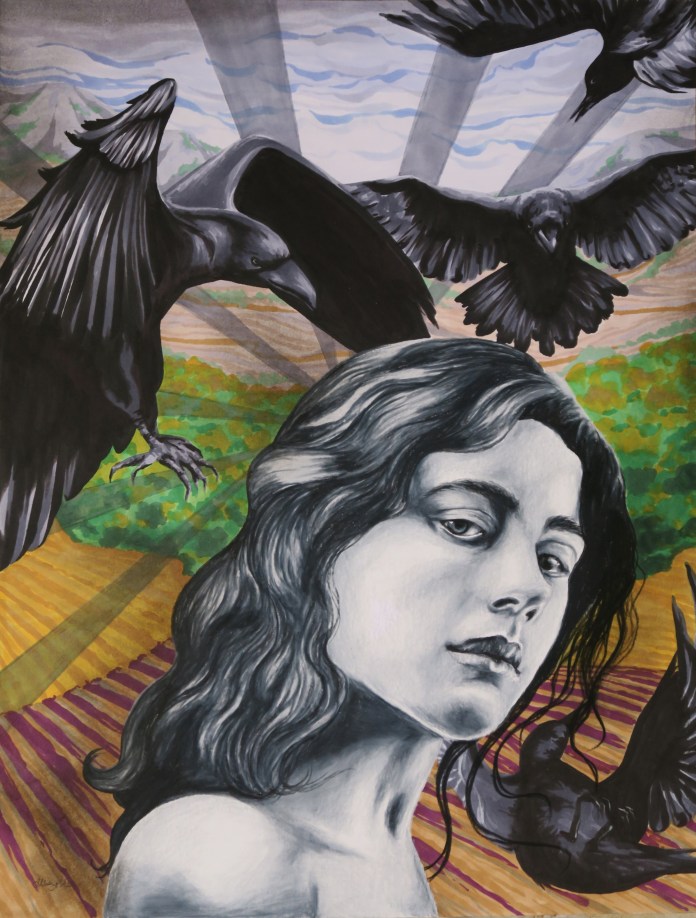
I am obsessed with raven imagery, and parted with one of my favorite pieces recently as a gift for my brother, a fellow creative who just bought a new home and is getting married this fall. I knew I wanted to do another similar piece, but with a bit more color this time. I lead an art therapy program for adults with varying disabilities, and see every day how creation can be a life saving force that reminds people that they are worthwhile if only because they have made something that day. Art can be a window in an otherwise dark room. Part of the art therapy aspect of my forcing myself to keep making art even when all I wanted to do was watch movies or go to sleep early after getting home for the day was to inject my own personal thoughts and feelings into the chosen aesthetic of what I was creating. In “Flight Response”, the subject’s face is deliberately calm and expressionless while the birds flying around her appear fast and chaotic. Both she and the birds are done entirely in high contrast black and white to appear connected as one entity. They could be physical manifestations, or projections of the woman’s psyche. The background being almost opposite the woman and birds, a more expressionistic landscape in bright, peaceful colors, is also deliberate. There is hope, and there can always be better things ahead. Though not always aware of it, she is in control.Flight Response

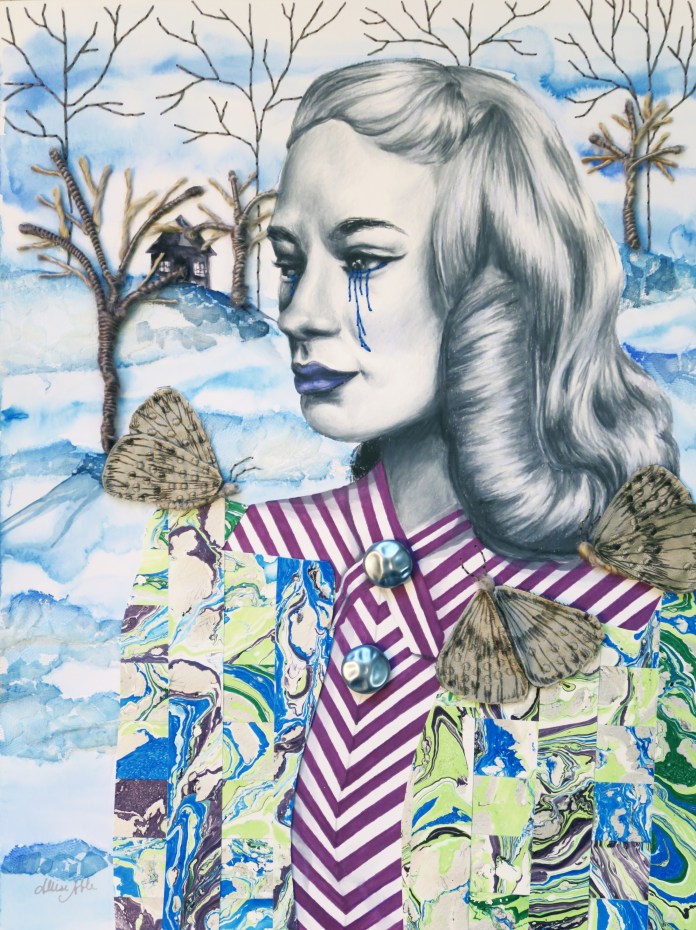
I also wanted to take the opportunity to play around with some different techniques and combinations of materials with no pressure on achieving a specific result, another important aspect of art as therapy. In “Waiting”, I  tried watercolor painting on wrinkled lace, wire wrapped with yarn, embroidery, and weaving strips of hand marbled paper along with my traditional ink and prismacolor pencil drawing. Again, there is an aspect of sadness and isolation but not without a lingering hope. I aimed to craft a story based on what I was experiencing as a way to process my thoughts, but a story that is open ended so the viewer can create their own narrative as well.

waitimg

As the smoke is clearing, I’m still working on my series based around color psychology and looking forward to doing more teaching again in the Fall. Both of the above pieces are available for purchase, and I’m starting early on some small and affordable Halloween-time art that will soon be posted in my eBay shop, so keep an eye out! For a time lapse of some of the background illustration for “Flight Response”, check out my artist facebook page.


Standard
Art Education, Project Ideas

Kintsugi – Creative Minds Art History Project

I’ve always loved Kintsugi pottery not just for its striking visual interest but also for the symbolism behind it. Kintsugi means “golden joinery”, and is a practice that started as early as the 15th century in Japan. With Kintsugi, artists fix broken pottery by using a special lacquer mixed with powdered metals to join the pieces back together. Influenced by the Japanese philosophies of wabi-sabi (seeing beauty in imperfection), mottainai (the regret of wasting), and mushin (the acceptance of change), Kintsugi pottery highlights flaws rather than hiding them, showing each piece’s unique history and turning brokenness into beauty. Our experiences, mistakes, scars, and the things that make us different are what build us into who we are, and beauty can be found in all of these things as we move forward.

I knew I wanted to incorporate learning about Kintsugi into my Artshop class, but the question was how? In this class, we typically do different small projects each week, so it would need to be something that could be completed in an hour and a half. Additionally, I have no background in pottery or sculpting (100% 2D artist over here!) and wanted to use supplies our studio already had on hand without depleting our clay class’s supply. A couple of months ago, a group of friends I do crafty girls nights with and I found an idea to make small, marbled ring dishes out of polymer clay on Pinterest. This craft got me thinking … why not make sculpey pottery?

It took some trial and error, but I ended up coming up with something that works using sculpey, a cool whip container and some 4″ diameter and 3-3.5″ diameter oven safe glass storage containers, hot glue, and broken teacups.

The first step was to roll out a sheet of clay to the desired size. Students mashed, twisted, and striped their different colors together and then rolled them out to about 1/2 cm thick. We happened to have acrylic polymer clay rollers, but a rolling pin would work just as well – Just make sure to put a piece of foil or parchment paper over the clay so it doesn’t actually make contact with the rolling pin if you ever want to use it for food again. Next, they cut out a circle by tracing around a template using an xacto knife. We used an empty cool whip container as a template for students who wanted a 4″ diameter bowl, and a 4″ glass container as a template for students who in the end wanted a smaller 3.5″ bowl.

IMG_20190528_150010Once everyone had their flat circle, we placed our chosen glass containers open side down and centered the circle of clay on the base of the container. We then gently guided the sides of the circle  down to form a bowl shape, being careful not to press the clay down too tight (This makes it easier to remove later!), and not to press hard enough to leave fingerprints.

After this, we made a selection of teacup fragments from our stash. We then laid them where we wanted on the surface of our clay bowl shape, and traced around the fragments with an xacto knife, cutting out an empty space into which we could glue the piece once the clay was baked. Some pieces were more curved than others, so this also influenced placement. The holes can be a bit bigger than the piece, because we can fill any gaps with hot glue – You just definitely don’t want the hole to be smaller.

Once the spaces were cut we baked the clay on the oven safe glass containers, still open side down, in the oven per the instructions on the sculpey package (275 degrees for 15 minutes). After letting the hardened clay cool, we were able to use hot glue to fill in our bowl with the teacup pieces. Once the glue has hardened and is painted with metallic gold acrylic, it looks just like the fusing used in traditional pottery!

These make for interesting decorative bowls or catch-alls, and though our process and materials were quite different, it was a fun way to reinforce the history lesson. My hope is that these tiny vessels will sit out somewhere as a reminder for people to love themselves, cracks and all, and remember that no one is ever broken beyond repair.


Standard
Artists To Know, New Work

New Projects and Oddities

I feel like I’ve been sharing more class projects than studio projects lately, and wanted to update everyone on what I’ve been up to. I am still continuing to work on my series based on the symbolism of color, but have been trying to complete some smaller projects in between that are less about some complex visual metaphor and more focused on the interplay of pattern and things that I just plain find visually interesting. If I become to singularly focused on only one specific project I’ve found it makes me more susceptible to artist block, and I’ve also had a mentally and emotionally taxing last couple weeks that left me needing some of that creation therapy I’m always urging my students towards (nothing serious, never fear! This too shall pass and all that jazz…).


The amazing news is that all 3 of these projects from watercolor to mixed media to a doll repaint not only provided a bit of sunlight in my miniature storm, but also found good homes with art appreciators!


For a lot of my teens and early-mid 20s I felt like I didn’t have a cohesive aesthetic because I appreciate so many different types of visuals. Even when I get dressed in the morning, am I going to be goth, street style, barbie, androgynous, hippie, stepford wife, some odd hybrid of them all … It entirely depends on my mood for the day. I feel like in the last 5 years I’ve finally been able to marry my inspirations of nature and living things, the fashion world, vintage and antique, graphic patterns, and eerie elegance into a specific style without getting repetitive and monotonous.

Though I am not a very techy person and resisted bothering with both instagram and pinterest for longer than most, I have to admit I am now completely addicted to both for the constant stream of visual inspiration. To me though, at least looking at art and design on social media is a positive force, so long as you aren’t using it to compare yourself negatively to the journey of other creators! Today I wanted to share the current visuals I am feeling connected to right now. All are photography and fashion, which is an idea I feel like I try to bring into my drawings. I had a huge interest in pursuing photography for the longest time in college, but one can only focus on so much and eventually drawing won out! I also would have loved to go into fashion design but alas, I hate sewing machines!

creepy_kids_by_dina_lynnyk-inspiratu_6

Creepy Kids by Ukrainian fashion artist Dina Lynnyk.

Lynnyk collaborated with photographer Roma Pashkovskiy to make this aptly titled series of disconcerting fashion collages happen. The mainly monochromatic yet still surprising color palettes, detail in the wardrobe and accessorizing, and the incorporation of wildlife in the form of winged friends in many of the images drew me into this project right away (I’ve long been a fan of matching birds to clothing). Also, the pale stares! It makes you stop, and it is undoubtedly creepy but there is still such an elegance to it, like these children are some evolved form we have just discovered.

97d1ee4d4d8547cb3083b34a19013a47Gareth Pugh Spring and Summer 2015 Collection.

Gareth Pugh is an English fashion designer, and though my favorite image was from his Spring collection a couple of years ago, the inclusion of all-absorbing optic-art geometric prints are just as present in his current Spring collection for 2019. Many of his models are obscured in some way or completely covered by the designs, demonstrating garments’ power to quite literally transform the wearer into something or someone completely new. His hard edged, high contrast designs when photographed almost look like an ink drawing or painting, making the model a living work of art. 


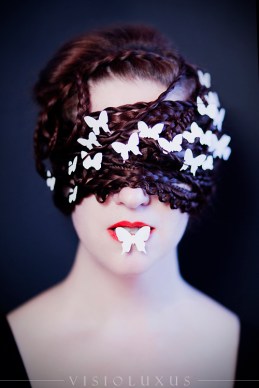
ab830156054015.5609a2c8de3fcElisa Lazo de Valdez, French Postcards Photography.

Elisa Lazo de Valdez is a portrait photographer who specializes in surreal, dreamlike, fairy-tale images. Many of her costumes, makeup, and props are detailed and elaborate. Though it was these images that drew me to her work in the first place, I was struck by how simple this incredibly creative photograph was as far as decoration, yet the strong impact that results. I’ve been including butterflies in a lot of my new art since Spring began, which is probably another reason why this particular piece attracted me.


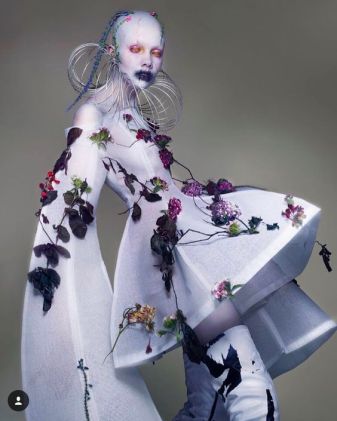
9b514eda1ec08bca74b6f8bfb9466475Matières Fécales.

I saved the most out-there for last. Montreal-based couple Hannah Rose Dalton and Steven Raj Bhaskaran make up the design duo whose name translates in English to, well, Fecal Matter. Everything sounds more elegant in French …  The couple are their art, appearing in public with no hair or eyebrows and alien-like makeup on the regular. Their designs are futuristic and slightly painful looking, but then there are nods to Victorian fashion at times, and every so often surprising botanical motifs will show up like in this favorite image of mine. Of their name, the couple says it is a comment on the relationship humans have with material possessions, their disposable nature. They also claim the unpleasant brand name forces the buyer to purchase one of their garments because they actually like it, not because they just want to own or advertise a certain name-brand. To me, some of their work seems like it’s more focused on shock value than creating art, but nevertheless there have been creations of theirs that have intrigued and inspired me, and that is no small thing.

Be sure to check out my Pinterest if you want to see more curated images of bizarre fashion and surreal portraits, as well as some really killer pescatarian recipes ;).


Standard
Art Education, Project Ideas

Monet – Creative Minds Art History Project

Since I’d been covering a lot of modern day artists lately with my Creative Minds class like Betsy Youngquist and Elizabeth Jameson, I wanted to start the new semester with another visit to the past with one of the founders of Impressionism, Claude Monet.

1-the_waterlily_pond_with_the_japanese_bridge

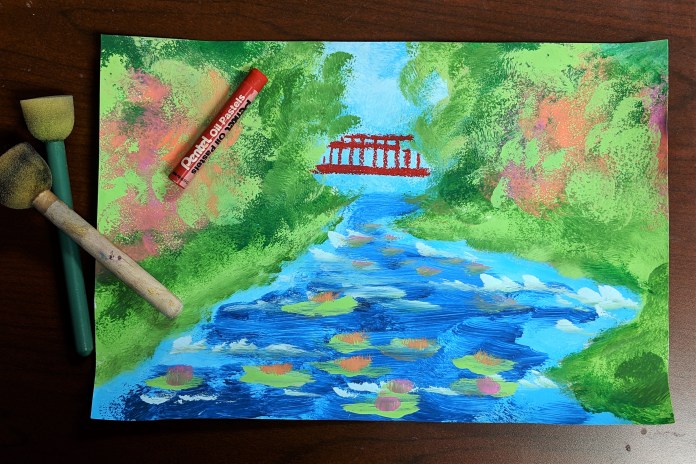
Though he used oil paints, we stuck to a mix of acrylic and oil pastel to avoid the mess and because these materials are easier for beginning artists. In order to … Well, I don’t want to say “force” but yes, force ;), the students to try painting in more of an impressionist style rather I had them use circular foam brushes to apply paint rather than the traditional bristled brushes. They were shown how to quickly pound up and down with the foam brush to create the texture of foliage, how to lay it on its side and drag it across the surface to create short or long streaks, and how to simply use it as a stamp to create circular shapes. However, the favorite technique was double or triple loading their brush with different bright and dark colors and experimenting with how easily they could create the impression of light and natural blending with a simple stroke of their foam brush. Students that struggle with fine motor skills ended up preferring the foam brushes to using a regular paint brush.We looked up photos of local natural areas to use as inspiration for our paintings, and students then moved forward to create an “impression” of what they saw and how it made them feel. Some used natural colors, others, like some of Monet’s own work, either exaggerated the boldness of the colors or used different colors entirely.

IMG_20190501_164253

Monet used a lot of bridges in his artwork, so many of the students chose scenes with bridges for their inspiration. We used oil pastels to draw the bridge over our scene at the end. Success!


This is another project that is great for all ages and abilities. Those with more advanced art skill can always add more detail, and working with creating the idea of a scene rather than trying to create an exact copy of an inspiration photo takes a lot of the pressure off and allows students to just enjoy playing with paint and experimenting with a new art style. Don’t be afraid to go try it for yourself! Happy creating :).

Standard
Art Education, Project Ideas

Betsy Youngquist – Creative Minds Art History Project

For my final Creative Minds class of this Artshop semester, I chose another current artist as the class inspiration that would also give us the opportunity to work with some summery materials (Based in MI, we are hoping it gets warmer someday!).


Betsy Youngquist is a surreal mosaic and sculpture artist who works with a lot of unique materials traditionally associated with crafting like beads and doll making supplies. On her website, she writes, “Children with their vast capacity for wonderment weave tales of gossamer, create magic kingdoms, and pass through invisible portals to lands of untold enchantment. As we follow the Yellow Brick Road in quest of Emerald Cities, those portals become hidden to us, removing our access to the wonderland within. Creating art is a means to return to the looking glass and reenter the garden where flowers whisper and birds can talk. As my beaded characters emerge they carry with them tales from the other side of the mirror. I am grateful for the joy and astonishment experienced through this journey.”

Since we only had one class to finish this project and student attention spans vary, I took inspiration from one of her smaller works, a bedazzled seashell! As mentioned before, this project was also perfect to get everyone in the mindset of warm weather vibes. It may only be a high of 45-50 degrees as of tomorrow but at least we didn’t get the snow that was projected to fall this weekend … Again, Michigan problems :(.

IMG_20190425_151756

Having an array of hobby tweezers with different angled ends is a must for this project to help in placing the beads, though there is no need to use teeny tiny seed beads as you can see from the finished projects! All of my Creative Minds students have a disability of some type, and many struggle with dexterity. The tools I’ve linked above helped them enjoy the process and experience success in creating their surreal, whimsical shells. It was easiest for them to apply a bit of glue inside the shell first, and then use the tweezers to just set the bead into the glue, just in case you want to try this at home! All you need is an array of different sized and shaped beads for creating patterns – glass, plastic, or whatever material is available to you works just fine. Though you could use specialty glues like E6000, we used tacky glue in class which adhered well and dries crystal clear. I also made sure to get some “oddities” as a nod to the surrealist quality of Youngquist’s work in the form of some realistic eye charms, though of course students will add their own creative edge to the inspiration project (Frozen, anyone? 😉 ). They were encouraged to start with a central focal point created either by a larger found object or a grouping of one color, and work radially out from that point.

I am so impressed with the results! They really rose to the challenge and created some gorgeous conversation pieces to display in their home. Beaded mosaics are another project that can be adapted to all ages and abilities, and something that anyone can enjoy even if they don’t feel they are “good at art”. The repetitive process of placing beads becomes calming and meditative as you work. A new semester starts in a week, and I am looking to learning about more artists from the present and past together with a new group!

Standard
New Work

New Work Inspired By Spring (and Stress)

I’ve taken a short break from my new series to work on a stand alone project for a competition coming up. I always have a couple sketchbooks going filled with any ideas for art projects that I’ve thought up over the past 10+ years, some I’ve gotten to and some I haven’t. I think it’s the fact that I live in Michigan and the winter has been never ending that made me want to work on something inspired by plants, insects, and basically signs of life. When I began this project, I had also been having a bit of a rough patch emotionally with some minor life trials, nothing vast on their own but when all occurring at the same time… yikes. I had done a watercolor sketch way back in 2008 of a crying woman with ladybugs crawling our of her eyes, but it ended up looking way too gross which took away from the original intent. Another previous piece (Seriously, check it out if you haven’t already – it has a fun story.) from more recently incorporating butterfly designs into the human form had been well received when showed at a curated exhibit and to my surprise actually ended up selling right away. With this in the back of my mind, I decided torn butterfly wings were the perfect vehicle for melancholia – not so creepy crawly.

From this creative soup came my newest piece, Torn, on 18×24 mixed media paper.

torn

One of the biggest challenges with this piece was maintaining a balance of light and dark and achieving the bold contrast I knew I wanted without the figure looking disjointed. The white outlined pattern taken from both the background’s ginkgo leaves and butterfly designs layered overtop the black watercolor drip of her torso helped to blend the dark areas into the light and remove some of the heaviness. I included pieces of stark black scattered throughout the piece to balance everything out, from the hair and parts of the wings to the thin branches in the background.

butterfly shirtAn additional challenge – my two loves are watercolor and colored pencil, and I especially love to utilize these two vastly different mediums together. What paper to use, though? Colored pencils just cannot blend on watercolor paper with the strongly textured, bumpy surface so I tend to opt for mixed media paper when using wet and dry mediums together. However, watercolor does not  act the same way on mixed media paper as on traditional watercolor paper. Doing wet-on-wet color application leads to some really blotchy, unpleasant results so I had to be patient and do a lot more light layering to build up to the look I wanted.

All in all, I am happy with the result and enjoyed turning one of my concepts in idea purgatory into a reality :). Prints of all types are available in both my Redbubble Shop and Ebay Store.


Standard
Art Education, Project Ideas

Elizabeth Jameson – Creative Minds Art History Project

Hello all, it’s time for another artist based creative project! I have a great group of ladies in my Creative Minds class this semester at Artshop, and have loved seeing how they interpret the techniques of the masters and make their creations their own. Though often times the focus of my class is renowned artists from history, I also love sharing inspiring and accomplished artists from the present with my students. I work primarily with adults with disabilities so I especially enjoy the opportunity to share the stories of artists with disabilities with the class, and how the artist’s identity as a person with a disability influenced their art and legacy.

Elizabeth Jameson is a visionary artist who found her creativity through an unexpected MS diagnosis. Jameson is a Doctor of Law, and her lifelong passion and driving force for her career was to fight injustice and poverty through the law, striving to make a difference. In the late 70s and early 80s her health took a turn suddenly, and she was eventually diagnosed with Multiple Sclerosis. Due to the progressive nature of her illness she was unable to continue working, and she felt her purpose was lost. A caring friend pushed her into trying an art class just to get her out of the house, and this class ended up changing the way Jameson saw the world and her life. Art teaches us to look at the world through a creative lens, and upon receiving her usual MRI scans from a doctor’s appointment, she came up with  the idea to etch in the stark, clinical and emotionless black and white images with rainbow colors. Her work evolved from there. Today, Jameson is still living her dream of changing the world, and says the goal of her work is to encourage others to, “contemplate the beauty of the brain, discuss what it means to live in an imperfect body, and to stare directly at the imperfect brain’s beauty and complexity with curiosity”. She collaborates with Neuroscientists and a studio assistant to continue her work.

jameson_carousel_utep-gift-1

Messages that can be learned from Jameson’s art and story are that with creativity it is never too late to begin, it doesn’t make you any less of an artist to ask for assistance, and individuals with disabilities have an unlimited potential to change the world for the better.

Obviously, we don’t have access to MRI machines ;), but to pay homage to Jameson’s art we did drawings with colored pencil on black paper. Students were asked to imagine a visual representation of the inside of their head, thinking about the emotions or memories different colors may symbolize, what straight, smooth lines versus wavy or jagged lines may say about what is going on inside their head, and to think of any representational forms that speak to who they are. Some students chose to indicate blocks of color for the different things that consume their thoughts, and some chose to do an all-over image or pattern. One student even dated hers in acknowledgement that one’s mental state changes over time.

I can see this project being an interesting activity for any age, and was pleased within my class on how a dialogue between the students about the meaning of their developing “artistic MRIs” grew as they worked.

As always, feel free to steal, share, or try it yourself at home :). I am hoping others will enjoy and become inspired by trying this project out.


Standard
New Work

New Series and The Symbolism of Color

I’ve always been interested in the social significance of color, both in cultural symbolism and in the psychology of how color can affect our emotions. Showing solidarity for a specific cause through a group of people all wearing the same color on a certain day or for the attendance of a specific event has become a common practice. My partner has a viscerally negative reaction to the color yellow, and will be caused agitation if surrounded by a bright yellow environment (so basically he just loves the bright yellow flower print wallpaper that was complimentary with the bathroom in our home upon move-in). I have received shocked reactions even from people in my own young-adult age bracket at the mention that if I ever get married at some point, I probably wouldn’t choose a white wedding dress. These are just a couple of examples of the strong reactions people have to color as a form of communication, tradition, and emotional influence in both our exterior environment and more personally in how we choose to adorn ourselves and present our bodies to the world.

Of course, I will be working on other separate projects in between but my main focus going forward will be on a new series exploring the symbolism of different colors worldwide, taking the significance of specific colors from regions all over the world and integrating these often opposing meanings into a single story about that color. I will be focusing on 5 main colors, the 3 primaries of red, yellow, and blue and then black and white. The first color I have represented is white.

Depending where you are, white can symbolize new beginnings and a clean slate, or endings and mourning making it very much a bookend sort of color. It symbolizes traits that are considered more docile like purity, innocence and virtue, but also more courageous sentiments like protection and sacrifice. White is also a color that across cultures is often associated with femininity.

white final

For “The End Is Also The Beginning” I used a mixed media approach, choosing the mediums that would lend themselves best to the look I wanted to achieve for different parts of the piece. I used watercolor for the ice figures, snow, clouds, and water. I used prismacolor pencil (including metallic silver accents) for the figure, rabbit, and areas of fine detail like the blossom trees and patterns in the sky. I used scrap fabric for the pattern on the dress (actually left over from the hemmed curtains hanging in my art room. This is why you never toss scraps!), and flat-back acrylic pearls and beads for the decoration on the neckline of her gown, and her earrings.

I have a couple of juried shows coming up, and this will be one of the pieces getting sent off, so wish me luck!

Standard
Artsnacks Unboxing

March Artsnacks Unboxing

Hello all! Obviously I’m a little late, but it’s been a weird month. I told myself I had to at least have this posted before March was over, so here I am!

53786370_10156360021179895_3968639679464472576_n

In this box, I received:

The Artsnacks gods must really want me to start using more green in my artwork, because I overwhelmingly receive green products where random color selection is concerned … And to be honest, I can only think of one other green artwork I have done in the last 10 years! That’s what I love about Artsnacks though, it gets you out of your box!

Now, for reviews! As a watercolor enthusiast, I was interested to try Ecoline’s liquid watercolor. It’s so runny compared to what I am used to using that it was a little hard to get used to at first, but it is definitely a quality product with rich color, just a different experience with a bit of a learning curve. I would be interested to try darker colors which are usually what I gravitate towards with watercolor, and also to experiment with how multiple colors blend or layer. I found it more difficult to get as wide a range of values with this product as I can with tube watercolors. To me it seems like these watercolors would be better suited to filling in concept sketches or more graphic illustrations like comics. Prognosis: Good product, uncertain operator!

Now on to the brush pen! It was really great to get to try out multiple Ecoline products being that this was a line I’d never tried before. I cannot get enough brush pens. I’ve mentioned before how my favorite have been Tombow’s water soluble brush markers, but what is great about these Ecoline pens is that they can be used in conjunction with Ecoline’s other products. Their brush pens, like Tombow’s, are water soluble and can be re-wet to blend even after they’ve dried. These Ecoline brush pens can be dipped in Ecoline’s watercolors or inks to mix colors and produce ombre and other blended effects which is a fantastic bonus. These products do seem to focus on the more pastel/tropical/ultra neon color spectrum which is not at all the palette I usually work in, but it is great for projects that call for a bright pop of color.

As someone who really enjoys using watercolor and ink pens together, I’m glad this box came with a pen to try as well. Drawing will always be my first love, and the bright colors available from the KINGART fine liners pair well with the Ecoline watercolors for seamless outlines. With a super thin, smooth line quality and no bleeding, I am definitely considering getting some of these as right now the only liners I have are black. They are also waterproof which make them a perfect fit for watercolor work.

Lastly, I will talk about the incredibly aesthetically pleasing pencils. I didn’t really get the brown sugar scent from the wood that was described on the information card I got with these products, but I also have had a habitually stuffy nose for the past 3 weeks so you can’t go by me! From a design perspective, these pencils are obviously gorgeous, and I can see them sitting on a side table next to a moleskin notebook in my soon-to-be mid-century-modern /slash/ industrial basement library that is right now just grey cement and a pile of wood scraps, but hey, we’ll get there ;). I’m a mechanical pencil girl for the most part, but I do get commissions for solely graphite works fairly often in which I use traditional pencils. It makes me happy to work with materials that are pretty, so these get a vote from me!

Another month, another great box! Until next time!

Standard