Another week, another artist! I shared my Van Gogh project last week. In week 2 we covered Henri Matisse. His personal story really resonated with the students, being a group of adults with varying disabilities.


Matisse spent the majority of his artistic career as a painter, being one of the leaders of the Fauvism movement in the early 1900s. Fauvism is characterized by a painterly, non-realistic representation of people and objects and a strong use of bold “crayola crayon” colors. Unblended strokes of pure color divide objects from their background rather than shading. He wanted his art to be calming and cheerful, an escape from the world’s troubles. In 1941, everything changed when Matisse was diagnosed with cancer and had to have surgery. His life was saved, but from that point forward he required the use of a wheelchair for mobility, and struggled with dexterity. Matisse famously said, “Creativity takes courage“, and at the age of 72 no matter how he had changed physically, he refused to give up on creating. He shifted gears to a cut paper collage format for his work as painting was harder to manage with his dexterity changes, creating yet another influential body of work. He ended up liking this new, modern style even better than what he had been working on before, and you can still see similar shapes, styles, and color schemes taken from his paintings and applied to his collage works, such as the organic leaf shapes. His final project was stained glass windows for the Chapelle du Rosaire de Vence as seen pictured above, designed in his iconic collage style.
Though the term disability pride wasn’t part of our vocabulary at the time Matisse was alive, I think his legacy perfectly embodies this concept. He did not look at disability as a barrier, but an opportunity to innovate.

For our project, we created beautiful decoupage bowls inspired by Matisse’s paper cut works. I chose to focus specifically on shapes present in his chapel design, though if you do an image search of his collage work you could find many other ideas. I cut patterns out of some scrap matte board for the students to trace. We used colored printer paper for the cutouts – It is thin enough to be able to bend along the round shape of the bowl without popping back up or creating massive wrinkles, but thick enough that the color of the bowl won’t show through. We used matte Mod Podge to apply and seal the shapes onto the bowl, and the bowls themselves were picked up at the dollar store, making this a ridiculously inexpensive project with beautiful results.


This would be a fun project to do with all ages from kids to seniors, and makes for a great gift idea if planned closer to the holidays or Mother’s Day. Since Mod Podge is not food safe, obviously you do not want to try to eat cereal out of these or something ;), but they are a perfect catch all for jewelry, keys, pens pencils and paperclips, or change. Also a cute decoration when filled with decorative orbs, glass marbles, or stones. I love color, and may just have to make one of these for myself at home!




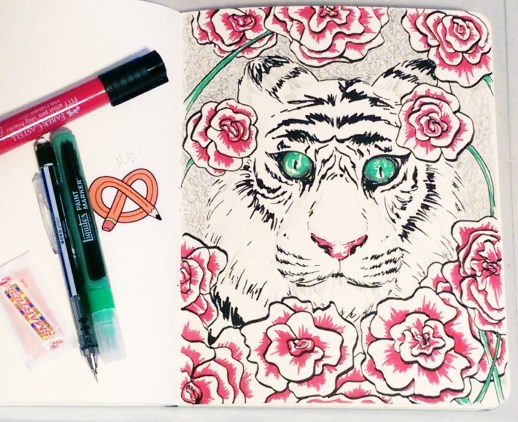
 So, first the scary thing which is the Copic Multiliner. I’m sure it would be a fantastic product if I knew anything about calligraphy, and that is about all I can say as I have no basis by which to judge calligraphy pens.
  Speaking of erasers, the next product was the KUM Correct-Stick eraser. I just now realized this product was hiding and didn’t make it into my picture, but here is what it looks like … This eraser did work really nicely and had a comfortable ergonomic grip, but I feel like it will lose its precise, pointed shape with use. As far as fine detail erasers I think my favorite will always be

 I am a bit late on my
  This was a very successful box for me – I loved the brush as well. The firmness and shape allows it to work well for both filling in tiny detail areas, and covering larger areas depending how you tilt the brush. It worked excellently for applying shading. Another success was the watercolor paper, which I expected since I already quite like the Canson brand :).


 Allise Nicole's Artistic Explorations