Project Ideas, Techniques and Tutorials

Crafty Christmas Tutorials

I do wait until Halloween is done at least, but once November hits I feel myself sliding into holly jolly mode and the older I get, the more I enjoy seasonal crafts :P. This year I played around with some fun clay ornaments and even taught a couple of workshops already! I also wanted to take the opportunity to share some other fun holiday demos I’ve done over the years. All of these projects I’ve used to decorate my own house, and have also been successful selling at art fairs and online.

I was always enamored by these jewelry trees when I’d see them at antique stores, and once you get the hang of how to lay them out they are relatively simple to create at home. It’s even more fun when you get to choose meaningful collected bits and pieces, or create your own “theme” or color scheme. I have made these in so many different styles – each one really is one of a kind!

Inspired after trying the trees, I decided to go to work on my old, mangled dollar store chip brushes. I have done an entire tree with these and it is so striking! Some people who have bought these from me have even hung them on their wall as a point of interest amongst a collage of framed photos.

How fun would it be to do a “family tree” with old photos using this style of ornament? Van Gogh is still my only version of these, but I really need to set aside the time to make more as I still have a bunch of sparkly pipe cleaners!

Resilient and cute is always a winning combination. These plush ornaments are kid, cat, and oopsie proof!

It’s almost December! I know this time of year can get so busy and stressful, but trust me taking even 5 minutes a day doing something creative will make all the difference in your mental health. I hope these demos inspire you, and feel free to reach out if you hit any snafus or have questions!

Standard
Art Discussion

The ABCs of Creation – C Is For Craft

An artist friend recently shared with me an article they wrote titled “The ABCs of Underground Art”. I really enjoyed it, and they encouraged me to write my own ABC’s of the type of art that I do as a fun journaling prompt to use to unwind and organize your thoughts. Those that have followed me for awhile know that I don’t typically stick to just one type of art, so to open up the limits I decided to make my “alphabet” the ABC’s of Creation. I have assigned a word to each letter, along with a video of my illustrating a cool little ACEO sized letter inspired visual to go with each word. Read, listen, or both – whatever works! 

C is for craft. Another word for creating something is to craft this or that object. This may be an unpopular opinion in the art world, but I get frustrated when I am pulled into conversations about “art vs. craft”, what pursuits are fine art and what is “just” crafting. I sure can’t make a quilt. Why should that be considered a lesser skill, especially with the amount of math and attention to detail that is involved? I love when gallery artists give the middle finger to what is supposed to be sophisticated materials, and add glitter, beads, paper ephemera, buttons, and other craft supplies into their work. Without craft, we are excluding an entire discipline that could teach us new ways to approach our art.

Above is a closeup from one of the piece’s in an inspiring Mark Messersmith exhibit I was lucky enough to catch last Fall while visiting family in Ohio – I’m detecting some GLITTER!

Standard
Project Ideas, Techniques and Tutorials

Vintage Inspired Christmas Ornament Crafting Tutorial

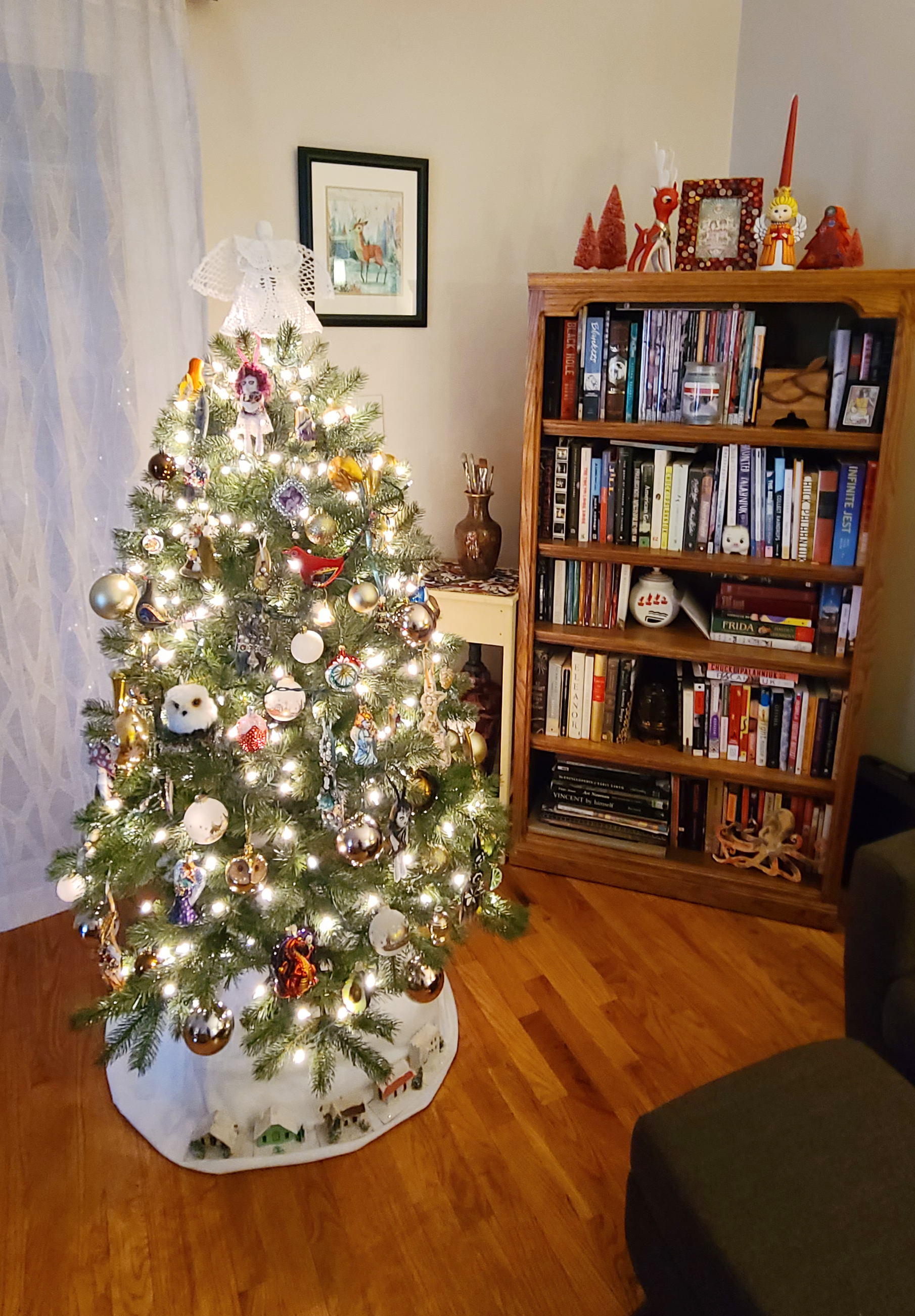
I usually wait until Thanksgiving weekend, but I couldn’t resist putting up my tree early this year ;). I love vintage Christmas decor almost as much as I love handmade ornaments, so I’ve combined my two holiday passions with this fun and simple craft. I hope you are inspired to give it a go!

This year, my main tree in the living room is covered in my paintbrush assemblage ornaments accented by bulbs in different shades of gold, some vintage pieces, and some softies gifted by friends and family. My second small tree in the spare room has all my bulbs decoupaged with images from art magazines. And of course, I have my own vintage jewelry tree hanging up in my kitchen! I did some tutorials showing my process for both the paintbrush ornaments and trees using old junk jewelry pieces last year, so be sure to check those out if you need some inspiration. I know for me, crafting these decorations has been wonderful art therapy in between my more taxing commissioned pieces, gifts, and pieces for upcoming shows. I know it can be difficult, but I hope you all take some time near the end of this year to reflect and unwind, and remember holidays are supposed to be fun – don’t pressure yourself too much or feel you have to stick to traditions that don’t work for you. Make these next couple months what you need them to be. ❤

sdas

Standard
Project Ideas, Techniques and Tutorials

Charley Harper: Creative Minds Art History Project

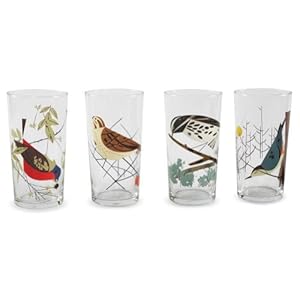
I was first drawn to Charley Harper‘s work in the gift shop of a local museum. One of my dad’s main hobbies is birding and wildlife photography, and Harper’s Mid-Century-Modern style illustrations just screamed the perfect birthday gift.

Harper grew up on a farm in the Midwest, and was inspired by the wildlife he experienced around him. He called his style “minimal realism”, taking in the world around him and distilling the imagery he observed down to the most essential details. He said, “When I look at a wildlife or nature subject, I don’t see the feathers in the wings, I just count the wings. I see exciting shapes, color combinations, patterns, textures, fascinating behavior and endless possibilities for making interesting pictures. I regard the picture as an ecosystem in which all the elements are interrelated, interdependent, perfectly balanced, without trimming or unutilized parts; and herein lies the lure of painting; in a world of chaos, the picture is one small rectangle in which the artist can create an ordered universe.”

Inspired by images from Harper’s body of work that capture his signature style, I encouraged my students this week to create their own minimal realist birds. Though Harper’s works were painted, they bare quite the resemblance to modern day digital art and graphic design. Instead of painting, we used a collage format to create our Charley Harper Birds. We used paint chip samples for our vibrantly colored creatures, colored cardstock for the background, and paint markers to add the linework details. From working on repainting the interior and exterior of a house over the last couple years, I had an accumulation of samples but never felt right throwing away even the colors I ended up not using. Upcycling to the rescue! At an arts non-profit, we love free materials ;). We outlined our geometric shapes onto the samples with a pencil, then cut them out and adhered them to a foam core board base (any heavier paper would work as well) with a standard glue stick. I’d suggest laying out the entire design before gluing in case you want to make some changes before the final masterpiece.

I teach adults with varying physical, psychological, and intellectual disabilities but this project is perfect for all ages and abilities. It is all inspired by simple geometric shapes and blocks of color, and can be done as simple or with as much detail as the artist desires. We created our works in an easy-to-frame 5×7″ size.

I hope you are inspired to try this at home (This would also be a fun project for bored kids, hint hint 😉 )! This is a simple, whimsical project that you don’t have to be an “artist” to enjoy. Unwind after work and get crafty with some basic, easy to access materials. As always, if you end up making one of these yourself I’d love to see pictures!

Standard
Techniques and Tutorials

Mid-Century Modern Tea Party – Ladybug

The Mid-Century modern design style has been having a moment for awhile now, and while I’m not usually one to latch onto trends I have always liked the geometric, retro aesthetic of this period.

Illustrations from this period are colorful and based on combinations of simple shapes and lines, which make them accessible to even those who don’t consider themselves “artists”. In this series, I am going to show you how to create some cute mid-century modern inspired bugs and flowers in honor of Spring. I will be painting on glassware (I’ve been dying to do something with these clear tea mugs!), but you can create any of these designs the same way on paper with any drawing or painting materials you may have on hand.

Start with a red vertical oval for your ladybug, and scatter some different large polka dots around it for our flower heads. Paint goes onto glass differently than on paper because it can’t absorb into the surface, so you will need to let your shapes dry and add another coat or two for solid coverage. Try to smooth out your paint as flat and even as possible, spreading out any “globs”.

Once we have our red oval, we are done with our ladybug for awhile. Focusing on the flowers, I added two sets of concentric circles to the bottom of my large dots in different colors, letting the paint dry in between each addition.

After that, it’s time for the leaves! Our leaves will just be simple teardrop shapes, placed next to each other at an angle centered underneath our flower heads. Once the green was dry, I added some white dots down the center of my leaves for some extra decoration. You can add a dotted pattern by dipping the end of your paint brush in paint, and touching it to your glass (or paper) using the paint brush end like a stamp.

Last is the line work that brings everything together and makes it pop. For this part, you can either use a black paint marker or a small detail brush with a pointed tip. Outline all of the shapes that make up your flower in black. I added a teardrop shape to the very center of my flower, but you can also just outline the concentric circles and leave the center alone. I added a line connecting the head to the leaves to finish our flowers. For the ladybug, I put a line down the center of my oval and outlined around the entire shape. I then added a half circle in black sticking up from the top, with two short lines for antennae. I used the end of my paintbrush to add a dot to the end of each antennae. If you have some larger paintbrushes, you can also use the end to stamp the larger dots on the ladybug’s body. Otherwise, just use a round brush with a pointed tip to outline a circle shape in the size you want and then fill it in.

Voila! See, that wasn’t so hard :). You can make some beautiful Spring designs to cover anything your heart desires once you learn the basics of how to build forms with simple shapes. I will be doing 4 designs in all with different flowers and insects, check back for more!


Standard
Art Education, Project Ideas, Travel

Isaiah Zagar : Creative Minds Art History Project

I love to travel, and was lucky growing up to be part of a family who enjoys a change of scenery every so often as well. An experience that still stands in the forefront of my mind is accidentally happening upon one of the most breathtaking displays of public art I have ever seen while in Philadelphia on one of the last trips my immediate family and I would take together in our little quartet before my brother and I were “officially” grown-up with our own jobs, schedules, and lives.

Mosaic artist Isaiah Zagar has his work across buildings all over Philadelphia and throughout the rest of the country as well, but his Magic Garden is something special, a truly immersive art experience that really does feel like you are being transported into a different universe temporarily as if by magic.

Though he started as a painter, he ended up becoming most known for his public mosaic work. He became an integral part of the “South Street Renaissance” in the 1970s, bringing excitement, inspiration, and beauty to the ignored and abandoned areas of his hometown. The interesting thing is, he only discovered this medium because of others’ willingness to invest and believe in the talents and well-being of those who are struggling. It was while being hospitalized for a breakdown related to undiagnosed bipolar disorder that he was introduced to mosaic making, and he credits this art practice with bringing him out of his depression. Zagar has stated that he was determined to use his breakdown as a springboard into positive mental and spiritual growth, and though mental health is a chronic struggle, he has done just that. At 80 years old, he is still here, filled with an enthusiasm for lifelong learning.

Zagar’s mosaics aren’t just glass and tiles. He utilizes a wide range of materials, much of it upcycled “trash”, and integrates painting and poetry into his designs as well. I had my students make their own mini mosaic on 12×12 tiles using a variety of mixed media materials such as glass pieces, broken jewelry, beads, discarded board game pieces, and more. This is a great way for art programs to use up any odd donations or miscellaneous supplies. I work with students with a wide range of abilities in my Express Yourself Artshop program, and we also have time constraints since we typically spend 1-3 weeks on one project before moving on to the next. To make mosaic art work for our needs, we had students paint the background of their tile whatever color they wanted to show through in between their mosaic pieces, and after they had chosen their pieces and laid out their design we used Weldbond adhesive to attach the parts rather than using grout.

It was interesting to see the messages and themes students were drawn to include in their work, and I was happy to hear that many of them found the process inspiring and therapeutic, same as Zagar did.

If you are interested in learning more about this artist, one of Zagar’s sons created a fantastic documentary about his father’s journey. You do not have to be perfect or feel like you have everything figured out to use your gifts and skills to bring light and life to others. Even through his intense struggles, Zagar has had a profoundly positive impact on his community and continues to do so to this day.

Standard
Art Education, Project Ideas

Betsy Youngquist – Creative Minds Art History Project

For my final Creative Minds class of this Artshop semester, I chose another current artist as the class inspiration that would also give us the opportunity to work with some summery materials (Based in MI, we are hoping it gets warmer someday!).


Betsy Youngquist is a surreal mosaic and sculpture artist who works with a lot of unique materials traditionally associated with crafting like beads and doll making supplies. On her website, she writes, “Children with their vast capacity for wonderment weave tales of gossamer, create magic kingdoms, and pass through invisible portals to lands of untold enchantment. As we follow the Yellow Brick Road in quest of Emerald Cities, those portals become hidden to us, removing our access to the wonderland within. Creating art is a means to return to the looking glass and reenter the garden where flowers whisper and birds can talk. As my beaded characters emerge they carry with them tales from the other side of the mirror. I am grateful for the joy and astonishment experienced through this journey.”

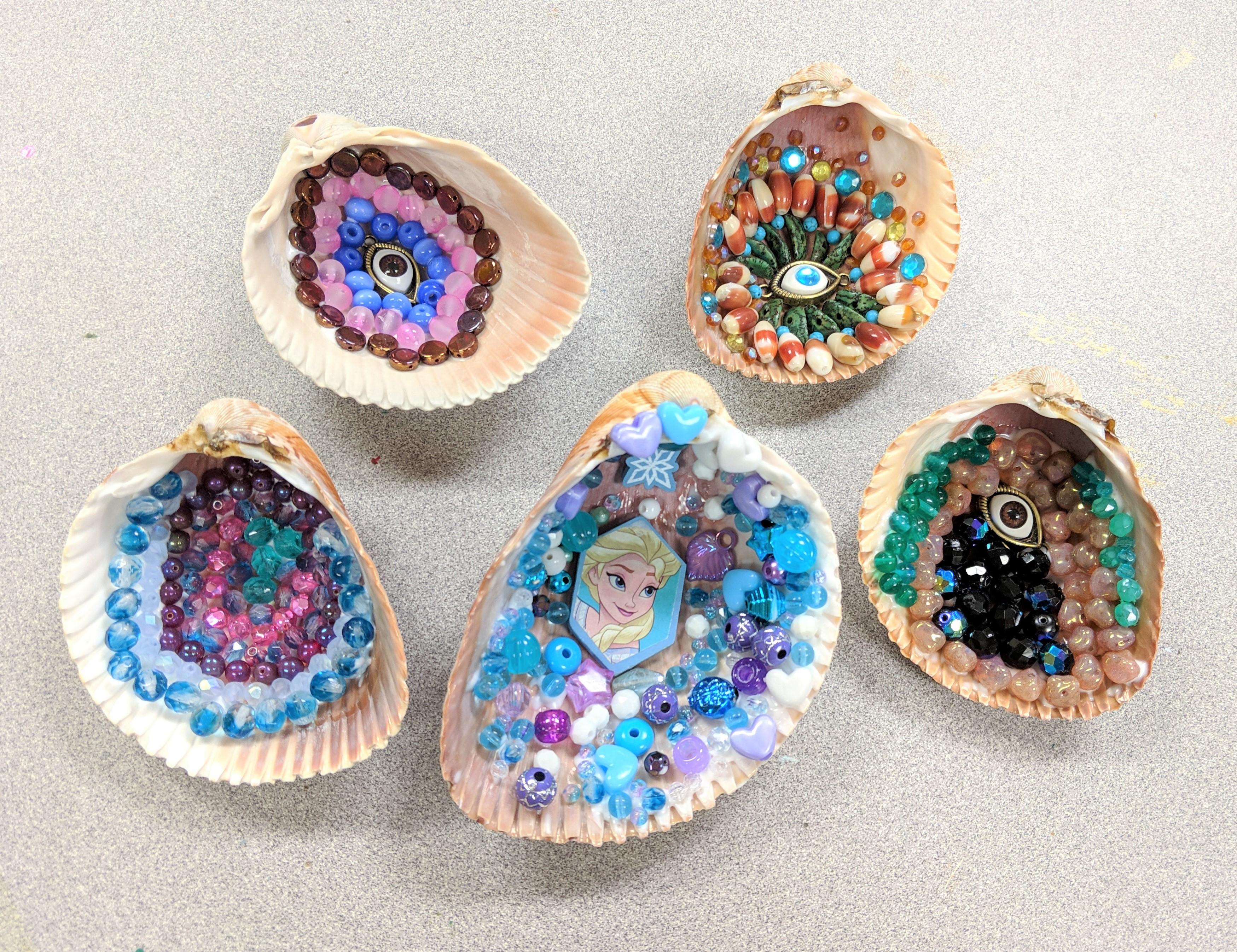
Since we only had one class to finish this project and student attention spans vary, I took inspiration from one of her smaller works, a bedazzled seashell! As mentioned before, this project was also perfect to get everyone in the mindset of warm weather vibes. It may only be a high of 45-50 degrees as of tomorrow but at least we didn’t get the snow that was projected to fall this weekend … Again, Michigan problems :(.

IMG_20190425_151756

Having an array of hobby tweezers with different angled ends is a must for this project to help in placing the beads, though there is no need to use teeny tiny seed beads as you can see from the finished projects! All of my Creative Minds students have a disability of some type, and many struggle with dexterity. The tools I’ve linked above helped them enjoy the process and experience success in creating their surreal, whimsical shells. It was easiest for them to apply a bit of glue inside the shell first, and then use the tweezers to just set the bead into the glue, just in case you want to try this at home! All you need is an array of different sized and shaped beads for creating patterns – glass, plastic, or whatever material is available to you works just fine. Though you could use specialty glues like E6000, we used tacky glue in class which adhered well and dries crystal clear. I also made sure to get some “oddities” as a nod to the surrealist quality of Youngquist’s work in the form of some realistic eye charms, though of course students will add their own creative edge to the inspiration project (Frozen, anyone? 😉 ). They were encouraged to start with a central focal point created either by a larger found object or a grouping of one color, and work radially out from that point.

I am so impressed with the results! They really rose to the challenge and created some gorgeous conversation pieces to display in their home. Beaded mosaics are another project that can be adapted to all ages and abilities, and something that anyone can enjoy even if they don’t feel they are “good at art”. The repetitive process of placing beads becomes calming and meditative as you work. A new semester starts in a week, and I am looking to learning about more artists from the present and past together with a new group!

Standard
Project Ideas

Piet Mondrian – Creative Minds Art History Project

piet.mondrianI promised I’d catch up in posting all my Creative Minds art history projects from the Fall and Winter semesters!

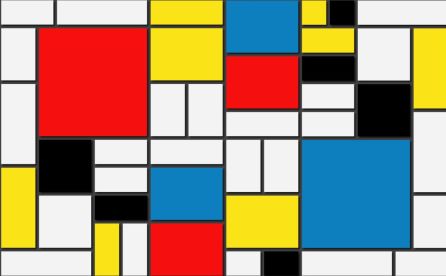
You may not recognize the name “Piet Mondrian“, but I guarantee you’ll recognize his imagery. Mondrian was interested in simplifying art down to its basic essence, and creating a type of universal design that could be used for everything: visual art, furniture, architecture, clothing … I’d say he was pretty successful, as his primary colored designs composed out of different sized squares and rectangles bordered by bold black lines can be found covering posters, furniture, jewelry, shirts, and the pair of Nikes I would buy if I were rich.

We do a lot of painting in the Express Yourself Artshop program, so though we easily could have done the whole “make a grid on canvas with blue painter’s tape” thing, I wanted to try something more original – transferring a Mondrian design onto glass. The glass we used was just glass from the inside of an inexpensive frame. This could be done in any size. The actual frame could easily be used on a future project. We used primarily colored tissue paper for our rectangles, though we happened to have a bit of patterned and textured vellum on hand that can be found in the scrapbooking section of craft stores and is great for mixed media art. The goal is to use thin, transparent paper so light can shine through the glass. I cut a variety of different sized rectangles and squares out of scrap cardboard for students to use as a pattern. Students chose their colors, and then traced different shapes using the patterns until they had a good pile to choose from. They then laid out their shapes on the glass to create the desired pattern. After they were happy with their design, it was time to glue. We just used traditional liquid school glue, but squeezed the glue out on a piece of foil and used a crappy paint brush to paint the glue on the back of the paper so it didn’t get too saturated.


The front of the finished product is going to be the glass side without anything glued to it, so if you do end up using papers with a one-sided pattern, you need to glue the side you want to see face down. Once the paper dried, we trimmed any paper that was hanging off of the glass and used a ruler to draw on the glass side (NOT the side the paper was glued on to) with a black, medium tip paint marker. This sharpens and finishes the design, and also disguises any uneven edges.

These can be as simple or as intricate as you want, and are a fun project with a beautiful end result that can be completed fairly independently by all ages and abilities. My students with disabilities who struggle with dexterity were still able to do this on their own and end up with a piece of art they were proud of. Display in a clear plastic plate stand … It would be especially cool in front of a window or other lighted area. Have fun creating :)!

Standard
Project Ideas

Alexander Calder – Creative Minds Art History Project

09e5c065d1594c85473cc0f55bc4e082I’m a bit behind on sharing my art history projects from Express Yourself Artshop … This one is from the first 5 weeks of the Fall semester! But, never fear, they will all be posted in due time! I am not really a 3D art person (love looking at it, hate creating it!) but even I enjoyed coming up with this upcycling activity based on Alexander Calder, the inventor of mobiles.

The great thing about this project is you can use scraps of literal junk that you have just sitting around the house (or if you are super cleanly and don’t let junk collect, start saving with this idea in mind 😉 ). We used primarily painted embroidery hoops, shower curtain rings, hardware odds and ends, painted toilet paper rolls, and the cardboard part that is left when you’ve finished a roll of colored duck tape!

Students were instructed to pick out a variety of small, medium, and large items that struck their fancy from the pile of supplies, and then start laying them out flat in front of them on the table so that they could plan the basic composition they wanted. Calder’s big focus was kinetic sculptures, which led to his eventual mobiles. These babies are meant to shift and move as they hang (part of why I couldn’t get very clear pictures … That and the fact that there is NO dead space to use as a backdrop in our art studio!). Once they had a layout they liked, they could start tying their most prominent “anchor” pieces together using fishing line with a dot of hot glue on the knot to secure it. After the main components were attached, they could focus on adding smaller pieces both to achieve the balance and/or movement they wanted and add visual interest.

If you have a spare hanger or anything else that you can hang your mobile on to step back and look at how it’s hanging while you create, this helps a lot. As they held it up, it bobbed and shifted and was a great opportunity to play around with some simple physics, adding different smaller weighted objects to either balance or cause purposeful imbalance to their growing mobile. Glass beads attached by making eye-hooks through them with jewelry wire made great counterweights if a student didn’t want to add anymore major elements to their design, but wanted to adjust how the mobile hung.

I work with adults with disabilities and some have dexterity issues and needed a bit of help from time to time with the knots, but this project is for the most part something that all ages can do relatively independently.  When you are done, you will have a dynamic piece of modern art that you’d never guess was made out of castaways!

Standard
Project Ideas

Gustav Klimt – Creative Minds Art History Project

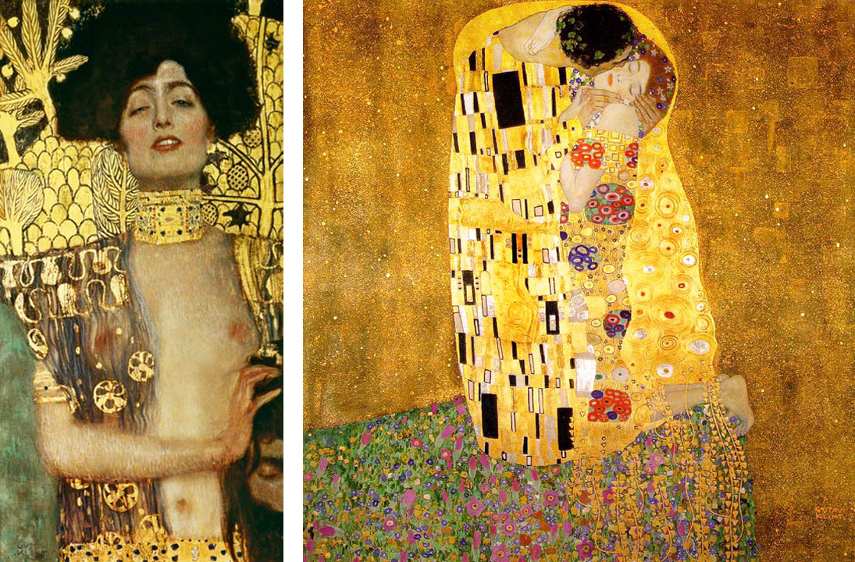
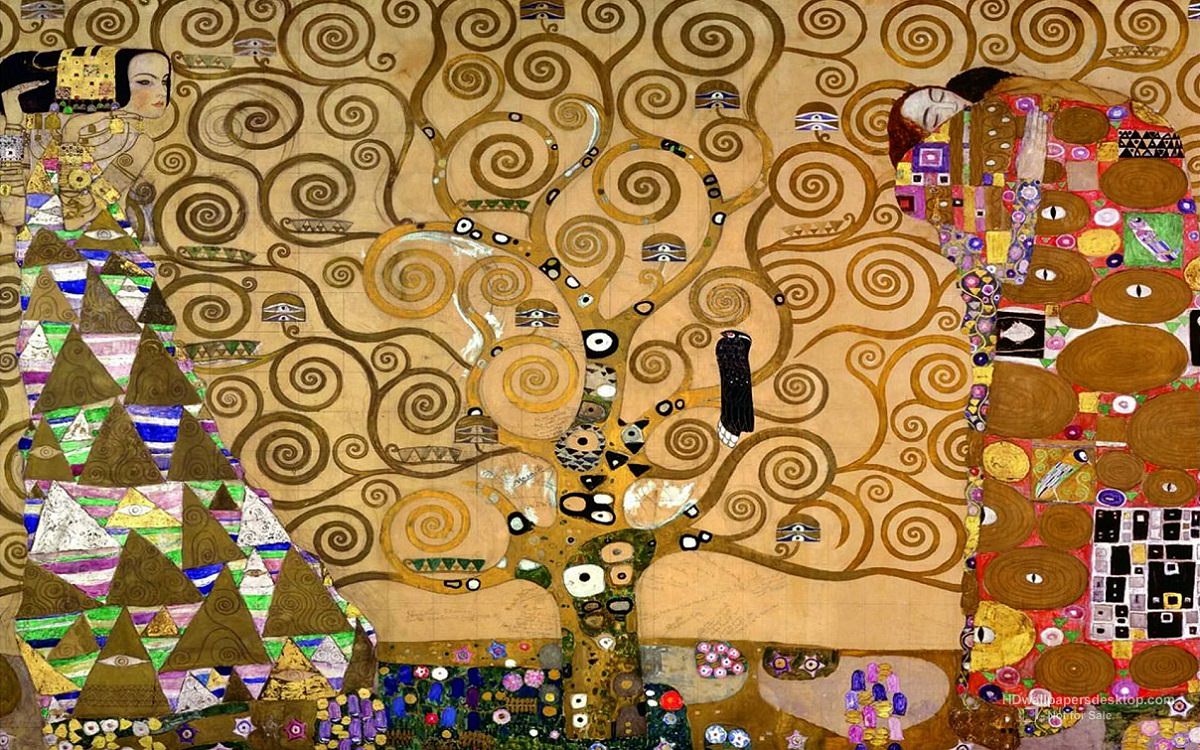
I got a bit behind on sharing my projects, but have now caught the awful Fall cold that is going around, so no better time than the present to sit and type with a hot cup of tea at my side. Gustav Klimt’s work, like that of the earlier covered Van Gogh, is one of those bodies of historical work that is recognizable even by non-artists because of his unique style that has been made readily available in print form to this day, and is appropriated and referenced constantly in new art. Though I’ve never experienced an emotional connection to his work, I love the use of metallics and vivid, overwhelming detail of his pieces as well as the merging of both realistic and painterly elements.

gustav-klimt-klimts-collages-images-via-principlegallerycom

Klimt began as a decorative painter under the belief that art’s true purpose was to show viewers something beautiful, and got his start painting murals on the walls and stairways of lavish, wealthy homes. His personal work was charged with an eroticism that was not present in art at that time, and it earned him a good deal of disdain but he remained committed to depicting the beauty of the world as he saw it. His pieces have resonated and stood the test of time, enough that virtual immersive experiences of his work were made available this year in Paris and Austria.

Not all of his work is sensual in nature or contains nudity, and there are plenty of other examples to show as inspiration if you are doing this project with younger audiences.

The-Tree-Of-Life

Klimt’s work incorporated figures and portraits, but learning how to draw faces and the human body properly is a whole semester of lessons within itself! To make a Klimt project that was accessible to all skill levels, fun, experimental, and stress free, we used collage. Some of Klimt’s portrait work does remind me of a very early form of fashion editorials, so we cut out models and celebrities from Elle and Vogue magazines to become the subjects in our Klimt inspired artworks.

Students were then encouraged to place their magazine cutout where they wanted it on the page, and trace around it with pencil to save the space. I recommend gluing the magazine cutout on last so it doesn’t accidentally get smeared with paint. After outlining, students could add on and sketch the outfit of their dreams with pencil. Once the basic outline was complete, students filled in the background and clothing in different shades of metallic paint first, and then could add detail overtop with pattern. As I’ve mentioned before, I work with a lot of adults with disabilities and seniors in my art program. Painting small patterns with a brush can be hard for some depending on their dexterity level so we made this project more accessible by also introducing the use of ink stamps for those who were struggling with fine motor skill. Innovation can lead to some simply amazing results, as can be seen by the work-in-progress above! Be sure to check back soon for more artist-inspired project ideas!

Standard