Art Discussion, New Work

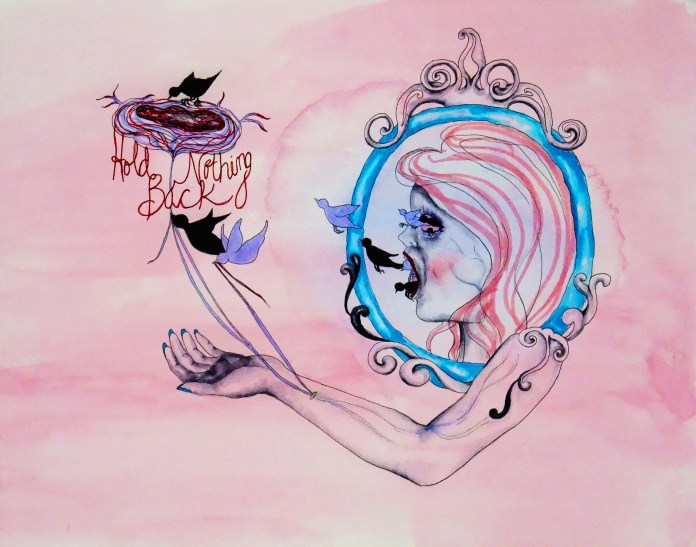
In A Black and White World, Be A Rainbow! New Work.

november she is entirely her own

I am still plugging along on my series that needs to be finished by mid-late Summer so that I can enter it into ArtPrize! 4 more pieces of 12 to go, wish me luck! This particular piece titled, “November: She Is Entirely Her Own” was a lot of fun, with lots of dramatic color and pattern – a true ode to creativity, independence, and expression. As it turns out, rainbow hair is as challenging to draw as it can be to create on an actual person’s head!

My series will eventually include 12 mixed media, surreal, conceptual portraits in which the meaning is influenced by the use of pattern and color. They will depict women of all ages, races, and time periods. Each will communicate a different theme, titled for each month of the year. I aim for the pieces to speak to women’s collective experiences beyond their differences. Though many of the pieces deal with difficult emotions, the overall feedback I’ve received is that viewers found the works in this series inspiring and encouraging. Over the last couple of years, I have really come into my own style as an artist. For the longest time, I thought in order for art to speak it couldn’t really be enjoyable to look at, and was so wary of my art slipping away from true art and into the category of “decoration”. However, honesty doesn’t have to mean horror and darkness, although there is certainly a time and place for that kind of art, too. You really have to just let yourself speak what naturally flows out of you as an artist, without trying to force a certain aesthetic or viewpoint just because you feel like that is what you “should” be making.

One of my all time favorite authors, David Foster Wallace, said this about creation, “In dark times, the definition of good art would seem to be art that locates and applies CPR to those elements of what’s human and magical that still live and glow despite the times’ darkness. Really good fiction (or art) could have as dark a worldview as it wished, but it’d find a way both to depict this world and to illuminate the possibilities for being alive and human in it.” If this doesn’t just sum up my definite art goals, I don’t know what does.

Lastly, I will leave you with some of my recent wedding photos. Oh, you didn’t know I got married by the most highly respected robotic priest in all of Michigan on the 30th of March, my 29th birthday?

Ok, April Fool’s. I don’t think this particular marriage ceremony held at Marvin’s Marvelous Mechanical Museum is technically legally binding, and the flimsy aluminum rings we exchanged couldn’t even fit properly on our gigantic sausage fingers. But nevertheless, spending a day at the arcade followed by delicious Italian food was a good enough birthday adventure for me. Perks, now everyone can stop asking us when we’re getting married, because we kind of already did, fools ^_^.

Continue to be the rainbow in a black and white world, dear readers. Until later …


Standard
Art Discussion, New Work

New Work – September: She Is An Atlas

This was one of the most challenging pieces in my series thus far, because I was working with multiple layers of meaning and thoughts. It also is the most “mixed media” of all my series installments, utilizing not just mixed fine art mediums but fabric, metal chain, tiny rhinestones, and torn book pages. I have been so into metallic accents since the collaboration with my friend and student, Heather. I also blame her for the inclusion of rhinestones – she encourages me to be sparkly.

she is an atlas

I’ve mentioned in previous posts that when I feel, I feel BIG or not at all. There is no other way. The sketch that inspired this piece started as a way for me to process the weight of my own emotions and feelings of powerlessness. As  I began further conceptualizing this current series, I realized the idea could fit as one of the 12 pieces. For new readers, here’s my blurb briefly explaining the series (If you are already in the know, feel free to skip ahead 😉 ): I am creating 12 mixed media, surreal, conceptual portraits in which the meaning is influenced by the use of pattern and color. They will depict women of all ages, races, and time periods, and each will communicate a different theme. I aim for the pieces to speak to women’s collective experiences beyond their differences. Each of the 12 will represent a month of the year. We tend to think of time and events in terms of our own personal history or the history of the nation in which we reside. But of course, there are women everywhere living out their day to day life all over the world, with hopes, dreams, fears , relationships. Our situations and struggles are very different, but were we in some alternate reality all given a chance to meet, I suspect we would find some surprising similarities, maybe more than we ever expected. The title of each piece starts with the month it represents, followed by “She Is _______”. The figure in this piece quite literally has “the world on her shoulders” through the pattern on her clothing, much like the mythic Atlas. Atlas the physical object is also defined as a book of maps or charts, and can signify one feeling that they alone must have all the directions and answers to all of the world’s problems, a grand and impossible responsibility.

The exposed heart necklace represents empathy, an open heart waiting to be wounded , left unprotected and raw. She leans against a bulls-eye wall, surrounded by an outline of thrown knives, a target girl like in the well known circus act. With each act of injustice and malice directed at others, she feels as if she is standing in their place, each offense a knife thrown at her, just missing. Though fearful, her face is strong and even. I’ve written before about how compassion and empathy does not equal weakness. To stick one’s head in the sand and be ignorant of the world’s ills is weakness; foolish, avoidant, and selfish.

Another way the subject can be viewed is not as the empathizer but as the victim. Some people are born into situations that are so difficult, living day to day is much like standing against a target with knives being thrown at them. It can be their geographic location, their income, the people that surround them or lack thereof, and the list goes on. Though yes, our personal choices certainly can influence outcomes, isn’t so much of life like a gigantic, living lottery when you think about it? Yet we shake our heads and wag our fingers when we see people who are struggling both around us and abroad, because certainly they must have done something wrong or things would look different? This way of thinking frees us of the responsibility to help others, and gives us a false sense of power that by doing certain things we can be 100% sure we attain the exact sort of life that we want. It all goes back to empathy and control.

One of the things I love about art is the way people can discern completely different meanings from a piece based on their own thoughts and experiences. Did something different strike you as you looked at this piece, did it remind you of something? Please share, don’t be shy!


Standard
Art Discussion

Art Discussion: To Suffer In Your Arms

to-suffer-in-your-arms

Happy February! This art discussion seems appropriate given that February has been appointed the month of all things lovey dovey. This drawing is one of my older ones, from about 8 years ago. Still, I’ve remained attached to it even though I can see spots where my pen and ink skills have certainly improved. It’s just the right mix of elegant and morbid, and I used an interesting process to come up with the concept. I had an assignment in my college drawing class in which we had to create a collage first, and then draw from that image we created. I used to be big into collaging (This collage actually won a contest in Deviantart’s collage club, of which I used to be quite the active member.), so this technique was right up my alley. I liked how collaging helped me come up with new image pairings I may not have thought of through sketching only. The loving couple used to be a cheesy perfume ad – major upgrade.

Outdoors, people are rioting and attacking each other. The couple are “safe” inside, shut out from all the cares of the outside world. But, even though they seem deeply in love, they too have wounds that they have imparted on each other. The woman is so enthralled with the picture in her mind of that perfect embrace, that oneness, that sense of not being alone that she ignores her own suffering. A dead dove lies shot and bleeding on the table, his blood bright red like the cuts and bruises on the woman, and the morbid image of the smiling, bleeding woman on canvas hung on the wall.

Love and peace are two words that are often spoke of together, as if married. What is odd is that despite all this, love is often in fact a destroyer of peace. People do all sorts of things in the name of a feeling they call love. In favor of love, common human decencies are thrown out the window without a look backward. People ruthlessly force their own ideas on others, sometimes to that others’ demise, all the while saying and wholeheartedly believing that this behavior is only because they love them and want good things for them.

Take a look at the relationships of any number of people you know as well as your own: you will find that often times once romantic love infiltrates a bond, you can expect things to be anything but peaceful. Love adds two entirely new dimensions to the already multifaceted structure of a relationship between two people, each different person with their own separate ideas of what both giving and receiving love is supposed to look like. 7 years after I pondered the simplification of love as the solution to everyone’s problems, this fantastic article was posted to Observer; “When we believe that “all we need is love,” … we’re more likely to ignore fundamental values such as respect, humility and commitment towards the people we care about. After all, if love solves everything, then why bother with all the other stuff — all of the hard stuff?” Love, like any other experience, can be healthy or unhealthy and it would do us all well to remember that. 

Love of only one or few things can easily grow into an obsession. With obsession comes possessiveness, jealousy, and a loss of attention to all else causing any other parts of life to shrivel and decay. Our perceptions can be tricked into a sort of bubble of “only I and what I love matter in this world”, when guess what, a whole lot else matters. The world keeps turning, and we let things that will inevitably be missed later fall away. Similarly, an intense, burning, passionate love of too many separate entities can cause overwhelming anxiety and leave an individual asking,”How can I show love to all of THIS when I only have _______”. One can end up feeling like the only spring left in a world of thirsty travelers. It can be hard to forget you are not the center of all that you love. In the case of love that is unrequited, you may not even be on the edges of what it is you love. And inner peace further erodes.

I, however, am still quite a fan of love (and always have been) and believe it can
accomplish wondrous things. I guess what matters the most and what we must think about always is where our love is coming from. Does it come from our own fleeting wants and demands, is it forced or artificially manufactured out of a sense duty with no real
compassion behind it, or does it flow from a deeper source? Love should always be external, because of who other living beings are, not internal, because of what we long to own. Love that comes from selfish desires undoubtedly leads to brutality.

Standard
Art Discussion

Art Discussion: New Year’s Resolutions

I have to admit, I never make New Year’s resolutions; partly because if you are truly dissatisfied with something, it seems silly to arbitrarily wait until the turning of the calendar to fix it. In part also because we all tend to set the same goals, those goals that we know everyone else is setting so we can easier relate to those around us as we share that we want to find our soulmate, get a promotion, or lose weight, and we can all laugh together about how we probably won’t actually do anything to work towards most of those things. But, what would happen if we committed to doing one thing that we were truly passionate about in this new year, one thing that we didn’t over analyze to death, asking ourselves, Should I want this? Is it too silly? Too shallow? Too lofty? Too weird? No one would understand anyway … 

1.jpg

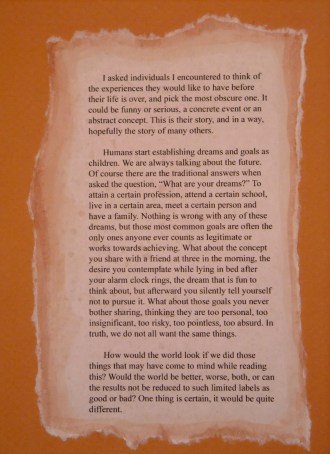
During my senior year of college 7 years ago (Whoa! 7 is a big number.), I entered an art book into the Annual Student Exhibition at Central Michigan University. I asked a sampling of the people I encountered in a day, some I knew well and some I did not, to think of a couple of experiences they would like to have before their life was over, and pick the most obscure one to share with me. I chose 35 different submissions to illustrate, and Underneath was  born. This was my first experiment with creating art based on collected personal stories, something I would use to create many more projects in the future. I also ended up winning the Grand Award for this piece, which was the first time I’d ever won anything for my art aside from a coloring contest in 4th grade, and not a bad way to exit my college career ;).


As annoying as it may be that the first thing anyone asks when meeting someone for the first time after “What’s your name?” is, “So what do you do?”, we kind of are what we do. This doesn’t have to mean our day jobs, or even be workplace related at all. What we do with each day is a choice, and it is these choices that reflect what we value and shape who we will become. True goals can give immense insight into each individual’s unique personality, drive, and psyche. That is why I so enjoyed sifting through the responses I received for this project.

I was reminded of Underneath recently for an unfortunate reason. The young woman who 7 years ago submitted the far right response above took her own life in a murder-suicide earlier this month. She attended my high school, but our school was so large growing up there were tons of people who walked in graduation with me that I felt like I’d never laid eyes on my whole four years there. I never knew her well, but our paths did cross and I remembered her submission deeply affecting me back then, as the news of what occurred deeply saddened me now. A couple of my good friends had had classes and clubs with her, some even keeping up over the years at least through texting and facebook, and the news hit them even harder.

This may not be a typical resolution, but something to be mindful of in the new year is this: we do not know everyone else’s story. We have no clue about everything the people we run into in our day to day life may be going through. People learn to adapt, and to act, and to portray themselves in person, at work, and in social media as how they want others to see them. I know I do it; I think we all do to a point. I have always been fascinated with the dichotomy between individual’s alone personas versus their public personas. It is a concept that is interesting to explore. It can also be a concept that is dangerous, because it can prevent people from reaching out who need help. If you make one resolution (aside from foregoing all convention and chasing your oddest dream / within reason and lawfulness, of course), resolve to be transparent and authentic, and resolve to be someone who is willing to make that reach when someone needs support either in the form of just a listening ear or otherwise. Christmas falling on a Sunday, I attended the Christmas morning church service at MFMC with my family this year. We spoke about how there is the whole Christmas story which most of us, churchgoers or not, have known since childhood. But, we all have stories, and our story, how we live and interact, can change someone else’s story for the better if we allow it to happen. We have nothing to lose for trying.

To see the rest of my art book in order, visit the album on my website.

Standard
Art Discussion

Art Discussion : Deliverance

wp-1478969352878.jpg

I have always thought of doing an art discussion post on this particular piece. Whenever I show it, everyone wants to know the story behind it as the fact that there is a symbolic visual narrative is clearer in this piece than in many of my others. Still, I have been putting it off for quite some time because explaining the concept behind this piece is very personal and would involve being really freaking transparent, so hold onto your hats. (I’m actually a big fan of transparency, but it usually manifests itself in the form of out-bursting deeply personal information in a sort of accidental social vomit, not neatly typing my feelings out for the world to see.)

This painting is a prayer.


When I started this piece, I was newly graduated from college and had been back to living in my childhood home for awhile afterward, which was super uncomfortable. I’m sorry, no matter how much you love your family it just is, unless said family adopts a sort of chill,  we are mutual adults living together almost like roommates sort of attitude, which nearly never happens.

I’d just finished training for a new job in sales that I already knew I was going to hate. Approaching tons of random people I don’t know all day and having to make forced conversation until they buy something? I might as well just get into the fetal position now for efficiency’s sake. The month long training involved driving 3 hours away and staying in a hotel with all the other trainees, and everyone was either horrifyingly mean and offensive or overtly sexually creepy. On more than one occasion, I finished a bottle of wine by myself sitting alone in my hotel room and I’m not a huge drinker. Not by any means advisable, but I honestly could not conceive of getting through this sordid affair without self medicating no matter how physically and mentally unhealthy. I’d had anxiety so bad 2 years before during my junior year of college that I had actually experienced brief hallucinations brought on by stress. I was not looking to have that be a repeat experience.

Even before I had embarked on my ill-fated new job, my emotions had been cycling out of control. I felt like my body was constantly sending off fight or flight signals, releasing chemicals that triggered the feeling that I was about to be chased by a tiger, except nothing was actually wrong. I would be elated and laughing and feeling creative and motivated one minute, and then suddenly this deep sense of dread like the sky was filled with pianos tied up on ropes that were about to all drop down on my head like I was in a Bugs Bunny cartoon would shake me to my core. I’d always been someone who felt BIG. When I feel joy, it’s intense and when I feel despair, it’s intense. I like to think it’s worth it for the times of joy, where the littlest thing can make me jump up and down like a little kid. A lot of people use that sense of celebration in the smallest details of life as they get older.

The first time I heard this song by one of my favorite artists, these lyrics really resonated with me because I think one of my biggest fears is people who never express their emotions. It’s just so foreign to me.

…But I would kill to make you feel
I’d kill to move your face an inch
I see you staring into space
I wanna stick my fist into your mouth
And twist your Arctic heart

The rapid up and down thing I was going through was something different, however. I’d always been in control of my mind and I felt like I wasn’t anymore. For someone who really likes to be in control of absolutely everything at all times, it was terrifying (I make itineraries for day trips even if I’m only traveling 20 minutes out of town. Excel spreadsheet lists are my best friends. Change plans on me at the last minute? Not unless you have a death wish. Just to give you a bit of insight…) It was also exhausting because the thing is, when your mind keeps sliding into that fight or flight state you actually feel as if you’ve just been in an extremely stressful and dangerous situation whether anything has happened or not. The fatigue is the same.

Another thing you may or may not know about me is that I am a Christian, albeit a Christian who has never felt very at home in the ofttimes bizarre sort of bubble of Christian culture (I swear people must have been able to sense it, because youth group was terrible. Maybe they could smell it like dogs smell fear.). This is mainly because it has always felt very exclusive, and also because being a female puts me in a sort of precarious situation with religion in general. It’s why the subject of “Women and Religion” actually has an entire college course of study devoted to it. Organized religion of any belief system tends to not be too kind to the ladies. (If I actually behaved how those super conservative “complementarian” advice articles advised that I do to be a “Godly woman”, never expressing a damn thought without asking “What do you think honey?” first, my current boyfriend would toss me off of our balcony. Or have me committed, one or the other. I found a keeper ;).) Basically, they just don’t seem to leave a lot of room for people actually being created with variation, people’s brains, hearts, and minds each working a little differently from the other. Luckily, Jesus doesn’t need you to be a robot that copies what everyone else in his bandwagon thinks, and He doesn’t need you to join any super special cool kids club. Also, despite how people like to twist religious truths to allow them to control others, he actually validated and lifted women up in contrast to society at the time. Don’t believe me? Some discussions on this issue can be found on God’s Word to Women, Sojourners, and a great interview on Christianity Today with one of my favorite christian writers, Sarah Bessey.

This is the first overtly faith based piece I’ve ever created, though my faith, my beliefs, and my passions inadvertently end up in all of my work in bits and pieces. I was obviously at a breaking point, and I was reluctantly praying about my struggle. I really didn’t even want to, because to be honest, I was frustrated, and I was pissed off. This was not what adult life was supposed to be like. I wasn’t supposed to still be dealing with this crap; I wasn’t supposed to still feel anxious and lost and overwhelmed; I wasn’t supposed to still feel like an outsider no matter where I put myself. Since drawing helps me focus and communicate my thoughts, I decided to draw my prayer.

Dealing with intense anxiety cages you. You aren’t able to function as your normal self, or even interact with others in the same way because every ounce of your energy goes into self care and basically trying to not feel like garbage all the time. This painting is a right to left narrative. A death version of the theatrical comedy/tragedy masks are embedded into this girl’s torso near the location of where her heart would normally rest. Hands are coming up from behind her and touching her shoulder in an act of comfort, you are not alone. The hands represent God, but they are not passive like a pat on the back or a “there there, everything will be ok”. They are active and forceful, saying “No, I will not let you continue to suffer.” A suffocating darkness creeps up from below. In the next part of the narrative, those same hands are breaking the mask in two, and out of the center, though still tangled, falls the girl; her true inner self, out of the cage. She is holding a watering can. In the final part on the far right, she is fully escaped from the prison inside the mask and water flows from the watering can she is holding, while silhouettes of human figures with flowers at their hearts stand in it’s spray. She is “watering” their souls, symbolized by the flowers.

When we go through tough things, we can use our experiences to better connect with and support others. No, that doesn’t mean the trials we go through are “good” (Seriously, “everything happens for a reason” has to be my least favorite platitude, and I really, really hate platitudes), but it means we can use something that was bad for good later on. Because of the struggles with anxiety I have experienced, I am able to better relate to a lot of my Artshop students and their mental health struggles which are oftentimes far more severe than what I have dealt with. I am better able to help them when they are going through a panic attack situation, better able to understand why on some days it bothers them to have a lot of noise during class when they are already on edge, better able to understand and empathize with the fact that they were fine an hour ago, and now are very upset even though nothing tangible has changed. I am able to be someone who says, “I hear you. Your feelings are legitimate. And you are not alone”.

A week or so passed afterward, and I ceased experiencing the out of the ordinary, rapid ups and downs.

No, my anxiety has not magically “poof!” disappeared, but over time  I have become far better at managing it and breaking out of its cage using a variety of learned techniques. For some, engaging in their faith and educating themselves on emotional management techniques isn’t enough and they may need to additionally seek counseling or medication. Everyone is different, and there should be no judgement.

Also, everyone should read this post about high functioning anxiety. I have never been able to articulate an experience so well, and it is a must read for all in my opinion, because I do not think this experience is uncommon. I think people just are apprehensive, like I was, to talk about it. I guarantee someone in your life right now needs you to know this.

What are some things you do to recenter yourself when everything around you feels out of control?


Standard
Art Discussion, New Work

March: She Is Everything At Once

Obviously, though I had a fun idea of doing the whole “a drawing a month” reveal for my new 12 part series, that didn’t happen as I am on March and it is now almost September. I would like to enter this series into Art Prize next year, and decided if I have until next Fall, why impose such a crazy impossible deadline on myself simply for the sake of themed blog posts and risk the quality of the work? Impossible self-imposed deadlines are this thing I like to do that I really need to ease up on. For those who haven’t read my previous posts, my new series involves 12 mixed media, surreal, conceptual portraits in which the meaning is influenced by the use of pattern and color, one representing each month of the year. They will depict women of all ages, races, and time periods, and each will communicate a different theme and season. I aim for the pieces to speak to women’s collective experiences beyond their differences. I want the series to flow together in its mainly black and white scheme with pops of color, soft mixed media application, and it’s classic portrait composition. However, I wanted each month’s portrait to still be distinctly different “characters” from one to the other, achieved via aesthetic theme and accent colors. For this piece, I went with bold, dynamic primaries and a nod to pop art. You can view January and February from earlier posts.

In this piece for March, my goal was to take the commonplace negative stereotype of women being “emotional” and turn it on it’s head, marrying caring and empathy with strength, and sadness and despair with hope for a better future. A surreal merging of classic pop art, which often featured dramatic beautiful women sobbing,  with realistic portraiture was the perfect fit for this concept.

march.jpg

Women are constantly being told they are too much of something, despite the fact that they are often expected to wear far more different hats responsibility-wise than their male counterparts. Google searches have become an interesting way to peek into mainstream society’s views. Anyone who uses the internet knows when you begin to type something in, google will finish it with the most popular searches and subjects. A UN Women ad from 2013 was the first to make a statement using this innovative approach.

un-women-search-engine-campaign-1

I tried the same concept, only typing in the starting phrase “women are too…” What I’ve found is that women are apparently too picky, but also too easy, too intelligent and successful to find love, yet too weak and too emotional to be leaders, the president, or involved in politics at all, but at the same time also too dominant. It looks like we’ve got a Goldilocks problem here.

As one who believes that sometimes problems we assign dominantly to one gender are still just basic human being problems, I didn’t want to negate the idea that there may be similar findings for men. However, when I tried “men are too…” I got nothing. In fact, when I simply pressed enter to see what articles would come up, the main article up top was “Monkeys turn into grumpy old men, too” about aging primates and behavioral changes. While hilarious, it is clear that this whole “Be everything at once yet also be nothing at all” contradictory expectation is something that, while maybe not entirely absent for men, is something that women face more in mainstream culture.

A descriptor routinely used to discredit women’s abilities is the fact that they are “too emotional” by default of their gender. However, when men step out of their perceived box by showing any degree of emotion aside from anger, they too are often chastised and ridiculed. This shows that our revulsion towards caring at least is a societal problem on the whole, not just a women’s issue. For some reason, people seem to view caring as weakness. This can be seen clearly in the dismissive term bleeding heart, always used with a strong air of disgust. (A note to be made here… when I talk about caring I am not including people sitting behind a laptop screen typing angry, obscene responses to random articles that they don’t agree with because they get off on being offended and telling people off. Nor am I talking about people who shut down and throw a fit every time they have to hear something that they don’t agree with. This is not true caring or passion, this is an addiction to “being right” all the time and putting people in their place, and it is unhealthy.)

I recall a conversation had with a person from my past 5-ish years ago. We were discussing some political or sociological issue. The other person, whom supposedly respected me, was nevertheless making zero effort to understand my view though I myself had stopped and listened to theirs. I remember growing frustrated and stating, “I don’t know why you are refusing to try to listen and understand where I’m coming from when this is an issue that is so important to me.” Their response was given bitingly and with a wave of the hand, “Oh, everything’s “the most important thing” to you.” Though it was meant as an insult, the more I pondered it the more I thought, I’m ok with owning that. Because everything does matter, in some way large or small.

In our culture, it’s cool not to care. You can see this fact brazenly displayed in popular entertainment (The Hangover 1,2,3,4,5? They just keep going.) People are routinely being told the answer to their feelings of isolation, depression, and anxiety is to just “let go”. But is the “ignorance is bliss” model really the one we should be following? This idea in and of itself seems to admit that caring is not weakness, but strength. Experiencing emotions of concern and empathy is an active state; not caring for anything outside of your own pleasure and needs is passive. To put it simply, caring about things is hard work. It can force us to take steps towards action that may make us uncomfortable, and take up a lot of our time and resources. It can be mentally and psychologically draining.

Caring is strength. Let’s lift up our mothers, our fathers, those taking care of an adult family member, our nurses, our teachers, our home health aides, our daycare workers, our counselors, our missionaries, our activists … No matter what societal norms tells us, they are our true heroes.


Standard
Art Discussion

Art Discussion : Seeing The Other

once we truly see eachother light

Once We Truly See Each Other / 2013 / 18×24 Watercolor, Ink, Embroidery Thread

At a young age, I began to notice the different ways in which men and women were viewed and treated. Ever since I first voiced confusion at this incongruity, I was answered with more questions such as “Why do you have such an issue with men?” “Why do you think men should be treated as less?” etc., etc., etc. These questions always left me with the disconcerting feeling that I’d somehow been shot into a parallel universe unbeknownst to me, where words that you spoke meant the opposite of what you’d said. How does equality mean one being treated as less than? The math just didn’t add up. Especially as one that tended to have an easier time talking to guys or tomboyish women than other “typical” ladies, was best friends with her younger brother, and generally thought men and women were equally awesome; how ever did someone get the impression that I wanted to bring anyone down?

As it turns out, social research is finding that when we as a society get used to seeing inequality for so long, any steps towards even partial equality are seen in an exaggerated light. An article from In These Times critiquing the fear of a “feminized society” , an anxiety that apparently is somehow all too prevalent, hits the nail on the head as to how this phenomenon occurs.

“So how do you get from some feminism, some of the time, to a feminized society?

The heart of the problem is one of the strangest manifestations of male privilege: It actually seems to interfere with men’s ability to count women. Specifically, it creates a tendency to actually see more women—or hear more female opinions—than are actually present at any given time.

Geena Davis Institute for Gender In Media found that, in crowd scenes, women tend to comprise about 17 percent of any given crowd. She’s argued, based on outside data and her own interpretations, that this imbalance relates to and reinforces the way men perceive the actual number of women in any given room.

“If there’s 17 percent women, the men in the group think it’s 50-50,” she told NPR. “And if there’s 33 percent women, the men perceive that as there being more women in the room than men.” ” (By the way, love Geena Davis. I watched and re-watched A League of Their Own I don’t know how many times as a kid, and I hate all sports, especially baseball.)

This same phenomenon happens where speech is concerned as well. You know that whole perception of “Hoo boy, women sure like to talk, yak yak yak!” Turns out it is just that, a perception. In mixed company, and especially in a workplace setting, women may be hard pressed to fit a word in edgewise according to a PBS series on language myths.

This same thing happens when it comes to race as well. People are always in self-preservation mode, and fear that by lifting one group  up the scales will be tipped so that they lose out. Or, I wonder if some don’t subconsciously fear that when we are all on an even playing field, they may sometimes get treated how they have treated the other for so long.

In reality, we are not living by the rules of the animal kingdom in this modern age. We are human beings with pretty solid cognitive and reasoning abilities when we choose to use them, and there is no rule that someone always has to be underneath the others’ foot. We need 100% of our society working together, and we need a collaboration of everyone’s ideas, not just 50% of the population’s ideas. By seeing each other for who we truly are, without the guise of archaic preconceived notions based on gender, everyone is lifted to a higher playing field.

This piece, titled “Once We Truly See Each Other”, is about support, and it involves men too. When striving for equality not just in our own backyards but across the world, it is a mistake to leave out men because they can be some of our biggest allies, and they are effected negatively by rigid gender expectations also. If you are ever in doubt of this fact, check out  the completely eye opening documentary, The Mask You Live In.

In my piece, women of all ages and ethnicity are illustrated as doctors, moms, members of the corporate world, musicians … Men are depicted as businessmen, athletes, artists, stay-at-home dads… The 3 cliffs are symbolic. Sure, men have started out on a historically higher platform as far as societal advantages are concerned. But, notice that third platform, the third and best option of all. In the piece, men are partnering to pull the women up. From there, the women are also helping the men up to reach their full potential. Equality requires that we invest in the lives of our fellow human beings, men and women both.

To me, equality is about allowing every individual to reach his or her full potential, whatever that may look like. No, women are not “settling” by choosing to be stay-at-home moms if that is their dream and what is important to them. They should have that option. No, the woman who wishes to rise to the top of her company and expects to be respected the same as her male colleagues is not an angry pink Godzilla hoping to kick every man in the balls with her shiny metal foot. She should have the chance to prove herself free of prejudices. And by the way, the same goes for men.

mecha_godzilla_individual_layouts___hello_kitty_by_nobackstreetboys-d5tf2np

Standard
Art Discussion

Art As A Tool For Expression

I had the first good night’s sleep I’ve had in awhile last night, so I thought it was a good time to reconnect with everyone. My lack of continuous rest can usually be attributed to one of three things:

A. Keeping myself awake having imaginary conversations with people in my day to day existence that will never happen in real life.

B. Making lists on various topics that I will never remember in the morning anyway.

C. Being kept awake by the sound of air molecules gently bumping into each other, even through my earplugs. Seriously, I am the auditory equivalent of “The Princess And The Pea”.

It was also the first week of a new semester at Express Yourself Artshop, which brings a lot to do and think about, so item B in particular was happening a lot ;).

It will be my first full semester as program coordinator after being involved as an instructor for a little over 2 years, and the fascinating idea of art as a tool for self expression is something that one is immediately confronted with the moment they enter the classroom.

kurt-vonnegut-arts

Many great thinkers and creators of all types have spoken on the importance of creatively expressing oneself, but rather than posting a list of 20 quotes or articles, I’d rather share with you through personal experience. Yes, I am an artist, but no, you don’t have to be to use something musical or visual or written to release whatever you are holding back. Often times, through written words or sketches is the only time anyone is afforded the opportunity to see our true selves, the selves we know we are on the inside that look so much different from others’ perceptions of us. It is why I panic whenever anyone I don’t know too well asks if they can look at my sketchbook. It’s not some temperamental artist thing where I am like “No, but it’s not beautiful yet! I can’t possibly reveal my rough beginnings!” It is because it reveals a 100% transparent view of my every thought and emotion, and that can be a bit embarrassing.

transparency  bright

Transparency, 2012, Watercolor and Ink

I had a lot of social anxiety growing up. Even through early high school, I would often go through an entire day without speaking a single word. I’d go home after school and my mouth would have that yucky stale, dry feeling like when you wake up in the morning, because I had literally not used my vocal chords for around 7+ hours. Then of course, lovely acquaintances would ask the oh-so-helpful question,”Why are you quiet all the time? Is there something wrong with you?” which made me want to clam up even more. If people already thought I was odd, God forbid I should open my mouth! Then they’d really have something to talk about. I knew that the person I was presenting to the world wasn’t the real me. I was actually pretty damn opinionated and strong-willed from a young age (I think in one of our garage sales I saw that my mom actually had a parenting book called something like “The Strong Willed Child”, meant to advise parents in coping with this particular sort of, ahem, “gift”). I had ideas and interests and things to say, and I hated the fact that others may see me as dull or demure, but I couldn’t break through this seemingly invisible force that held me captive. That is where I turned to art, my sketches being anything but safe, quiet, or boring.

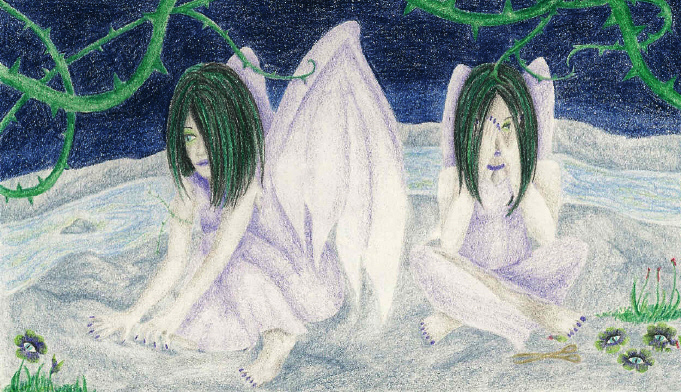
When I look back, my frustration with the self imposed isolation that I didn’t know how to navigate around is encapsulated in these visual expressions. Figures are often shown bound, missing one of their senses with eyes hidden or mouths literally sewn shut, or rendered immobile in an isolated environment.

blogexpressionwithopenedeyes

With Opened Eyes, Prismacolor Pencil, 2005

blogexpressionpatchestearsandloudnoises

Patches, Tears, and Loud Noises ; Prismacolor Pencil, 2005

blogexpressionofthesea

Of The Sea, Prismacolor Pencil, 2005


blogexpressiontimebound

Timebound, Prismacolor Pencil, 2006

blogexpressionsburied

Frozen, Prismacolor Pencil, 2006


Though emotionally painful at the time, I luckily connected with a few good friends junior and senior year who struggled similarly and could understand what I was going through, something that I couldn’t explain since it was all internal. This, coupled with going off to college and being forced into uncomfortable and unknown situations in which I would have to communicate out of necessity, helped me adapt and change, growing away from this extreme anxiety. Did it completely disappear? No, but it greatly lessened. Within the last couple of years I have also found that when I have a purpose to my communication and am passionate about what I am sharing, such as with art instruction, no matter how large the group of strangers may be my fears disintegrate (Ask me to talk about menial conversation fillers like the weather or how my day is going, and we may have a problem. I always say I prefer “big talk” 😉 ). Not all are so lucky. Some individuals are permanently nonverbal due to developmental disorders or injury. For them, finding alternate means of communication is not just therapeutic but necessary.

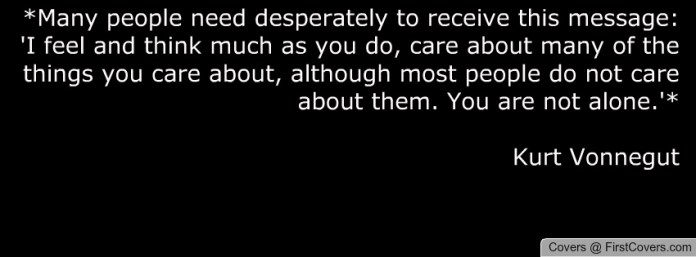
I am going to close with another Kurt Vonnegut quote that I’ve probably shared before, because it’s that good:

many_people_need-95908

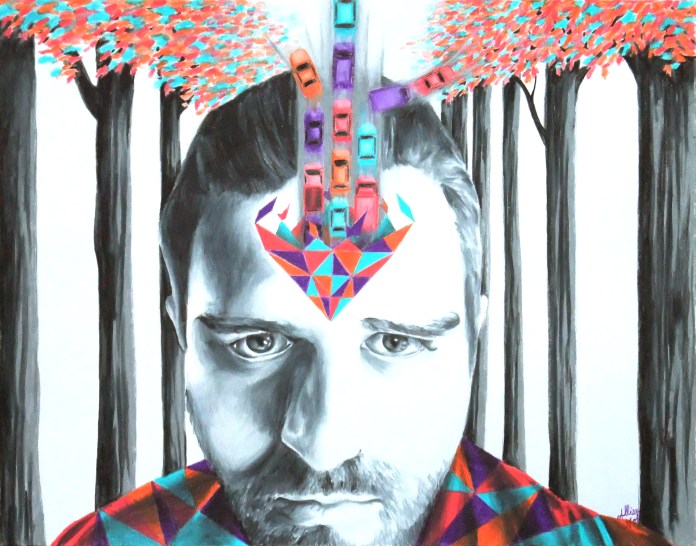
By expressing ourselves creatively whether the result is a masterpiece or not, we are not only helping ourselves, but are touching others positively as well. Through making oneself vulnerable, we “give permission” to others to do the same. We all think we’re the only one; the only one who thinks _________, the only one who feels _______, the only one who has experienced ________, when the truth is most likely we are not, everyone else is just too scared to say how they really feel. I can’t count how many people have looked at the piece below and simply said, “Yeah, I know the feeling …”

The Rush Hour

The Rush Hour, Prismacolor Pencil, 2014

Of this next piece, viewers have commented that looking at the work was actually uncomfortable because they could feel her claustrophobia. They understood the feeling of being confined and held back, of feeling like you have outgrown your current life or situation, of wanting to move and change while everything and everyone around you is staying the same. Everyone experiences feelings like this, there is just this unspoken rule that you don’t talk about it.

actually it is this world thats too small

Actually, It Is This World That’s Too Small; Mixed Media, 2014

You don’t always have to be expressing negative emotions, either. A student in Express Yourself Artshop’s Painting Exploration class this week wanted to tell a story about bright colors, music, and dance with her piece, and made a modern art version of a dancer playing the flute, referenced from an old painting from an art history book that she had found and connected with right away. Another tried painting for the first time, and chose to celebrate her favorite colors and the things that make her happy, like gardens. Besides aiding in dealing with difficult emotions, de-stressing and joy are two other side effects of self expression through art.

colleendancer

Artist : Colleen D.

michelle3

Artist : Michelle D.


Just pick up a pencil and play … you may be surprised what comes out, or whom you connect with and inspire along the way.


Standard
Art Discussion

Art Is Not A Luxury

More often than not in this modern age, as we have multitudes of tools at our disposal to both vocally and textually communicate, art has been getting bumped into the category of a “luxury”; unnecessary, mere decoration, or else something for the unbelievably wealthy who don’t know the value of a dollar to irresponsibly blow their money on. In fact, art is an important tool for effective communication today, and has been throughout history. With the less than stellar economy, art has been the first thing to get cut in schools for awhile, and yet we as a society are facing a complete breakdown of productive adult communication the likes of which has never been seen. Spend 24 hours amongst other human beings in a department store or 15 minutes on the internet and you will no doubt see what I’m talking about. I notice art and creative writing both tend to get the same rep: entertaining fluff, imaginary stories, unnecessary tools. I know quite a few people whose opinions I, on the whole, respect, that insist you can’t learn anything from fiction. They assert that it’s just something for having fun and relaxing, nothing more nothing less. Now while some creative works may be just that (Let’s be real – you aren’t likely to come to any existential truths while reading the Twilight series), if all fictional literature and all art were truly meaningless, there wouldn’t continue to be controversy around their messages; they wouldn’t still get banned from schools or showings. People don’t ban things they find uninteresting, unattractive, or mildly annoying – they ban things they find dangerous – because art has the ability to change hearts and minds. Art communicates, to those who are listening.

Visual communication has some staggering advantages over verbal communication. Firstly, we are a culture of immediacy. We want things and we want them now, Veruca Salt style. Visual communication accomplishes just that. Facts and ideas come presented visually with no complicated explanation, no lengthy preamble, simply look and absorb. People’s reactions to visuals are also often quicker and simpler than their reactions to spoken word. It is easy to cause feelings of happiness and ease in a viewer (and thus happiness and ease in them towards your message) by presenting them with an image of something they find pleasant. Turn this around, and it is also easier to inspire fear by showing images of violence or things that cause worry or disgust to a viewer. This is why advertisements for products are always primarily images, not columns or articles. Visual communication is also more versatile, and gives you more tools at your disposal. Rather than just words in your arsenal, you have all the elements of design; color, shape, texture, space, form.

This is a blog post, not a book, so know that there are innumerable examples not highlighted here on art’s role in history (And, this just in American History, let alone the many examples to be found in the history of other cultures!). I figured I’d today simply touch on the real hot-button historical moments, those that we begin hearing about in social studies class as early as elementary school.

While cameras were certainly around during the Civil War, it was still common for the media portraying historical events and news to be hand-drawn.

The lithograph above was done by an unknown artist, and portrays a well-known victory of the famed Underground Railroad. Henry “Box” Brown made headlines in 1849 when he escaped from slavery in Richmond, Virginia in a quite unorthodox manner. Brown actually packed and mailed himself to the North, and to freedom, with the help of abolitionists. When the lid was removed, he allegedly said, “How do you do, gentlemen?” and quoted some Bible verses to celebrate his escape. The fact that he is dressed the same as the men standing around him upon arrival, in a fine looking, tailored suit, is probably not indicative of how he actually arrived on the scene, but a deliberate decision on the artist’s part to reinforce his equality with these other men.

A great historical change that art played a direct role in beyond immortalizing events was the Suffragist movement.

Art has the ability to visually re-frame stereotypes, and cause people to envision situations in a new way. The first illustration below turns the assumption at the time that suffragettes were “vain, idle rich women with nothing better to do” completely on its head by showing a working woman. For the working class, the ability to vote is vital, certainly necessity far more than luxury. It asks the question, if they are contributing to keeping the “machine” of society running smoothly day in and day out, shouldn’t they have a say in how it runs? The second illustration reminds me of a quote I read recently (I wish I could remember who/where, because I think it is just excellent!), “If you’re a man that says he’s not a feminist, I want you to go explain to every woman in your life why you think she doesn’t deserve to be treated equally.” The poster asks men to think of their mothers. You respect them, you revere their wisdom, so why don’t you trust them to help the country make decisions? By framing it in a personal way, a technique that is still used to combat societal problems of sexism today, women are taken out of being this distant, abstract category or group and humanized into your daughter, your mother, your sister, your wife, your best friend …

Fast forward in history, and art plays a fascinating and unexpected role in the two World Wars.

It is argued that without modern art, there would have been no camouflage, a vital tool in saving lives on the battlefield – the ability to hide in plain sight. The idea for the complex geometric designs on “dazzle ships” is credited to artist Normal Wilkinson. These hypnotizing designs confused the spotter with their sharp, contrasting colors and confusing intersecting lines bumping into and interrupting each other. The enemy had a difficult time determining how many ships there were, as well as their range and location making it more difficult to shoot. Understanding how patterns can trick the eye from a distance also became vital to concealing targets during the first World War.

Later on, two Australian modern artists, photographer Max Dupain and painter Frank Hinder, would experiment with applying some of the newer modernist techniques to modern day warfare. One of Max Dupain’s photography experiments with optical camouflage is shown below. They used double exposure and obliterative shading, techniques that make it difficult to distinguish between foreground and background.

Never before and never again since WWII have we seen such a unity in American patriotism and civic responsibility. Whether this is a good thing or a bad thing is up to you, but one thing is certain: the iconic propaganda artwork of the WWII era played an instrumental role in banding people together under a common cause, and inspiring a strong, almost blind sense of duty and optimism. The famous “Rosie the Riveter” piece is still to this day a feminist icon, and the inspiration of many Halloween costumes, both celebrity and pedestrian (and even some great face-in-hole shots. Girl power! I’d like to think I’m almost as fierce as Beyonce). Those at home were represented as just as vital to the war as those abroad, and given a renewed sense of purpose through this inspirational artwork.

rose

In the 1960s, artists took up the cause of the Civil Rights Movement.

Jacob Lawrence’s 1962 painting “Soldiers and Students” is shown below. Lawrence was always interested in using his colorful paintings to document African American history, and during the civil rights crisis of the 60s, he began documenting the disturbing everyday scenes he witnessed in the struggle for equality.

The birth of feminist art also took place around this time. I have to admit, although I have always considered myself a feminist, I could never get into feminist art. I wanted to like it, I really did, but as someone who has never felt overtly in touch with their so-called “feminine” side to begin with, I felt a lot of the motifs and delivery methods were simply lost on me. It seemed strange to me to make art that was only accessible to a specialized group rather than reaching the whole on some level. Isn’t feminist art just a bunch of flowers growing out of vaginas and bad performance art? Male or female, if you feel like you don’t really get feminist art, watch the !Women Art Revolution documentary – it’s on netflix instant. While I still can’t pick out any iconic piece of work from that era as my “favorite art ever”, these ladies really paved the way for what I do today, and I owe them heaps of gratitude, whether their artistic style or methodology is my bag or not. By the way, there’s still work to do, ladies.

Today, though it’s easier for art to get lost in all the noise with people plugged into some media or another 24//7 and everyone and their great-grandma with their own website or blog, artists are still speaking. For this same media also gives us easy access to an unlimited stream of creative media to peruse. Below, Michael D’Antuono’s painting “Conservative Christ” critiques the marrying of Christianity with extremist far-right politics. Street artists have also done a brilliant job at visually speaking truths, placing their work right in the unavoidable path of citizen’s daily commute.

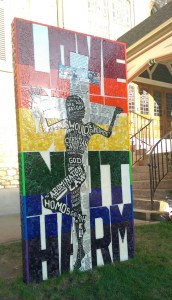
noharmI am reminded of this beautiful piece I saw at Art Prize in Grand Rapids last year, especially relevant in light of the recent supreme court decision. (And the subsequent vicious, mean-spirited attacking coming from both sides in the aftermath that made me want to delete my facebook forever.)

Throughout history, art has been used to both promote mainstream values and also oftentimes clash against them, and it has the potential to be wielded as a weapon of good or a weapon of evil, hate, and deception. You can see below how art can also be used to persuade people into harmful beliefs and mindsets. After all, at the same time as the victory garden posters were circulating, so on the other side were illustrations praising Hitler and demonizing the Jewish nationality. It can be used to justify withholding rights from a group of people, like the anti-suffragist poster (lol, chocolate). It can be used to poke fun at and disrespect people who look different than us as “less”, like the vintage soap ad (Nothing to laugh about in this next one. I felt uncomfortable even posting this particular ad, and it was not even close to the worst that can be found, unfortunately). It can be used to promote unhealthy lifestyles, and guilt people into feeling like without a certain body or certain clothes, they are ugly and worthless, like the current day Photoshopping controversies. As artists, we have to realize that what we create speaks. We have a valuable platform, and as Uncle Ben tells Peter Parker, (Ok, so Voltaire said it first but I’m a total Spiderman geek) “With great power comes great responsibility”.

Standard
Art Discussion

Art Discussion – Legacy

Legacy, 11x14 Prismacolor Pencil

Legacy, 11×14 Prismacolor Pencil

Today, I wanted to unpack a piece from my conceptual portraits series I’ve been working on since beginning of last year, titled “Legacy”.
The script scrolling from her head at the top right reads “I fear being ordinary most of all”. For this piece, I had been thinking a lot about how many decisions we make are rooted in a fear of mortality. We fear that once we are gone it won’t matter… we will have left nothing behind to be remembered by. We long to be KNOWN for something, to be successful at something, for others to know our name. Sometimes we don’t even care if what we are noted for is positive or not, just as long as our existence is eye-catching and out of the ordinary and commands fame and astonishment for good reasons or for terrible. LIke Oscar Wilde said, “The only thing worse than being talked about is not being talked about”. Everything we do, in the relationships we build, the work and pleasure we choose, is leading towards a legacy we hope to build and the perception by which we will be remembered. I used the repeated pattern of the skull and grave markers on her clothing as a motif symbolizing mortality. You will also notice the burning city in the background at the bottom of the composition, which she turns away from smiling, so inwardly focused that she takes no notice of the external destruction.
I have always been interested in masks, mainly because I am interested in almost any form of art that involves faces. Masks can also symbolize so many different things. They can symbolize falseness, pretense, anonymity, invisibility, the concealment of sins. But, they can also symbolize celebration, personal expression, the fact that human beings are flexible and multi-faceted and shades of grey – not black and white, and the power we have over who we want to be in our own story. I am especially drawn to the aesthetic of Japanese Kabuki and Noh masks, two forms of classical Japanese musical drama that involve masks and elaborate costumes to aid in telling the story. In Noh, each mask symbolizes a different type of character. For the background of this piece, I chose to tile the demon character mask (destructive, powerful) alternating with the traditional woman mask (usually symbolizing a character who is beautiful, refined, elegant, and demure). This symbolizes the interplay between a person’s two choices (or more accurately, what we perceive as our only two options). Too often we think that the only way to get ahead, be noticed, be outstanding, is to forgo our ideals and do what is best for ourselves and ourselves only. Those who make history do tend to have an awful lot of skeletons in their closet. But does doing what is right condemn us to having to play the role of the mouse smiling and curtsying in the corner? I’d ask you to also look to history (Think of Martin Luther King Jr., the most well known example!) and see that no, that is certainly not the case.

It is always interesting to hear others’ thoughts. Who are some of your favorite notable figures who broke the societal assumption of power and success being inseparable from selfishness and violence? What kind of legacy do you want your existence to build?

Standard