New Work

This Is Why You Should Keep Old Work Forever.

The Beauty Of It All

The Beauty Of It All, 11×14 prismacolor pencil and watercolor

For about 2 years, I had an 11×14 piece of bristol board with this woman’s face covered in flowers on it, and a metallic silver world map view behind her. She was surrounded by nothing else but white space. I was convinced it looked absolutely horrible, and I had no idea what to do with the rest of the background. I chocked it up to a loss and tossed the drawing in my storage portfolio case. A couple times I ran out of paper and thought about just using the back of it when I had a new idea and didn’t want to delay inspiration with a drive to Michaels for more bristol board. Other times I almost chopped it up into pieces for scrap paper to sketch ideas onto. I thought of posting it on my artist facebook page as a giveaway for whoever wanted it, and letting them color all over it like crazy to see what happened; an impromptu collaboration over vast distances.

Luckily, I never did any of these things. I’ve been doing a lot with watercolor lately, and was wishing I had one more piece to hang in my upcoming exhibit. I didn’t have the time to start anything else from scratch, but when I found this I decided to play around with the background and see what happened. I spontaneously dripped blues and greens and metallic silvers over the entire background, throwing the paper this way and that to guide the drips. Once I stopped over-analyzing and worrying over how terrible I thought my piece looked and just started enjoying the process again, everything came together. Sometimes even something as subtle as a bold color splashed into the backdrop can turn an entire piece around. Mine went from a drawing of a girl who looked like she had a strange, alien, flower-shaped skin disease to a pretty nice finished piece.

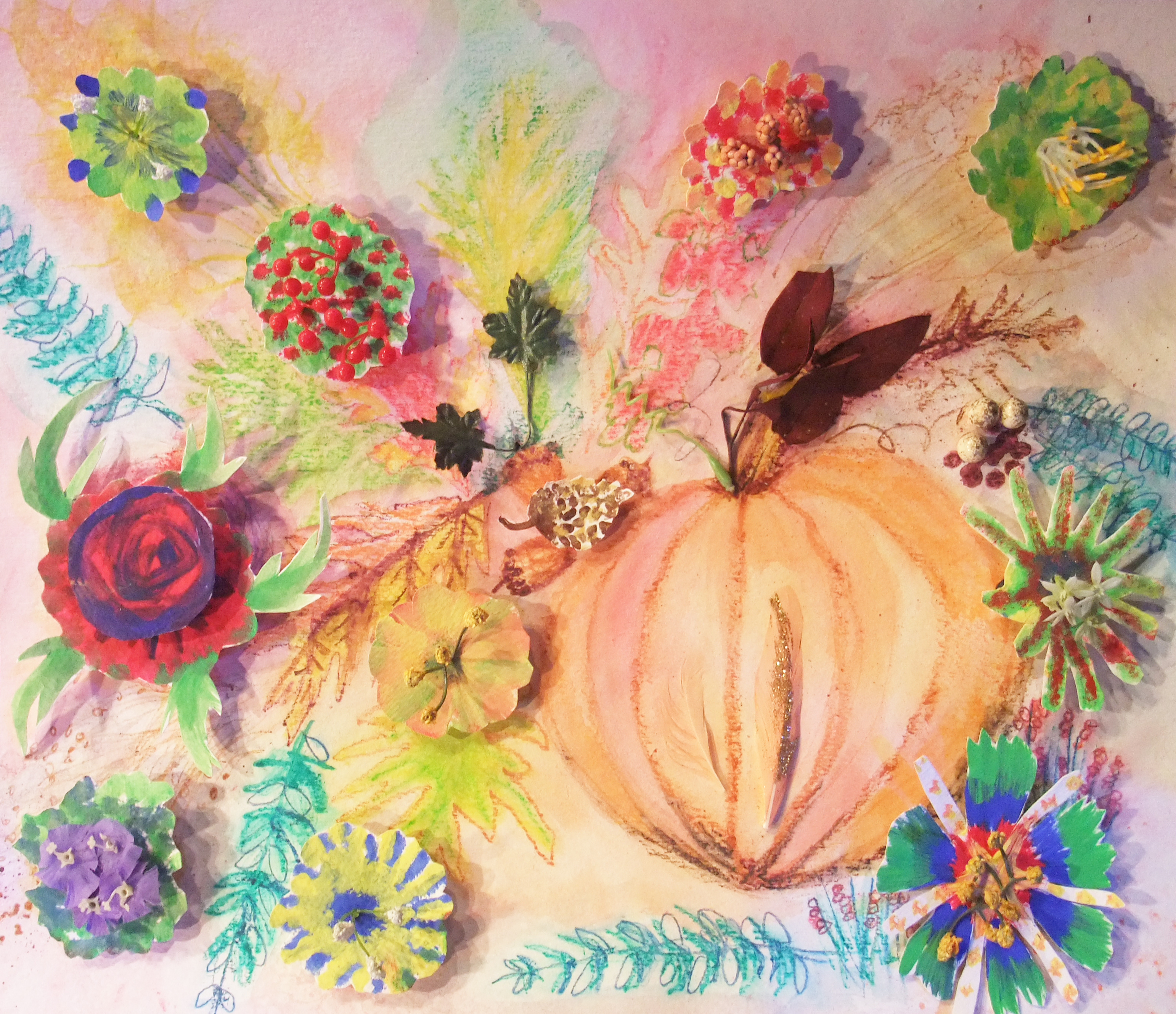
This is why I cannot emphasize enough, don’t toss out old, unfinished work! Paper is flat, it keeps pretty easily. I’ve my seen students do some really cool things with incomplete projects they could have tossed away. In this piece below, a student cut out elements she liked from a “practice” acrylic painting from the semester before that didn’t really turn out. These made for some great smaller blooms popping out around the central focus of the pumpkin. Even if you don’t end up turning the leftover physical piece into anything, something half-finished could at the very least provide an idea or concept for a project you do later.

And again, I have the best students ever. Unique floral mixed media for autumn.

Nancy’s autumnal mixed media, salvaging cutouts from an old acrylic practice lesson the semester before.

I’m actually constantly revisiting old work, even from as far back as high school. Most of that is also unfinished because I, like any teen, had a real short attention span. This painting, which my mom fell in love with and now has hanging over the sofa in my parents’ living room, was created from scratch in 2012. But, it was based on an old colored pencil drawing from 2005 that I never finished shading in. The particular sketchbook the original drawing was in is still in the closet of my old bedroom in my parents’ house or I would post it here, but it was a color scheme of entirely red and black and the parasol people were dressed in old-timey but super goth attire, and the faces on the parasols looked like they could all be members of a My Chemical Romance copycat band. Trust me, it was something else. Behold, the reboot.

"Wait Out The Storm", 18x24 Watercolor and Ink

“Wait Out The Storm”, 18×24 Watercolor and Ink

Now that I’ve turned you all into hoarders, I have one more all-together new piece I’d like to share. I have always been deeply interested in the steampunk aesthetic, but never created any steampunk-esque art myself. This is my first, and I’m pretty excited about how it turned out.

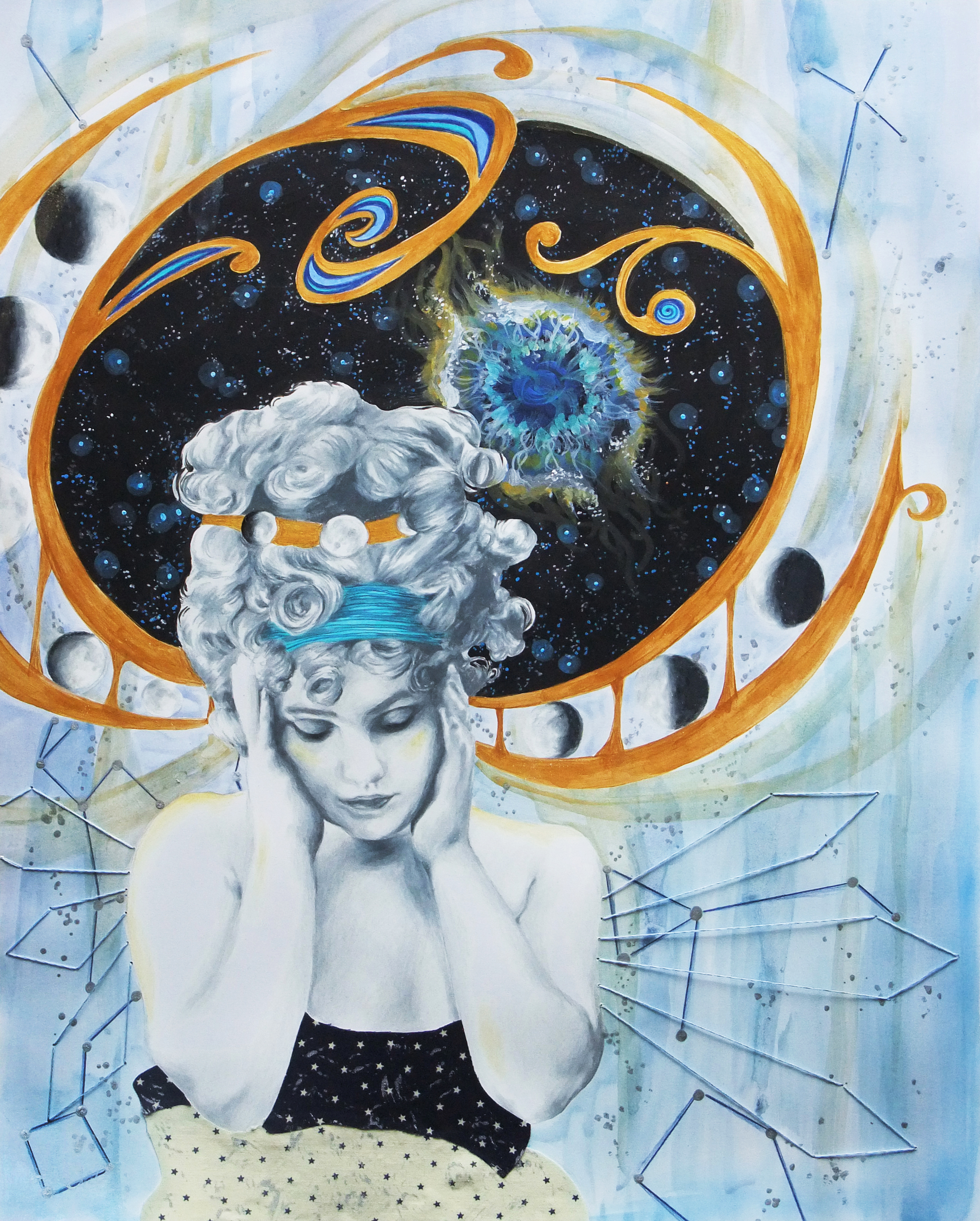
"Dreams Of Gold", 11x14 Prismacolor Pencil and Chalk

“Dreams Of Gold”, 11×14 Prismacolor Pencil and Chalk

The deep gold is metallic, though you can’t tell in the digital image. I was heavily inspired by the Victorian aspect of Steampunk, even turning the classic Victorian lace pattern into something metallic and industrial. I am finally going to be hanging all of these pieces up tomorrow in Espresso Milano, and will be sure to take pictures. Have any cool steampunk art you yourself have created or that you’ve seen by other artists? Throw me a link! I am a long time appreciator, but creation-wise, a novice. As I’ve promised, photos soon!

Standard
Exhibitions and Other News

Back to Real Life, But Excited For What’s To Come.

I just got back from one of the most fun trips yet to the charming and exciting land of Ludington, MI; hiking, swimming, sketching on the beach … my boyfriend and I were determined to jam in everything that epitomizes summer before it’s too late! I vowed to not check my email to make it a true reprieve, but I did peek just once in the car on the way there, and I’m glad I did because I got some awesome news. Two of my pieces were accepted into Studio 23 in Bay City’s Women’s Perspective show for September! If you’ve read my earlier post, ladies sometimes get forgotten in the gallery scene even today, so I am excited and honored to be a part of what I’m sure is going to be a wonderful show. Below are the two works that will be showing. If you’d like to learn more about the process of creating “On My Mind”, you can visit my earlier entry focusing on this piece.

On My Mind

On My Mind

The Peacock

The Peacock

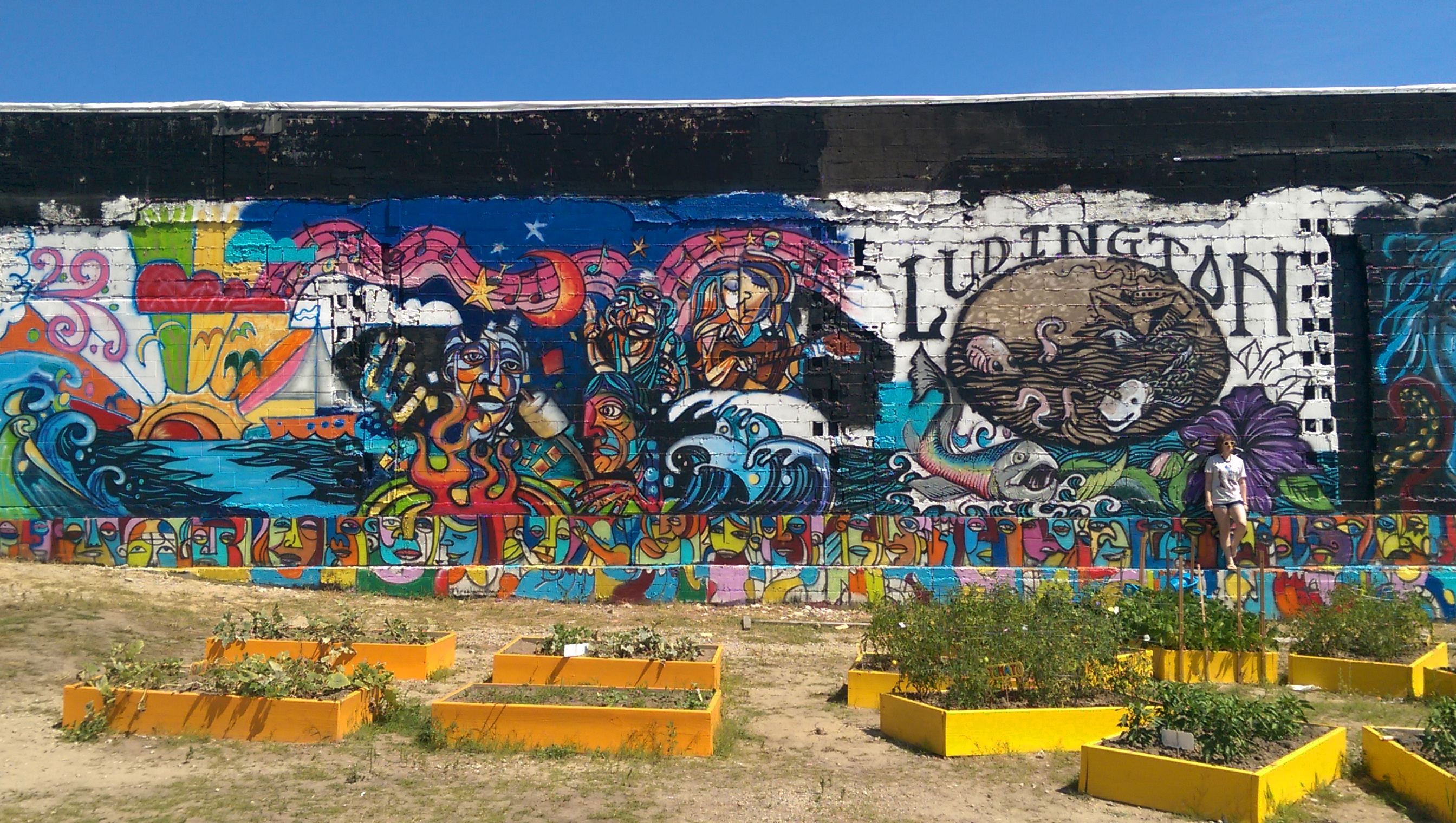
Another fun surprise was the new murals up in Ludington to take touristy photos in front of! Art truly is everywhere, and it is wonderful. Murals aside, not to be cheesy, but one can’t look at the serene layers of bright blue water, warm yellow-beige sand, and bold green foliage and not see the very world we live in as one of the largest, most complex creations to ever exist, and truly the largest, most interactive art project.

Me posing oh-so-cool in front of my favorite mural of the bunch.

Me posing oh-so-cool in front of my favorite mural of the bunch.

Behold!

Behold, bright colors! Yes, that is Spider-man on my t-shirt.

I just ate it after a wave literally knocked me on my butt while I was wading out. There were weather warnings out all day, which of course means perfect day to go swimming! Thrill seeker 4 life.

I just ate it after a huge wave literally knocked me on my butt while I was wading out. There were weather warnings out all day, which of course means perfect time to go swimming! Thrill seeker for life, man.

Standard
Artists To Know

Artists To Know! Installment 6

Susan Saladino

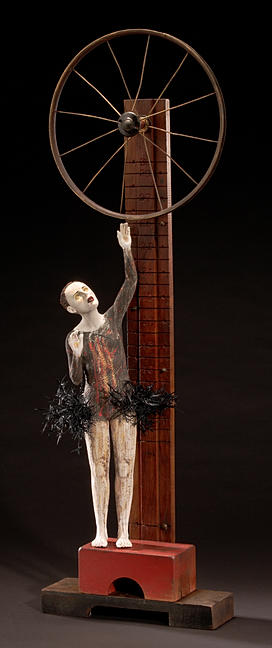
In her bio on her webpage, Susan Saladino states that her work revolves around her belief that “we as humans have a kinship with all life”. In her series of sculptural figures, the series that first hooked me onto her work, they are made using materials from nature, and are often blindfolded. To Saladino, the blindfolds symbolizes humanity’s turning away from realities they find uncomfortable and would rather not face. She believes that the blindfolds must be removed to make the required changes, and that change must occur, especially as it comes to environmental conservation and animal cruelty. I am completely enamored with tree forms, which is why this series featuring the gowns made of branches caught my eye. This blindfolded woman looking up and away from the red bird she cradles could symbolize a variety of different things to different people, but to me, knowing the artist’s symbolic intent further increases my appreciation for her detailed and ethereal work.

Willy Verginer

Willy Verginer resides in Ortisei, Italy. He has been exhibiting his characteristic sculptures since the early 1990s. His exquisite figures carved out of lime tree wood are earmarked by solid color blocking against pale ivory, often with surreal touches. His sculptures interact, but their eyes never truly meet, and they can often be found with things growing from their hands, objects balanced on or connected to their bodies, or cut off at the torso or limbs and sinking into the floor as if it were made of liquid. The series the sculpture shown above is from is titled “a fior di pelle”, meaning “to flower of skin”. It is meant to describe hypersensitivity and to express the fragility of the youth and the ability to dream. Moving, calm, and eerily realistic, I would love to see some of his work in person someday.

Nicole West

I discovered this artist on pinterest, at first thinking her work was some really unique alternative fashion photography, and later learning oh my gosh, those aren’t photographs of real people but SCULPTURES! Is your mind as blown as mine was? Her gorgeous fantasy sculptures are made using polymer clay, and the perfect understanding of human form is apparent if you observe the perfected muscle tone down to the slight undulating in and out of the shape of the arm and the tiny indent in the elbow in the second photo above. As if the sculpting wasn’t amazing enough, each figure is adorned in luscious, detailed costuming including unique decorative jewelry and beyond fabulous hairstyles. Each has a dewy glow, so that it radiates human warmth and you’d be shocked to touch one and find it hard clay rather than soft, velvety skin.

Christina Robinson

I found Christina Robinson on etsy and was instantly intrigued by her whimsical, stylized figures that have a fun children’s book style cartoonishness to them but with a Tim Burton kind of twist. Really, no direct comparisons can be made though, because Robinson’s style is all her own. She paints as well, using the same playful colors and prominent faces with rather neutral expressiosn that still manage to say so much. Her bold, expressive style is certainly memorable.

Christy Kane

I don’t remember how I first discovered Christy Kane, but it was sometime in late high school. I remember ordering her short story book, a play on children’s morality tales including detailed photographs of her dolls posed to enact the sordid turn of events. Shortly thereafter, this short film came out.

Her dolls make up the true island of misfit toys. I love how they are not meant to be conventionally perfect and beautiful and everything you normally think of when you think of dolls, and I love the attention that is paid to each doll’s individual “story”. Each of them has a life, memories, experiences, likes and dislikes. That is truly giving your art life.

Kirsten Stingle

I discovered Kirsten Stingle on pinterest also. Her sculptures are primarily porcelain, and she uses a straight pin to detail the tiny faces, hands, and feet. Stingle is focused on storytelling, and believes our stories are what connects us to one another and explains who we are. She aims to combat isolation by presenting stories common to the human experience. This is something I value as well, and aim to do with my own work, so I really connect to her concept. I know I can relate to her figures struggling towards figuring out an arch for their life and forming their own identity; I suspect we all can.

I was left completely in awe of these artists. After a failed foray into paper mache in a summer art class (My “princess” turning out none to regal…), followed by a lumpy, bubbled copper ice skater I churned out for a project in junior high (I got a B on it! The calamity! Yes, I was one of those kids, but only in art class ;)) , I kind of shied away from sculpture. Forced to revisit it in college, I thought it would be amusing to share some of my projects of the 3-dimensional variety.

Miniature of the Library of Celcus in Ephesus. I thought it would be fun because I love books ... KILL ME NOW!

Miniature of the Library of Celcus in Ephesus. I thought it would be fun because I love books … KILL ME NOW!

We were supposed to make an abstract sculpture out of these little blob guys (balloons filled with plaster) that portrayed a tension between beauty and repulsion. I called this "Sisters". Alternate title, "A Very Angry Drag Queen" (note the feathers and nails).

We were supposed to make an abstract sculpture out of these little blob guys (balloons filled with plaster) that portrayed a tension between beauty and repulsion. I called this “Sisters”. Alternate title, “A Very Angry Drag Queen” (note the feathers and nails).

Just remember guys, nobody’s perfect ;). Keep working at your art and trying new things and you will find your niche. Don’t let fear of failure stop you from experimenting, taking new classes, learning new things … Many of our projects will not be successes but hell, at least you can have a good laugh about it later, right?

Standard
Art Discussion

Art Is Not A Luxury

More often than not in this modern age, as we have multitudes of tools at our disposal to both vocally and textually communicate, art has been getting bumped into the category of a “luxury”; unnecessary, mere decoration, or else something for the unbelievably wealthy who don’t know the value of a dollar to irresponsibly blow their money on. In fact, art is an important tool for effective communication today, and has been throughout history. With the less than stellar economy, art has been the first thing to get cut in schools for awhile, and yet we as a society are facing a complete breakdown of productive adult communication the likes of which has never been seen. Spend 24 hours amongst other human beings in a department store or 15 minutes on the internet and you will no doubt see what I’m talking about. I notice art and creative writing both tend to get the same rep: entertaining fluff, imaginary stories, unnecessary tools. I know quite a few people whose opinions I, on the whole, respect, that insist you can’t learn anything from fiction. They assert that it’s just something for having fun and relaxing, nothing more nothing less. Now while some creative works may be just that (Let’s be real – you aren’t likely to come to any existential truths while reading the Twilight series), if all fictional literature and all art were truly meaningless, there wouldn’t continue to be controversy around their messages; they wouldn’t still get banned from schools or showings. People don’t ban things they find uninteresting, unattractive, or mildly annoying – they ban things they find dangerous – because art has the ability to change hearts and minds. Art communicates, to those who are listening.

Visual communication has some staggering advantages over verbal communication. Firstly, we are a culture of immediacy. We want things and we want them now, Veruca Salt style. Visual communication accomplishes just that. Facts and ideas come presented visually with no complicated explanation, no lengthy preamble, simply look and absorb. People’s reactions to visuals are also often quicker and simpler than their reactions to spoken word. It is easy to cause feelings of happiness and ease in a viewer (and thus happiness and ease in them towards your message) by presenting them with an image of something they find pleasant. Turn this around, and it is also easier to inspire fear by showing images of violence or things that cause worry or disgust to a viewer. This is why advertisements for products are always primarily images, not columns or articles. Visual communication is also more versatile, and gives you more tools at your disposal. Rather than just words in your arsenal, you have all the elements of design; color, shape, texture, space, form.

This is a blog post, not a book, so know that there are innumerable examples not highlighted here on art’s role in history (And, this just in American History, let alone the many examples to be found in the history of other cultures!). I figured I’d today simply touch on the real hot-button historical moments, those that we begin hearing about in social studies class as early as elementary school.

While cameras were certainly around during the Civil War, it was still common for the media portraying historical events and news to be hand-drawn.

The lithograph above was done by an unknown artist, and portrays a well-known victory of the famed Underground Railroad. Henry “Box” Brown made headlines in 1849 when he escaped from slavery in Richmond, Virginia in a quite unorthodox manner. Brown actually packed and mailed himself to the North, and to freedom, with the help of abolitionists. When the lid was removed, he allegedly said, “How do you do, gentlemen?” and quoted some Bible verses to celebrate his escape. The fact that he is dressed the same as the men standing around him upon arrival, in a fine looking, tailored suit, is probably not indicative of how he actually arrived on the scene, but a deliberate decision on the artist’s part to reinforce his equality with these other men.

A great historical change that art played a direct role in beyond immortalizing events was the Suffragist movement.

Art has the ability to visually re-frame stereotypes, and cause people to envision situations in a new way. The first illustration below turns the assumption at the time that suffragettes were “vain, idle rich women with nothing better to do” completely on its head by showing a working woman. For the working class, the ability to vote is vital, certainly necessity far more than luxury. It asks the question, if they are contributing to keeping the “machine” of society running smoothly day in and day out, shouldn’t they have a say in how it runs? The second illustration reminds me of a quote I read recently (I wish I could remember who/where, because I think it is just excellent!), “If you’re a man that says he’s not a feminist, I want you to go explain to every woman in your life why you think she doesn’t deserve to be treated equally.” The poster asks men to think of their mothers. You respect them, you revere their wisdom, so why don’t you trust them to help the country make decisions? By framing it in a personal way, a technique that is still used to combat societal problems of sexism today, women are taken out of being this distant, abstract category or group and humanized into your daughter, your mother, your sister, your wife, your best friend …

Fast forward in history, and art plays a fascinating and unexpected role in the two World Wars.

It is argued that without modern art, there would have been no camouflage, a vital tool in saving lives on the battlefield – the ability to hide in plain sight. The idea for the complex geometric designs on “dazzle ships” is credited to artist Normal Wilkinson. These hypnotizing designs confused the spotter with their sharp, contrasting colors and confusing intersecting lines bumping into and interrupting each other. The enemy had a difficult time determining how many ships there were, as well as their range and location making it more difficult to shoot. Understanding how patterns can trick the eye from a distance also became vital to concealing targets during the first World War.

Later on, two Australian modern artists, photographer Max Dupain and painter Frank Hinder, would experiment with applying some of the newer modernist techniques to modern day warfare. One of Max Dupain’s photography experiments with optical camouflage is shown below. They used double exposure and obliterative shading, techniques that make it difficult to distinguish between foreground and background.

Never before and never again since WWII have we seen such a unity in American patriotism and civic responsibility. Whether this is a good thing or a bad thing is up to you, but one thing is certain: the iconic propaganda artwork of the WWII era played an instrumental role in banding people together under a common cause, and inspiring a strong, almost blind sense of duty and optimism. The famous “Rosie the Riveter” piece is still to this day a feminist icon, and the inspiration of many Halloween costumes, both celebrity and pedestrian (and even some great face-in-hole shots. Girl power! I’d like to think I’m almost as fierce as Beyonce). Those at home were represented as just as vital to the war as those abroad, and given a renewed sense of purpose through this inspirational artwork.

rose

In the 1960s, artists took up the cause of the Civil Rights Movement.

Jacob Lawrence’s 1962 painting “Soldiers and Students” is shown below. Lawrence was always interested in using his colorful paintings to document African American history, and during the civil rights crisis of the 60s, he began documenting the disturbing everyday scenes he witnessed in the struggle for equality.

The birth of feminist art also took place around this time. I have to admit, although I have always considered myself a feminist, I could never get into feminist art. I wanted to like it, I really did, but as someone who has never felt overtly in touch with their so-called “feminine” side to begin with, I felt a lot of the motifs and delivery methods were simply lost on me. It seemed strange to me to make art that was only accessible to a specialized group rather than reaching the whole on some level. Isn’t feminist art just a bunch of flowers growing out of vaginas and bad performance art? Male or female, if you feel like you don’t really get feminist art, watch the !Women Art Revolution documentary – it’s on netflix instant. While I still can’t pick out any iconic piece of work from that era as my “favorite art ever”, these ladies really paved the way for what I do today, and I owe them heaps of gratitude, whether their artistic style or methodology is my bag or not. By the way, there’s still work to do, ladies.

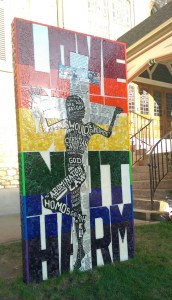
Today, though it’s easier for art to get lost in all the noise with people plugged into some media or another 24//7 and everyone and their great-grandma with their own website or blog, artists are still speaking. For this same media also gives us easy access to an unlimited stream of creative media to peruse. Below, Michael D’Antuono’s painting “Conservative Christ” critiques the marrying of Christianity with extremist far-right politics. Street artists have also done a brilliant job at visually speaking truths, placing their work right in the unavoidable path of citizen’s daily commute.

noharmI am reminded of this beautiful piece I saw at Art Prize in Grand Rapids last year, especially relevant in light of the recent supreme court decision. (And the subsequent vicious, mean-spirited attacking coming from both sides in the aftermath that made me want to delete my facebook forever.)

Throughout history, art has been used to both promote mainstream values and also oftentimes clash against them, and it has the potential to be wielded as a weapon of good or a weapon of evil, hate, and deception. You can see below how art can also be used to persuade people into harmful beliefs and mindsets. After all, at the same time as the victory garden posters were circulating, so on the other side were illustrations praising Hitler and demonizing the Jewish nationality. It can be used to justify withholding rights from a group of people, like the anti-suffragist poster (lol, chocolate). It can be used to poke fun at and disrespect people who look different than us as “less”, like the vintage soap ad (Nothing to laugh about in this next one. I felt uncomfortable even posting this particular ad, and it was not even close to the worst that can be found, unfortunately). It can be used to promote unhealthy lifestyles, and guilt people into feeling like without a certain body or certain clothes, they are ugly and worthless, like the current day Photoshopping controversies. As artists, we have to realize that what we create speaks. We have a valuable platform, and as Uncle Ben tells Peter Parker, (Ok, so Voltaire said it first but I’m a total Spiderman geek) “With great power comes great responsibility”.

Standard
Artists To Know

Artists To Know! Installment 5

I know I promised sculpture in my next Artist To Know! post; I even had all the images picked and everything! But, with another semester of Express Yourself Artshop coming to a close, it seemed like a good time to share some of the empowering art about disability and mental health I’d been archiving. I hope these images encourage, inspire, and maybe get you to think a little differently about the people you encounter in your day to day life.

“Be kind, for everyone you meet is fighting a battle you know nothing about”. – Wendy Mass

Carol Rossetti

Manu

Kelly (inspired by this beautiful video – I implore you all to give it a watch. I never cry during touching videos but this one had me tearing up).

Lorena

I have been in love with Carol Rossetti’s “Women” project since I first discovered it. Since then, her incredibly personalized drawings have gone completely viral, and I’ve been seeing them everywhere in the great, vast world of the interweb! Her pieces highlight different women’s stories of judgement, with a response of affirmation from Carol herself below. Many of the stories are about women who have been judged based on their age, physical appearance, or life choices; but I’m so glad she also decided to include women with disabilities. Clicking the link on her name and also visiting her facebook page, which shows all of the stories, is worth a look. Some of the women’s stories I found myself nodding along with thinking “Oh my god, I know exactly how she feels!”, others were as far removed as can be from experiences I’ve had or decisions I’d ever find myself making. But that’s kind of the point, isn’t it? We all have stories to tell, and judgement gets us nowhere, it just blocks our ears from reading and our eyes from seeing a new story different from our own. As well as hurting others, we miss out on reaching out and forming important connections.

Christian Hopkins

20-year-old Christian Hopkins says he was never good with words, which is why he loves communicating with pictures. He is studying biochemistry, but has had to take some health leaves due to severe clinical depression that he has dealt with for the past 4 years. This struggle is the subject of his photography. Though his work has gotten notoriety, Hopkins says photography for him is just a hobby, and a medium through which he can express himself. He has never had a single photography class or any form of instruction, which is pretty amazing when you see his intense, moving images. Using creativity as a means to come to grips with personal struggles, and explain parts of your life you find hard to talk about with others is something I wholeheartedly believe in, and one of the reasons I have such a passion for art. Creating is so much more than making pretty pictures.

Viktoria Modesta

This Latvian singer and model was born with a dislocated hip and leg. She endured terrible bullying at school because of her disability, and underwent 15 unsuccessful surgeries. She moved to London for better medical care, but still the surgeries she underwent didn’t help. Finally, weary of surgery after surgery that did nothing she convinced doctors to amputate her leg. She has never looked back. She has more confidence now after what she went through than she ever did, and is living her life doing exactly what she loves. She is the first widely known amputee pop star, and is paving the way for other talented individuals with disability to take their turn in the spotlight.

Steve Rosenfield

The tagline for Rosenfield’s powerful photography project is “Building security through insecurities”. Rosenfield himself didn’t start out in photography, but network administration. He describes how his former self of over a decade ago as “a very opinionated and materialistic person with a huge ego”. He never shared his feelings or insecurities, afraid that they would shatter his carefully constructed image, and this left a lacking in both his relationships and personal happiness. Fed up, Rosenfield began to “research” why he was so unhappy through reading and journaling, trying to get to the bottom of the lack he felt. When he found that the key was honesty, compassion and transparency, he quit his 9-5 to travel the world and start over. A friend he met in France got him into photography. In his series “What I Be”, subjects are exposing a side of themselves normally hidden from the world, and proclaiming “I am not my ____”. It isn’t about whitewashing over their struggles, but admitting that though they have these issues in their lives, the struggles do not define them. “I am not my amputation.” “I am not my cycle.” “I am not my fatness.”

I hope you’ve enjoyed another art immersion! Lastly, I’d like to leave you with some work from some super cool artists with disabilities that I know personally through Artshop, my wonderful students. We’ve had another great run :).

Adorable mixed media birds

Adorable mixed media birds

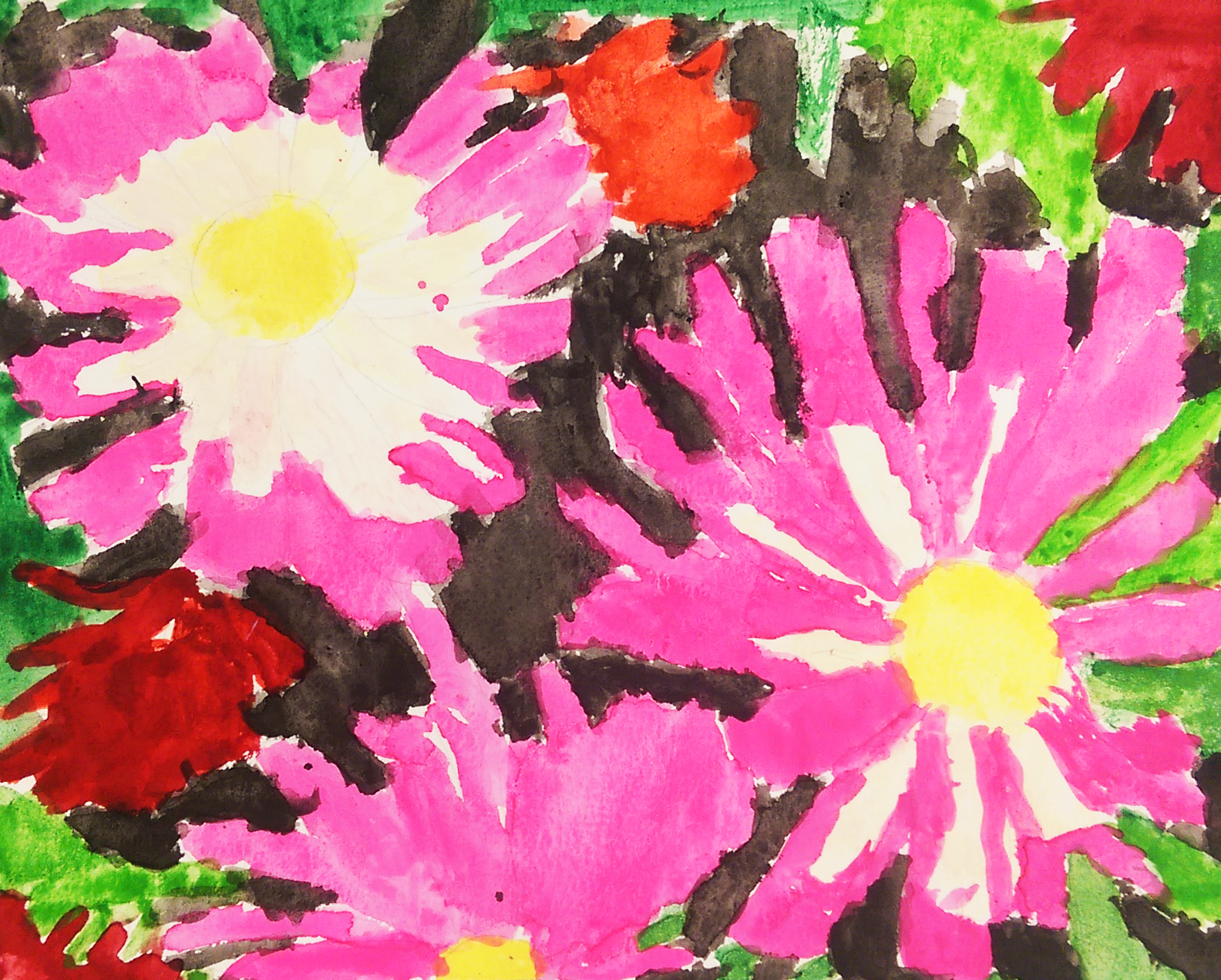
Bright watercolor flowers

Bright watercolor flowers

Cool collage mandalas

Cool collage mandalas

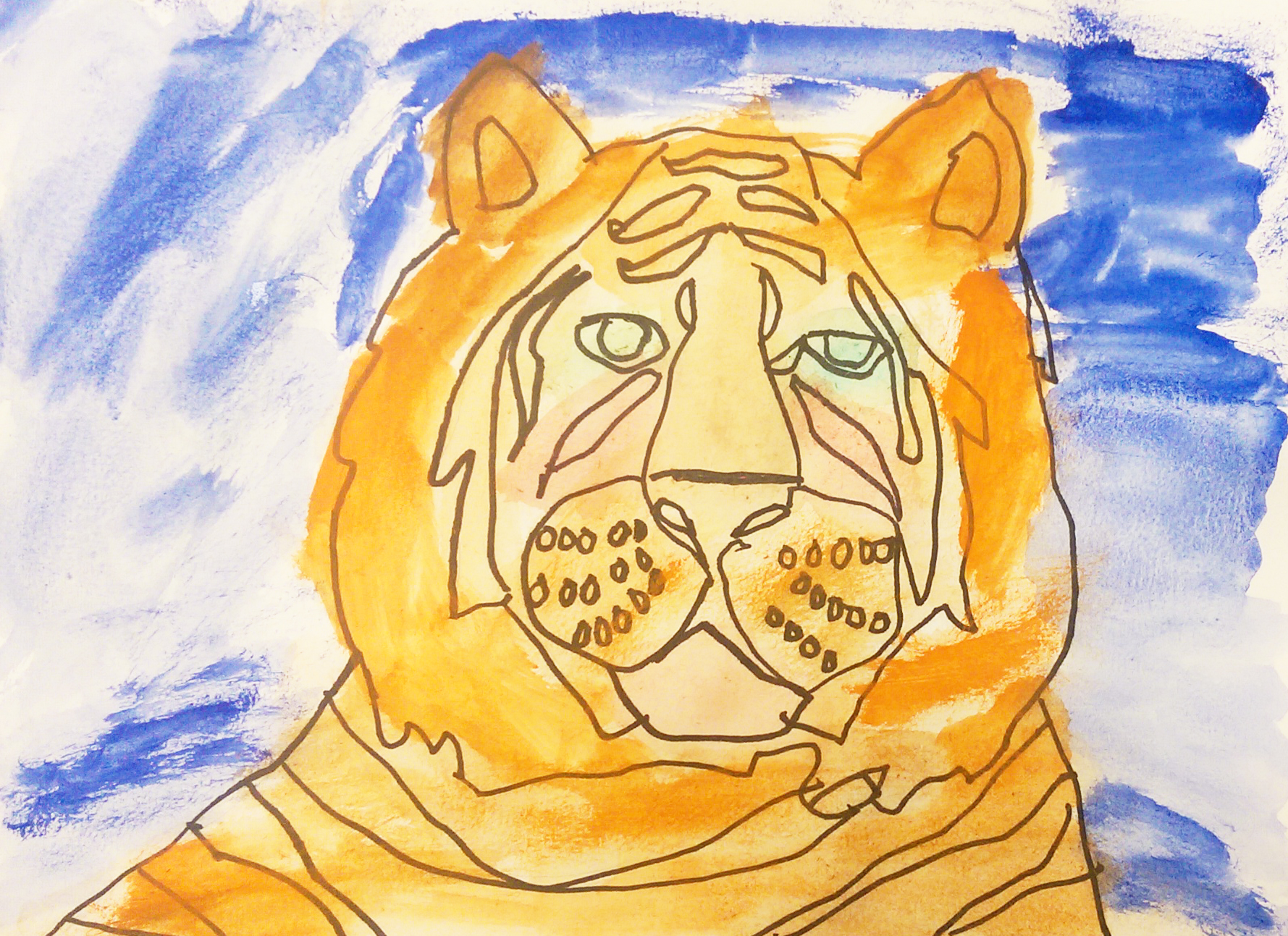
Watercolor tiger

Watercolor tiger

Naked no more! These bears have a snazzy new wardrobe thanks to the sewing class.

Naked no more! These bears have a snazzy new wardrobe thanks to the sewing class.

Standard
Artist Bio

Redefining Pride, And The Daily Battle Of Artists.

From "One Thing To Say", 2013, Colored Pencil and Ink

From “One Thing To Say”, 2013, Colored Pencil and Ink

As someone who has always been interested in perception, how it is formed, and generally what makes people tick, I sometimes have to turn the tables on myself and question why I have the knee-jerk reactions to certain things that I do. It all started when I saw a little girl wearing a t-shirt that said “I love me” across the front in gigantic, metallic gold block letters.Wow, that’s obnoxious. I would never let my non-existent imaginary future-children wear something like that, went the immediate dialogue in my head. I’d seen shirts with variations of it, “I’m awesome”, etc at the stores lately and had a similar internal reaction. But the more I thought about it, couldn’t I have used a reminder at that age that I was pretty awesome? Most definitely.

I was very shy as a kid, anxious around new people and sometimes even around familiar people depending on the day. At about a .05 on the confidence scale, I constantly worried that if I did or said the wrong thing, the whole earth would explode (or something equally horrible would happen). By upper elementary, I felt like I wasn’t even worthy to talk to others in my class who were more outgoing or had a lot of friends. I felt like most people flat out didn’t like me, and it caused a lot of unnecessary heartache because really, I can count the times a fellow classmate said something bad about me on one hand. The only time I ever felt comfortable was in art class. I finally got to feel like a star, and I wasn’t afraid to mess up, like I was certain that I would everywhere else.

Most artists rage a daily battle with confidence. In order to get others’ excited about your art, you have to project the fact that you believe in the art form you are presenting, and that you know you’ve created something amazing. You have to exude excitement to share your craft with others before you can ever expect them to care about what you’re doing. Yet at the same time, real art, good art, is an extension of the artist themselves and a reflection of how their brain works and who they are as a person. Getting excited about ourselves can be really awkward. I cringed when I first saw that in the write up for one of my new classes I had been described as “The instructor, award-winning artist Allise Noble…” Why did I feel so uncomfortable being described that way? It’s not a lie, I have won awards. Why was I so embarrassed to be publicized? I’ve mentioned the book by Amanda Palmer, “The Art of Asking”, before. It deals a lot not only with asking for help and the journey of an artist; but with the struggle to recognize, yes, have the confidence, to call yourself an artist. She writes, “When you’re an artist, nobody ever tells you or hits you with the magic wand of legitimacy. You have to hit your own head with your own handmade wand. And you feel stupid doing it.” – isn’t that the truth? You’re not an artist until you say you are, and often times our own minds are the hardest to convince. It doesn’t help that pride is even, what, one of the 7 deadly sins or something? Yikes. Thanks a lot past humans, you guys have done a really good job at making confidence seem like a flaw rather than an asset. Now, no one likes an obtuse, conceited braggart who thinks they are better than everyone else (I’m looking at you, Kanye West). That is in no way what I’m advocating here, balance is always key. However, I think that the idea of pride being something so heinous and despicable, something to avoid at all costs, pervades our culture in a myriad of negative ways. Just look at the comments on any body positivity blog or human interest article where people submit instagram photos of themselves feeling beautiful. The fact that a bunch of women have the audacity to take a photo of themselves and say “Hey, I look damn good today,” is apparently shocking enough to send multitudes of normal folks into a blind, troll-y rage.

[There is bad language in this comedy sketch so if that will cause you unhappiness, I’d suggest not clicking play. My aim is not too offend anyone, but this clip made me laugh out loud when I first watched it because it so accurately pokes fun at the philosophy I’d just been thinking about. For those who don’t watch, I’ll summarize. You know that moment when you compliment someone i.e. “You look really nice today!” and they respond with “Oh, you’re so nice, I look like I just walked out of a smelly, steaming dumpster!” Have you ever gone against this unwritten social code and when someone compliments you simply said, “Thank you. This is my favorite outfit,” and seen the complimenter now give you the dirtiest look ever? That’s the gist. For some reason, this seems to mostly happen amongst women. Ugh, women… I know I am one, but seriously!]

Human beings are really good at creating false dichotomies. After all, if I see one more film where a main character that has ambition and cares about or *gasp!* actually gains fulfillment from their job portrayed as a greedy, heartless ice-queen/king I’m going to lose it. Not that that never happens, but it shouldn’t be treated as the norm because it isn’t. You can love your family, and love your job! Similarly, we all actually have the capacity to love ourselves and still love other people! The definition of self-love isn’t self-centered, because our love is not a pie chart where we only have so much to give and if we give too great a percentage of love to ourselves, there will be less left for other people. Actually, someone who goes around saying “I wish I was somebody different, I’m a failure, I’m worthless …” is going to be the worst at reaching out to other people and forming healthy relationships. More wisdom from “The Art of Asking”; “When you’re afraid of someone’s judgment, you can’t connect with them. You’re too preoccupied with the task of impressing them.” Pride may be a dirty word, but it shouldn’t be. There is nothing wrong with saying, “Hey, I love who I am. I’m pretty darn awesome!” Whether it needs to be emblazoned across a shirt is a matter of opinion ;).

Standard
Artist Bio

6 Surefire Ways To Make Artists Cringe

Of all the many articles composed entirely of lists published online on a daily basis (Thank buzzfeed for that one.), “Things Never To Say To A _________” seem to be the most popular. As a society, we are becoming more conscious of the power of words and how they influence our perceptions of others we share this world with, and though hypersensitivity and searching for reasons to be offended can be some of the natural fallout from this kind of shift, I think all and all it is a good thing. Individuals no longer feel the need to stay silent about things that bother them to avoid a possible awkward confrontation. It’s like hey, I deserve respect just like anyone else in this world, and it’s actually ok to ask for it! Plus, raising awareness via the airing of grievances normally shoved deep inside just begging to be unleashed is fun, deny it all you want. Artists or anyone in a creative field tend to hear the same sorts of grating comments over and over again in their day to day life, and it can get mildly irritating at best, at worst totally defeating. I am a person who honestly believes most people are not jerks, and at least in my experience these comments are normally not ill-intended, but offered up as a lighthearted joke, or meant well and even supposed to be complimentary. Whether trying to compliment or get a laugh, these common comments really have opposite effect on the creative person in question who has spent a lifetime developing their specific skill. Hey, nobody’s perfect, but knowledge is power, right?

G.I. Joe, what a guy.

1. Let’s just umbrella this one: Basically any comment that questions one’s intelligence. “Cool! I wish I could go into art, then I wouldn’t have to go to college!” “Wait, but you’re smart, why did you go into art/interior design (or insert other creative field here, I’m simply speaking from my own personal experience.)?” Or my personal favorite, “Oh, that would be a great field for me, I hardly passed high school.” This should be common sense, but for those for whom it isn’t, it is seriously rude to address anyone, be it an artist or individual of any other vocation, with any variation of these comments. Some of my favorite artists are self taught, and some didn’t finish high school. Everyone learns differently but despite that fact, education and skill assessments are mainly based on rote memorization so some are destined to struggle. Income is also a factor: college is freaking expensive. There is absolutely no shame in not attending college if it doesn’t work for you. The issue has nothing to do with the level of education and everything to do with implying certain fields are easy or “blowoff work”. Most if not all creative people, through obtaining a degree or alternate means, had to work their butt off to get where they are regardless. Don’t assume. Also, comments like this are kind of a slap in the face to someone who did spend four years and insane amounts of money getting a degree. Not necessarily freelance but most other graphic design and illustration jobs require a degree, and in many states one must have a bachelor’s to officially call themselves a licensed interior designer (versus a decorator or something else).

2. Starving artist jokes. If a person really is starving, then it’s probably not something to laugh in their face about anyway, huh? Have some compassion and buy them a sandwich. If this is not the case then… what are you even talking about? The joke kind of loses its punchline. I (and many others sharing the field) am not some delusional crazypants hanging on to a pipe dream of stardom and fame. That’s why I teach, and also went to school for interior design so I could still use my creativity but open up the field a bit. Options, baby. Also, realize that working a creative job besides “world renowned painter” or “international rock sensation” is not giving up or settling. It’s not a failure. I love what I do and I honestly would get bored if all I did was work in my studio creating fine art pieces all day, every day.

3. “So you just get to play around with paint all day? What a fun job!” Yikes. This is the adult equivalent of acquaintances in college thinking I had coloring for homework. The reality, “Yay! Because I’m an interior design major art minor, all my classes get to be 3 hours each session instead of 1, and I get to stay up till the wee hours of the morning finishing studio projects no matter how well I budget my time, because workload expectations are completely insane compared to other disciplines!” Certain semesters, I pretty much never went out. This is one of those comments that I’m sure the person meant well, like “You have an awesome job!”, but after running around like a chicken with my head cut off all day keeping track of different jobs at multiple locations, diffusing student difficulties or outbursts, spending most of my spare time at home prepping for free (I’m not complaining, I love my students, I love my job, and I feel in some small way I am making world better place, but still.) in between finishing up commissions and keeping up my multiple online venues in which I hope the time I put in will actually pay off eventually, equating my job to “playtime” is the last thing I want to hear. “It’s cool you get to do what you love” is probably close to what you meant, and a much better way to communicate the sentiment.

4. “Can you do Project A/B/C for me? I’m not going to pay you but it will be great exposure!” when in reality the only exposure you will be getting is the precedent that “Hey everyone, this guy will work for free.” I’m not saying be a Scrooge, but there is a difference between helping out a friend/family member, doing volunteer or charity work, or supporting a small business or non-profit whose cause you want to help get off the ground and who really can’t afford to pay, versus someone who can pay but is just being lazy and wants something for nothing. David Thorne also has some hilarious insight on this subject via a colorful email exchange.

(Excuse the language, but I think we can all appreciate the sentiment)

5. “You’re so lucky you’re good at art.” Luck hasn’t got a thing to do with it. We are willing to acknowledge the part hard work plays towards proficiency in other fields, but with creative areas we act like the art fairy sprinkled rainbow pixie dust on certain people’s heads and now they are good at everything. Hours of study, practice, observation, classes learning from those more experienced (even in summer!); a lifetime of all of these things has gotten artists (and musicians, actors, etc.) to the level they are. As a kid, I wasn’t involved in after school clubs and activities and didn’t do much with friends. I came home and drew till bedtime; every day. It sucks to feel like your hard work goes unnoticed, and when others always use the words “luck” and “talent” as an explanation for why you’ve become successful, it negates all the sacrifices and sweat and tears and failures that went into the process to get where you are. This view is definitely a cultural thing. Here in the states, if we are bad at something, our response tends to be, “Well, I’m just not a _______ person I guess” and we move on to the next thing. In other parts of the world, especially in Asian countries, if you do poorly at something, your response is to work harder to improve; “I must not have practiced enough”. You can’t expect to be good at painting if you’ve never picked up a brush before. Why are you surprised when your work doesn’t turn out looking like a Van Gogh? You haven’t put the time in yet. This “you have it or you don’t” mentality with the arts is a psychological brick wall I run into time and time again in teaching, especially with students starting as adults. This attitude may seem harmless, but at best it’s simply not constructive, and at worst it’s self-sabotaging.

6. “So then do you do a lot of drugs?”

Standard
Artists To Know

Artists To Know! Installment 3

Today’s Artists To Know Installment is all about faces!

Natalie Foss

I discovered this artist on Behance. She is a Norwegian illustrator who works mainly in colored pencil. I wish more magazines used interesting illustrations like these; I would subscribe to all of them just to save the pictures :). I adore how focus is brought to the faces of her subjects by making their skin the only three-dimensionally rendered element of a piece, leaving the rest flat and filled in with solid color or pattern. The unusual colors she uses also catch the eye. She makes blue toned skin completely believable by placing the undertones like pinks and yellows in just the right places. The faces have a reflective quality, and make the viewer believe they can reach out and touch them. I’ve truly never seen portraits quite like these.

Natalie Foss

Malinda Prud’homme

This artist I found on twitter via my newly created account (Look at me, getting with the times. @AlliseNoble if you’d like to follow :)), and was immediately drawn to her comprehensive range of portraits styles from photo-realistic to more stylized, in a variety of mediums. There are even three-dimensional mixed media elements in some of her pieces, like gems adhered to the surface of a subject’s jewelry rather than simply painting the ornamentation. It is rare for one artist to work in so many different styles, and they all look fantastic. On her website Malinda states, “My greatest passion is portraying a variety of natural female beauty in order to express that all women; regardless of age, size, style, or ethnicity; are beautiful in their own unique way.” – right on!

Malinda Prud’homme

Arisa Nakahara

I found Arisa Nakahara on pinterest. There is way more to pinterest than just recipes and cute wedding ideas – pinterest is another fantastic place to find some truly mind-blowing, excellent art. I love how most of Arisa’s portraits are painted straight on, and look you right in the eye. It’s a bit jarring and also captivating, especially since the eyes are the most detailed part of her faces. She says her theme is “The power to live”, and I can see that thread throughout all of her colorful portraits, saturated in lush fruits and floras and insects. All of her designs transport you to that magical warmth as spring and summer are just beginning. Her entire body of work is so cohesive and timeless, and the images, quite simply, make you incredibly happy.

Arisa Nakahara

Elsa Mora

Another artist I discovered on Behance (seriously, even if you don’t create art yourself it’s worth having a profile simply to browse and favorite all the amazing projects to be found here!). Elsa works in a variety of mediums including drawing and illustration and even extending into 3D mixed media sculptures and jewelry design, but I first found her through her paper cutting work. It is truly a testament to patience which I can never even imagine attempting. She creates whimsical storybook universes and achieves an unbelievable depth all with layered paper.

Elsa Mora

Lucy McLauchlan

I discovered this artist back in late high school when I still actually subscribed to magazines, and she was featured in an issue of Juxtapoz. Lucy McLauchlan is another artist whose work you can spot as hers from a mile away. The combination of heavy black and white contrast and the balanced flow of designs made entirely of undulating lines and stylized faces is hard to look away from. I would love to walk around in this place (and maybe have my bedroom painted like this, hm?)

Lucy McLauchlan

Ruben Ireland

Another artist who favors dramatic black and white contrast, Ruben’s art is one more find from pinterest. He uses the black and white to divide elements of the body and draw out or recede features into the dark. He seamlessly weaves animal and woodland/nature imagery through his portraits as well, forming almost a psychic connection between the two. His subject’s facial expressions are ambiguous and stoic, leaving you to look to other cues to imagine what is on their mind.

Ruben Ireland

Are there any other types of artists or artwork you’d like to see? Let me know! I’m always open to suggestions!

Standard
Artists To Know

Artists To Know! Installment Two.

James Jean

James Jean is a double threat Taiwanese American artist – known equally well for both his commercial (DC Comics, ESPN, Prada, and Atlantic Records to name a few) and fine art gallery work. I know James Jean most from his arresting illustrations that grace the covers of Bill Willingham’s “Fables” graphic novel series. I am not one to ever keep up with series, but I cannot stop adding more of these books to my collection. Not only is the art obviously exquisite, but the stories are gripping, and the very reason I just cannot get into that “Once Upon A Time” TV show everyone is freaking out over – Same idea, but “Fables” is just so much better. Jean’s illustrations range from the ultra colorful to the monochromatic as featured below, but they all have a transparent, ghost-like quality to them that is just made for depicting fantasy characters, not fully “real” themselves. His website features a lot of his non-fables work, which was fascinating to see since I wasn’t as acquainted with it.

James Jean

Madge Gill

Madge Gill is not a current artist, being born in the late 1800s and passing in 1961. Though I usually highlight artists still working today, her primitive ink drawings drew me in the moment I first saw them. One of my workplaces had a couple-month-long focus on outsider art over the fall, which prompted me to want to learn more about the genre. Outsider art is literally art created by outsiders or untaught artists, art created outside the boundaries of official culture. I watched a documentary about outsider artists on youtube one evening, and Madge was one of the artists highlighted. She had a life filled with more hardship than many have to face. After delivering a stillborn child in 1920, one more painful life event, Madge claimed she had become inhabited by a spirit guide named Myrninerest. This connection continued throughout her life, and she would often go into trance like states, withdrawing more and more into herself. Though her detailed drawings of characteristic females; most of which took her only minutes at a time; continue to captivate viewers, it seems she never found peace. Near the end of her life, even her art-making had become a burden, more an obsessive-compulsion than a therapy. The biography on her website asks, “Are these in a sense self-portraits, or rather: attempts to stabilize her own fragile being, as it were through fleeting snapshots? Another reading equates the faces with Myrninerest, envisaged as the artist’s otherworldly alter ego, immune to the traumas of actual life.” (In the documentary, I noticed the alter ego’s name was pronounced as “My inner rest”, which would seem to suggest that the alter ego created as an escape or explanation for behavior she could not control is a plausible hypothesis). Her story is a sobering realization that although art helps us in coping with difficult emotions and can be a vital form of self-expression to those whose voices are stifled, creation alone is sometimes not enough, especially in isolation.

Madge Gill

Yayoi Kusama

I first saw Yayoi Kusama’s work at The Mattress Factory on a school trip to Pittsburgh (shown in the photo below). Though I wasn’t familiar with her at the time, this installation was my absolute favorite. Same as with Madge Gill, I learned about Yayoi Kusama through my outsider art documentary binge. A clip of a similar installation to the one I saw was shown in the film, and I suddenly realized “Oh my gosh, I’ve walked around inside her work before!” Also similar to Madge Gill, Yayoi Kusama has wrestled with psychological issues throughout her life, though her story has a far happier ending. Kusama began creating art with polka dot motifs as early as 10 years old, one of her first pieces a drawing of her mother with dots emanating from her portrait (Her mother was physically and emotionally abusive). She also began suffering hallucinations at an early age, seeing these dots everywhere, flowing towards her, in her own words trying to “obliterate” her. To date, many of her works include the words and themes of “self-obliteration”. In 1973, she checked herself into Seiwa Hospital for the Mentally Ill and still lives there to this day by choice, her studio nearby. Kusama has reached out, and come to enjoy the residents and staff and art continues to be a source of joy and purpose in her life. A creator of all trades (and master as well), she creates paintings, sculpture, installations, clothing and accessories, fashion editorials, films, and poetry and short stories all cloaked in her trademark surreal, ultra colorful, polka dot covered world.

Yayoi Kusama

Yayoi Kusama

Martine Johanna

Martine Johanna is a Dutch artist who started out in fashion design, but left the industry desiring more freedom to devote to her own work. The fashion influence is evident in her figure’s pose, gaze, and design. What I love most is how she sometimes leaves areas of pieces less developed to draw the viewer’s eyes to where she wants them to rest. If you look through the rest of her work as well, you will also see how she uses bold, bright colors you wouldn’t think of using for skin tones like blues and yellows to render her figures’ flesh. Bringing these natural undertones to the forefront gives her work an otherworldly quality that it is impossible to look away from, and highlights her imaginative nature.

Martine Johanna

Arabella Proffer

Google+ is a great place to discover artists as far as social media goes, and that is where I found Arabella Proffer. She was born in Ann Arbor, Michigan (woohoo, shout out to my home state, where I still reside) and now lives in Ohio (second shout out to where my parents are from and where most of my extended family still lives. I guess some cool art CAN come out of the midwest, huh?) – I thought that was pretty cool. Her work combines old school, aristocratic portraiture with pure 1980s punk rock and gothic culture. She also has an interest in medical history, remnants of which find their way into her work. The contrast of all these elements creates a tension that makes me want to get to know the fabulous women in her pieces, sit down and have a cup of coffee with them in their imaginary, velvet curtained living rooms – they all seem like so much fun.

Arabella Proffer

Standard
Project Ideas

No Canvas, No Problem! – Using Unexpected Materials

I first discovered my love of corrugated cardboard when the movie “The Science of Sleep” came out. If you haven’t watched it, it’s an extremely visually fun movie and you should check it out. If you have, the various imaginary cardboard-based sets depicting the main character’s dream worlds, such as the car chase sequence or the cardboard cityscape, attracted me to corrugated cardboard’s simple, whimsical, DIY charm. I started using it for projects in college not only for the charm itself but for utilitarian reasons. After having to buy so many canvases and large pieces of illustration board for studio assignments, by the time I got around to my own personal projects I simply didn’t want to have to buy another damn thing! It was light and easy to transport for painting outdoors on nice days, and was readily available at no cost.

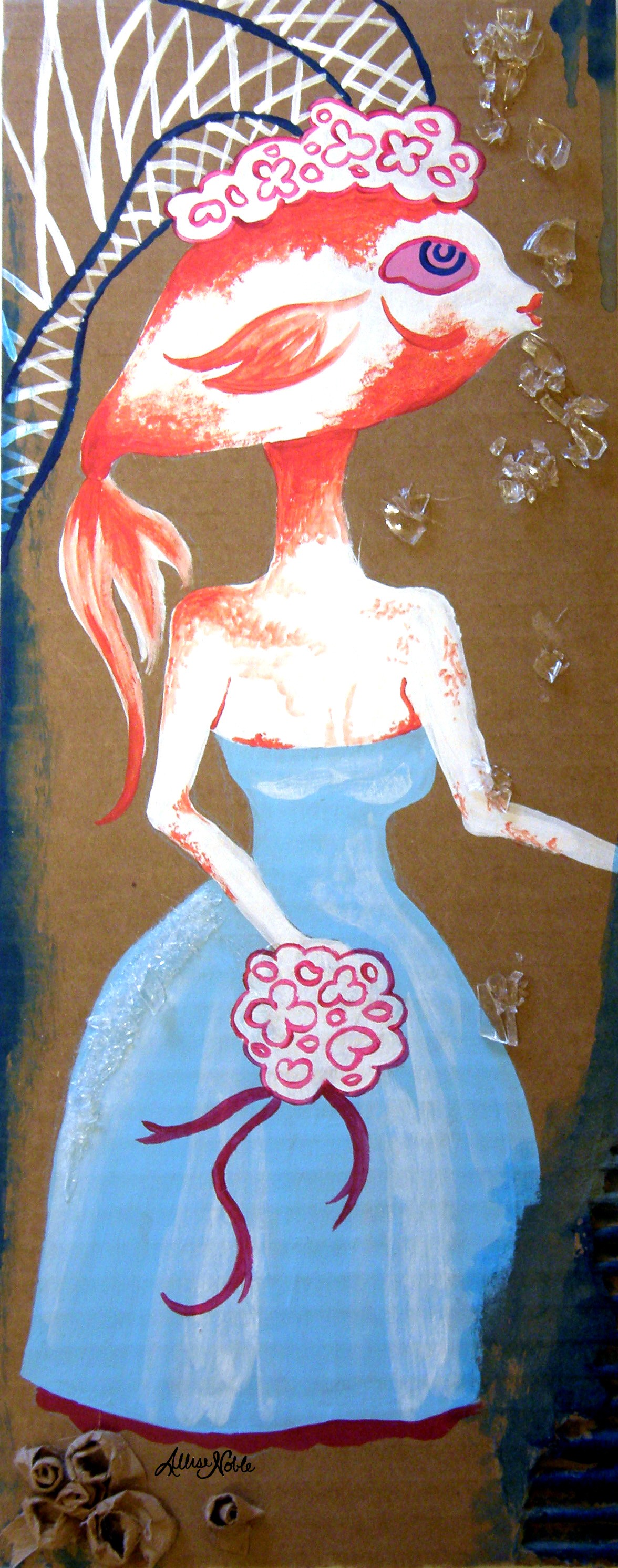
Cardboard also offers more easy textural options than canvases simply by layering or ripping away at its surface. Tearing away at the cardboard’s outer layer reveals the interesting ribbed texture beneath to be used as a design component. Layering torn edges automatically gives your piece an industrial, time weathered feel like the monochromatic cityscape below. Scraps can even be used to roll, crinkle, and fold 3D elements, such as the rosettes at the bottom of my fish bride piece. There is a story to this one; my roommates and I had 2 feeder goldfish we rescued from the tank at the grocery: Mr. Mustache and Mistress Bouffant. This is why I don’t have pets. Even the death of this tiny, normally dinner to bigger fish, goldfish caused distress, and I decided I needed to immortalize her. I used broken glass as bubbles due to the clear, reflective nature of the pieces. I still remember smashing bottles with a hammer on the front porch of our apartment. A neighbor asked what I was up to, to which my quick answer was, “Our fish just died.” I only realized in retrospect how that must have appeared, me furiously hammering away with that statement as my only explanation. No wonder they were never too chatty with us.

I’ve included some photos of my own experiments as well as some cardboard art by other artists as inspiration. The next time you get a package in the mail and have some extra cardboard laying around, I’d encourage you to give a project like these a try.

RIP Mistress Bouffant, Mr. Mustache will morn your absence. (A side note, the other goldfish really did have a black marking above his lip that looked exactly like a drawn on mustache.)

RIP Mistress Bouffant, Mr. Mustache will morn your absence. (A side note, the other goldfish really did have a black marking above his lip that looked exactly like a drawn on mustache.)

Painting on layered cardboard, using the texture of the corrugation as part of the design.

The flawless, traditional black and white portrait contrasts with a work surface left rough; with dents, tears, and even leftover paint smeared here and there as if the artist was cleaning off their brush.

Valery Koshlyakov – High-rise on Raushskaya Embankment (2006) – Tempera on Cardboard

Retro Barbies, acrylic on cardboard

My retro Barbies, acrylic on cardboard

Standard