Project Ideas

Creating Mixed Media Work Inspired By Photography

I love mixed media work that layers and collages varying elements into one piece, but still creates a cohesive universe, a dreamworld with the same depth and breadth as the natural world around us. I’ve found the best way to create mixed media work that maintains perspective and three-dimensionality is to base your piece off of photos you’ve taken. I usually build a concept first, then find photos that support the design I’ve constructed in my head. Those that don’t know where to start can begin with a photo that has meaning to them, one they find inspiring, or one that just plain looks pretty and build from there. I’m going to take you through my process for creating mixed media pieces inspired by photography, but each person may approach their own process a little differently once they get started.

The Dance, Awarded Best 2D; prismacolor pencil, ink, watercolor, fabric, book pages, embroidery thread

The Dance, Awarded Best 2D “Piece By Piece” at Creative 360 Gallery; prismacolor pencil, ink, watercolor, fabric, book pages, embroidery thread

Quite literally, frolicking in the woods. I knew these poses wood come in handy for something one day ...

Quite literally, frolicking in the woods. I knew these poses would come in handy for something one day …

An outtake from playtime :)

An outtake from playtime 🙂

Once you have your concept and your photo(s), the first thing you want to do is break your image down into components, and decide what material will be used for which component. A sketchbook comes in real handy for jotting down notes during this part of the *adventure*.

For “The Dance”, I first thought of what needed texture, and what didn’t. The ground covered in fallen leaves was certainly full of visual texture, as was the bark on the trees. The figures and the path could be left flat – you don’t want to overdo the texture or a piece can get confusing. Framed by the raised texture, this would also help the figures stand out as the focus. Only a handful of the trees in the woods were actually birch, but I knew I wanted a lot of light colors so the girl’s gowns would be in stark contrast to the background, similar to in the black and white photograph. Therefore, I decided to make all the trees in my mixed media birch bark. FYI, book pages are fantastic as birch bark. The color is already spot on, and the all over text compliments the black circles and rings that tattoo its surface. I twisted the paper into thin tendrils for the roots and branches to bring the trees off the page. As for the ground, I used torn muslin fabric. The white color allowed me to use the fabric similar to plain paper once applied, and layer watercolor paint over it until it reached the desired color. Torn fabric is great for ground cover because it frays, creating a believable texture all on its own. I knew I wanted the dresses to be done in ink because ink appears lighter in weight and airier, and would communicate the translucent flow of the skirt. Colored pencil works well for tiny, precise detail and I also am far better at drawing the human body than painting it, which is why I used pencil for the head and hands. Ink was used for the path as well, because once again I wanted a “light” feel to the path to help it stand out and so I could better capture the strong light source hitting it from the sun. The ink also transitions well into watercolor. Transitions are still important even in more “assemblage” type projects. When creating mixed media scenes, though you are in essence collaging, you don’t want to completely have that seamed together, cut and paste look.

The choices I made for “The Dance” were based on two things; first, what look do I want to achieve but also second, what is practical based on my strengths and weaknesses with the various materials? This second deciding factor will be different for each artist. I have learned from teaching that many, many other artists do not enjoy drawing people as much as I do, and quite a few even flat out despise it. If this is you, for a piece with people in it you may choose to have the figures printed and cut them out, pasting them into the scene rather than drawing them. A way to work photography into the piece so it doesn’t look separate from the rest of the environment would be to perhaps print them in black and white or sepia and then “colorize” the photos by lightly shading over the eyes, hair, cheeks, etc. with a colored pencil. You can also add three dimensional elements over the photo such as some fabric leaves blowing across the body, a small paper flower on the person’s jacket or in their hair, or gluing actual fabric over their clothing. This “anchors” the photo of the person/people within the environment to become part of the entire piece rather than a separate cutout element.

"Actually, It Is This World That's Too Small", Mixed Media

“Actually, It Is This World That’s Too Small”, Mixed Media
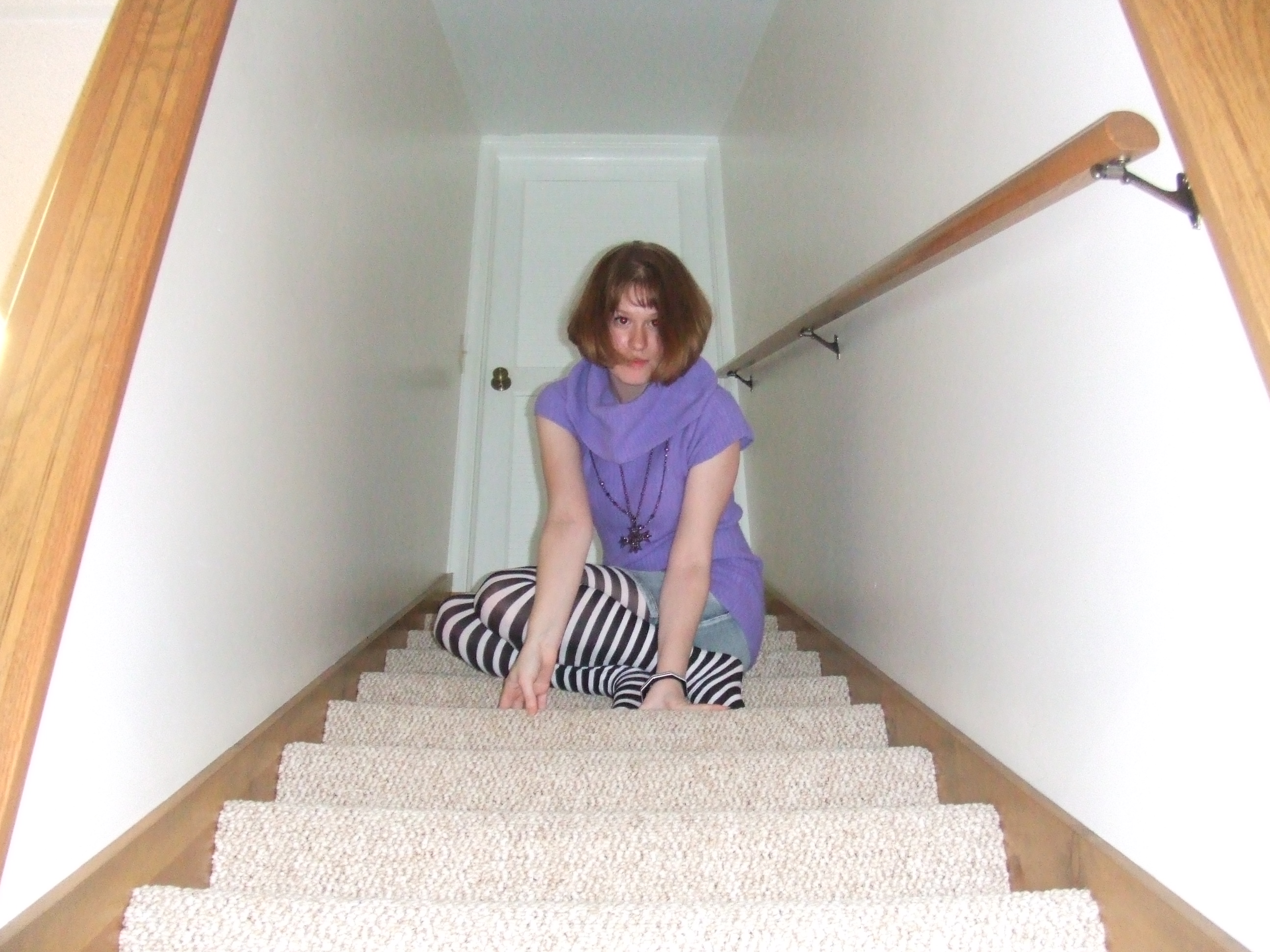
My 10 year reunion is coming up next year, and the clothes I used to wear are officially beginning to look silly. Short sleeved turtleneck sweaters for the win! And always striped tights, because The Dresden Dolls (would still rock those!)

My 10 year reunion is coming up next year, and the clothes I used to wear in high school are officially beginning to look silly. Cap sleeved turtleneck sweaters and pre-worn jean skirts for the win! And always striped tights, because Amy Brown fairies and The Dresden Dolls (I would still rock those!)

“Actually, It Is This World That’s Too Small” is a mixed media piece I based on a photo a friend took in high school while we were hanging out, playing around with cameras in my basement. I never felt that I shared much in common with “typical” teenage girls, but a desire to constantly take photos of each other was one stereotypical trait my friends and I all did share – just sometimes my photos involved face painting or cardboard masks rather than manicures and false eyelashes. I found it interesting how the angle of the photograph made it look like the door behind me was miniature, like the door the white rabbit escapes through in Alice In Wonderland. You can see how the photo serves as a guide and an inspiration, but by no means dictates what your final piece has to look like. Creative alterations are always an option, and encouraged.
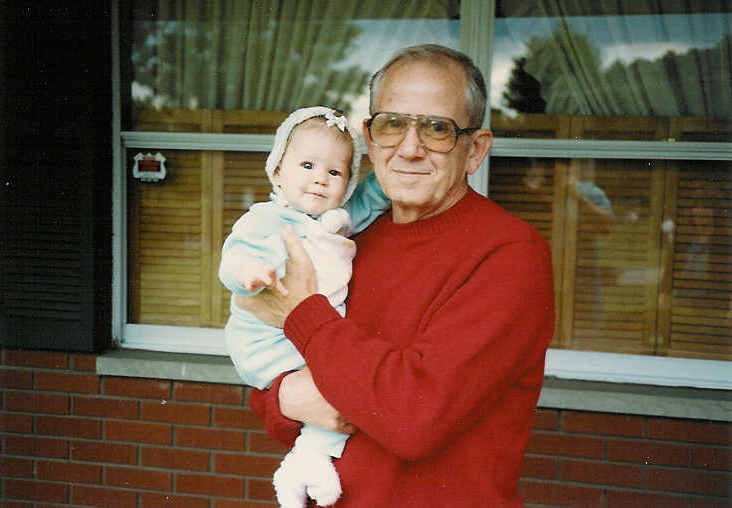
Old family photo with Grandpa (I can't believe I'm posting this, but for the sake of art ... I will publicly expose baby photos - at least the non-embarassing ones).

Old family photo with Grandpa (I can’t believe I’m posting this, but for the sake of art … I will publicly expose baby photos to the online universe – at least the non-embarassing ones).

What’s really awesome is that beyond conceptual art, you can apply this same technique to family photos, and make a truly meaningful piece of work that is entirely personal. I’m going to talk you through how I would approach this photograph above if I were going to turn it into a mixed media piece. This will give you another example that will hopefully help you solidify how to proceed on a project of your own. I would probably draw the people since I adore portraits and figures, but once again if figures are not your thing, you could print yours from an enlarged photo and collage them in – it’s totally allowed :). There is really no reason to just color in a solid red shirt, so I would probably trace a pattern to get the right shape, and then cut the sweater out of fabric and paste it over my grandpa like I did with the purple dress in the staircase piece shown previously. Remember, always look for places to add interest with different materials. Due to the light, reflective nature of the window glass, I would use a mix of ink and watercolor for that part. The bricks are definitely the most textural element in this particular photo, so for those I would mix a gritty element like sand into acrylic paint, and create a rough, uneven texture in dark red on the wall. Once dry, I would then paint the grey cement lines over with a thin brush. For the sake of my sanity and also to make it more interesting and less institutional looking, I would probably change the brick to an uneven pattern of varying size and shape as opposed to the uniformity that was there in real life. How else can we add interest? In the photo, there are no flower boxes on the windowsill, but why can’t there be? You can cut flowers out of paper or white fabric and color them with ink or watercolor, or you can glue on small ribbon rosettes available in the floral or wedding aisle of most craft stores.

I hope this post has given you some ideas, and I’d like to end with a simple (though not set in stone) guide as to when certain materials are most beneficial when creating your own mixed media wonderland.

Watercolor: overall background coverage, light or translucent forms, florals, glass, water

Ink: flowers and plants, light or translucent forms, fabric, glass, water, figures/faces/skin/hair

Colored Pencil: small details, figures/faces/skin/hair, birds or furry animals, stone or bark

Fabric: clothing, flowers and plants, ground cover (soil, grass, leaves, etc), interior wallpaper

Book Pages: trees and bark, interior wallpaper, flowers

Sand Mixed With Paint: brick, stone, dirt

Other Accoutrements: embroidery thread sewn through the paper as anything composed of thin lines: tree branches, eyelashes, veins, flower stems …; small ribbon flowers, tiny prints on photo paper as interior wall art, strung seed beads or glued on flatback rhinestones as jewelry, use your imagination and don’t be afraid to try something new!

Feel free to comment or message if you need any advice on a project you’re working on or a new one you are beginning. I’m happy to help!
Standard
Project Ideas

Creating Beautiful Decoupaged Beads and Pendants

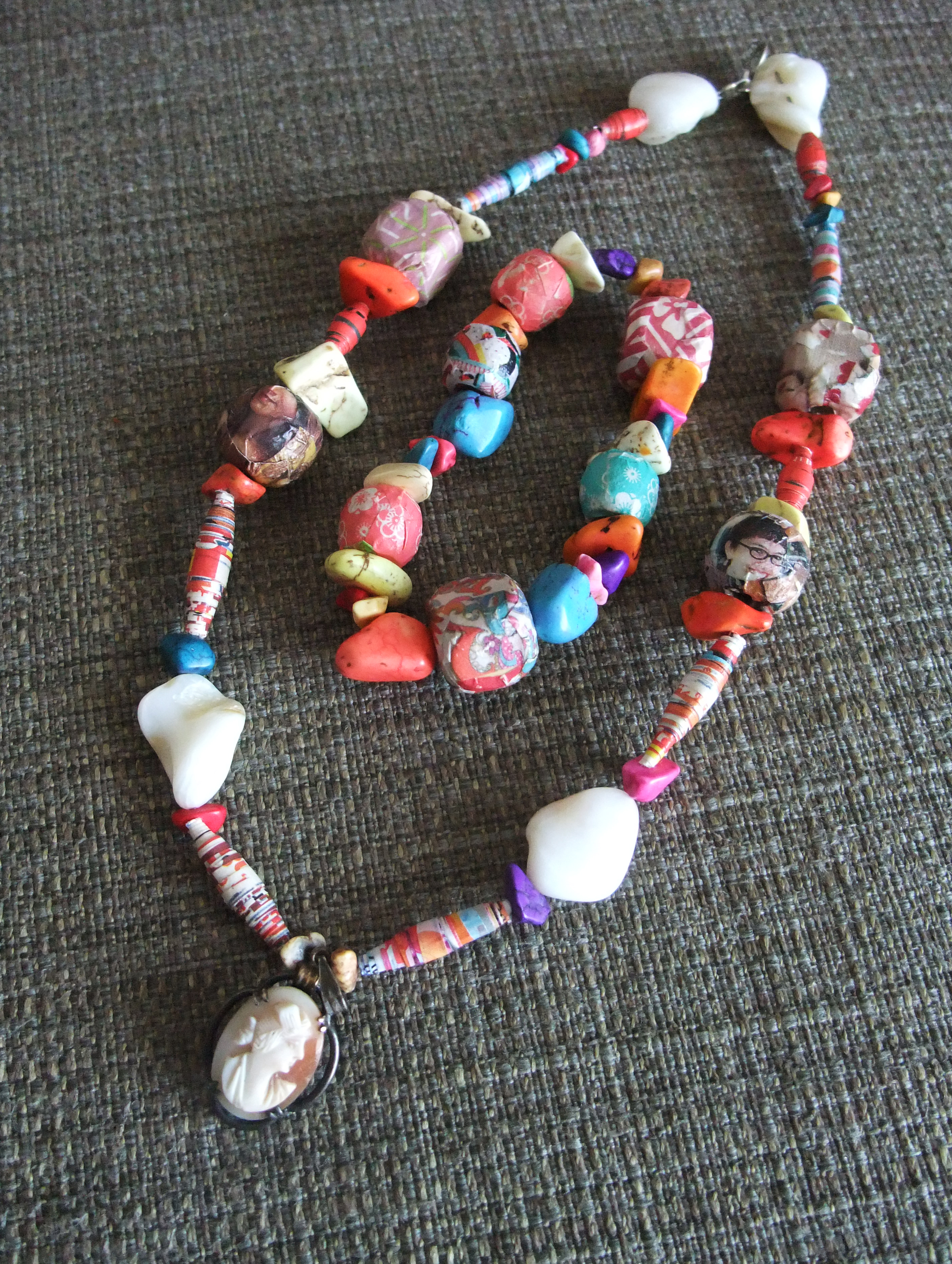
Necklace and bracelet made with decoupaged origami paper beads - These would look amazing in a monochromatic color scheme, too, but I made this set specifically for myself and I love colors so...

Necklace and bracelet made with decoupaged origami paper beads – These would look amazing in a monochromatic color scheme, too, but I made this set specifically for myself, and I love colors so… 🙂

This is a simple undertaking with beautiful results. I’ve done this wearable art project with my Artshop students and they loved it (For those new to the blog, I work with an art program for adults with special needs, and my students are the coolest).

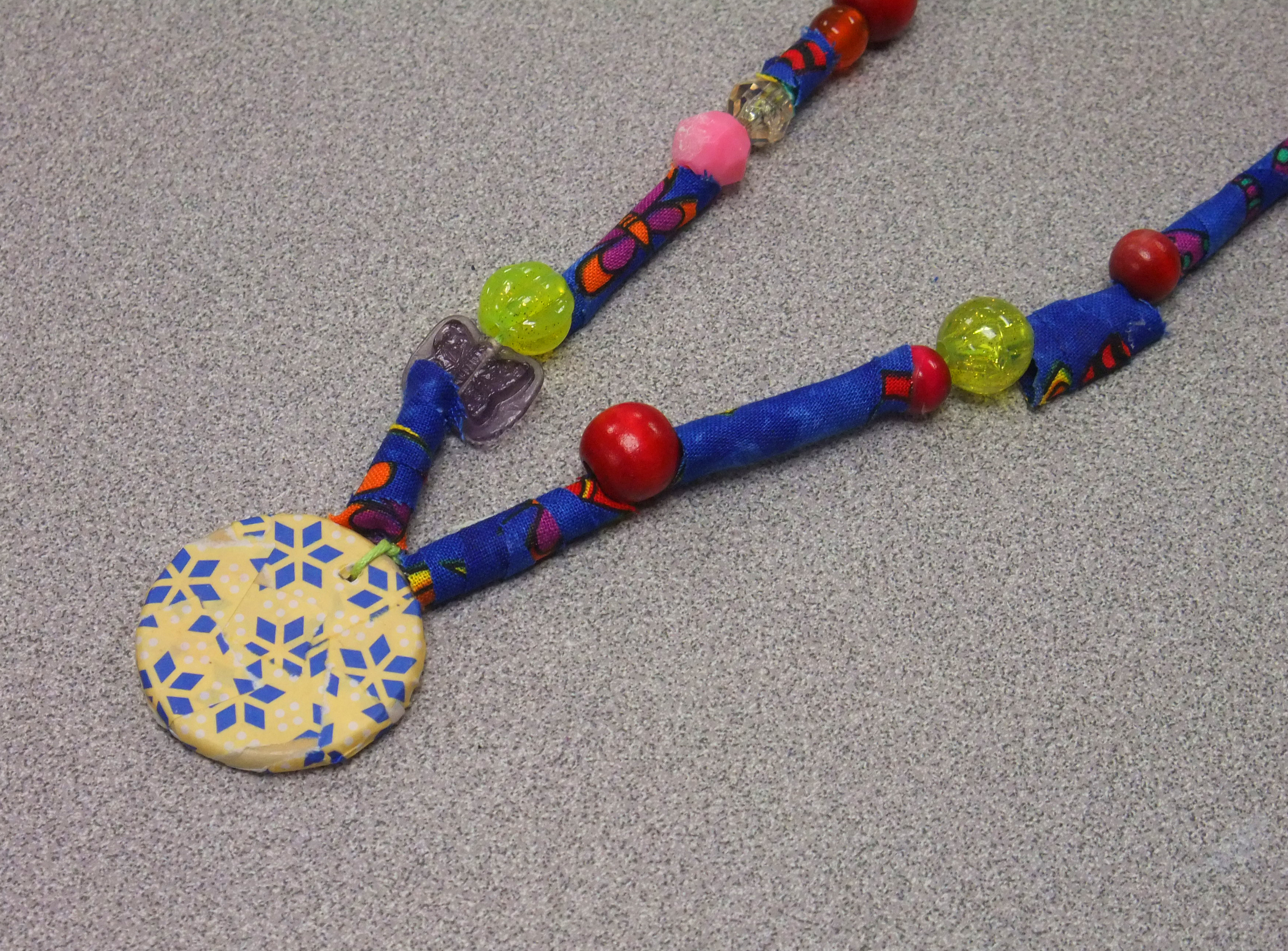
A student's decoupaged pendant necklace (accented by fabric beads she rolled herself, too!) We share a love of all things rainbow.

A student’s decoupaged pendant necklace (accented by fabric beads she rolled herself, too!) We share a love of all things rainbow.

Any jewelry created with these handmade beads and pendants has an artsy, unique look that draws constant oohs, ahhs, and inquiries. What’s also great is you can completely customize the style based solely upon the paper you choose. You can use magazine pages (see faces on my cameo necklace) but for most beads I prefer using lightweight origami paper. This thinner paper bends and forms to the shape of the bead much easier, and once the sealer dries the wrinkles lay much flatter. Besides the paper, you will also need wooden beads (These can be bought in almost any craft section or hobby store in a bulk mixed container), mod podge for paper or any other decoupage sealer in any sheen, a large-ish cheap paint brush, wooden discs in the desired size (found amongst the other unfinished wood pieces like plaques, boxes, letters, etc. in most craft or hobby stores), and a small crafting drill (or any drill that offers smaller bit sizes) to drill a hole in your pendant. If you don’t own a drill or just don’t want to bother, you can buy pendant backs to glue on at the end. I don’t live in an area with a large array of art and jewelry supply stores, so I ordered mine online – they’re cheap.

An overview of materials needed

An overview of materials needed

The process is the same for both the pendants and beads. Once you choose your paper or combination of different papers (mixing and matching can look cool for the pendants, but the beads are so small I recommend sticking to one design only.), tear them into pieces between 1 and 3 cm in size. You can paint the sealer on the back of the paper at this point, or just dip the paper in the goo and then smooth it onto the surface of the bead/pendant with your fingers to make sure all wrinkles are flattened down, and there are no air bubbles. The more soaked the paper is, the more malleable it will become, allowing you to form it flat to the surface. Your fingers WILL get messy. It’s ok, just roll with it. A bowl of water nearby to rinse off every so often will stop them from getting too sticky as you work. With both the beads and pendants, don’t worry about the hole. Once the entire surface is covered with paper you can use a toothpick to poke the hole back through before it dries. Set the beads and pendants on wax paper to dry so they won’t stick. Once they are dry, coat them 1-2 more times with mod podge using the paint brush. Once again, mod podge or any thick sealer is really hard on brushes so I recommend a cheap brush. Voila! Making these beads can be surprisingly therapeutic after a long day. Turn on the television or your favorite music and get cracking!

Look! She even has a hair bow. What could be better?

Look! She even has a hair bow. What could be better?

Part 2 : Since I enjoy sharing other creators I am in love with, I wanted to show another option of what to do with those blank, unimposing little wooden discs. This artist I discovered on etsy turns these wooden circles into a unique cast of adorable characters with a little acrylic paint, gloss sealer, and mad detailing skills. Her shop even has some recognizable femmes like Katniss and Cinderella, but I like her original characters best myself.

I hope some of you try this out when you have a day off. Who knows, you may even come up with some of your own unique tricks for turning these wooden blank canvases into awesome wearable art!

Standard
Project Ideas

No Canvas, No Problem! – Using Unexpected Materials

I first discovered my love of corrugated cardboard when the movie “The Science of Sleep” came out. If you haven’t watched it, it’s an extremely visually fun movie and you should check it out. If you have, the various imaginary cardboard-based sets depicting the main character’s dream worlds, such as the car chase sequence or the cardboard cityscape, attracted me to corrugated cardboard’s simple, whimsical, DIY charm. I started using it for projects in college not only for the charm itself but for utilitarian reasons. After having to buy so many canvases and large pieces of illustration board for studio assignments, by the time I got around to my own personal projects I simply didn’t want to have to buy another damn thing! It was light and easy to transport for painting outdoors on nice days, and was readily available at no cost.

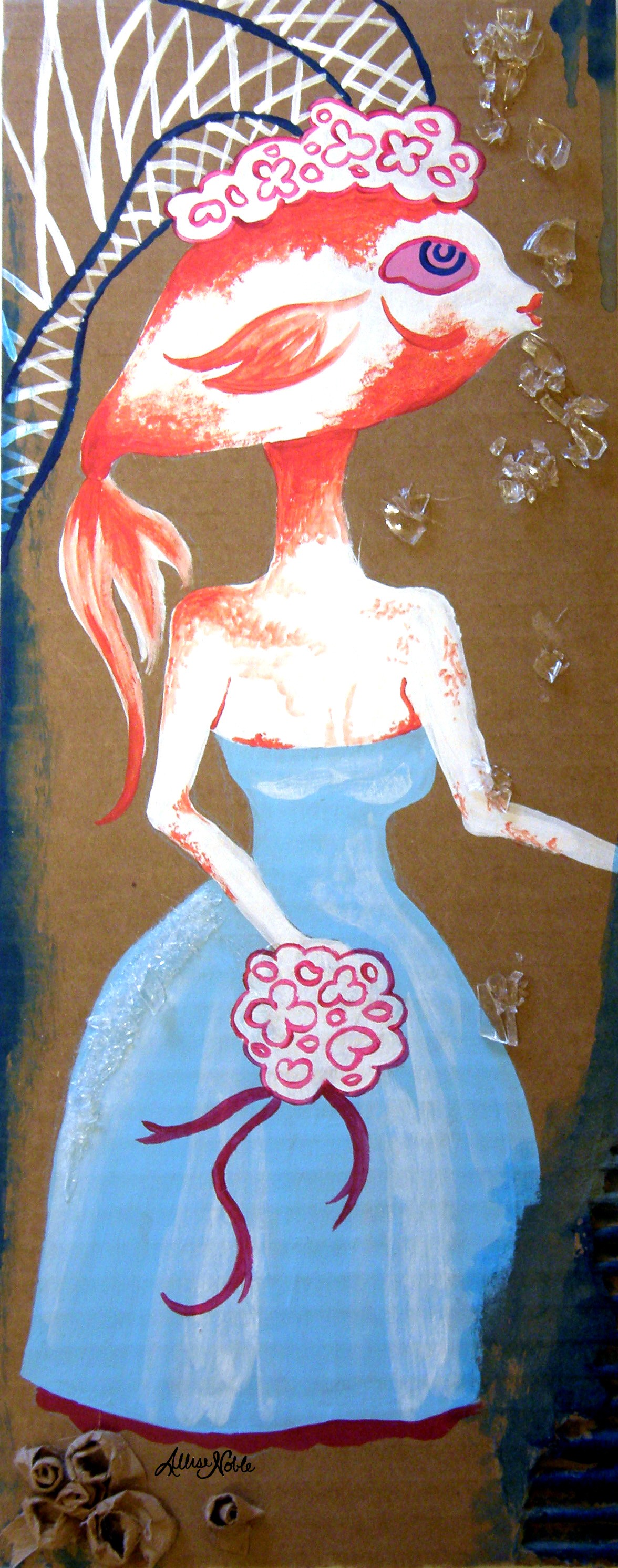
Cardboard also offers more easy textural options than canvases simply by layering or ripping away at its surface. Tearing away at the cardboard’s outer layer reveals the interesting ribbed texture beneath to be used as a design component. Layering torn edges automatically gives your piece an industrial, time weathered feel like the monochromatic cityscape below. Scraps can even be used to roll, crinkle, and fold 3D elements, such as the rosettes at the bottom of my fish bride piece. There is a story to this one; my roommates and I had 2 feeder goldfish we rescued from the tank at the grocery: Mr. Mustache and Mistress Bouffant. This is why I don’t have pets. Even the death of this tiny, normally dinner to bigger fish, goldfish caused distress, and I decided I needed to immortalize her. I used broken glass as bubbles due to the clear, reflective nature of the pieces. I still remember smashing bottles with a hammer on the front porch of our apartment. A neighbor asked what I was up to, to which my quick answer was, “Our fish just died.” I only realized in retrospect how that must have appeared, me furiously hammering away with that statement as my only explanation. No wonder they were never too chatty with us.

I’ve included some photos of my own experiments as well as some cardboard art by other artists as inspiration. The next time you get a package in the mail and have some extra cardboard laying around, I’d encourage you to give a project like these a try.

RIP Mistress Bouffant, Mr. Mustache will morn your absence. (A side note, the other goldfish really did have a black marking above his lip that looked exactly like a drawn on mustache.)

RIP Mistress Bouffant, Mr. Mustache will morn your absence. (A side note, the other goldfish really did have a black marking above his lip that looked exactly like a drawn on mustache.)

Painting on layered cardboard, using the texture of the corrugation as part of the design.

The flawless, traditional black and white portrait contrasts with a work surface left rough; with dents, tears, and even leftover paint smeared here and there as if the artist was cleaning off their brush.

Valery Koshlyakov – High-rise on Raushskaya Embankment (2006) – Tempera on Cardboard

Retro Barbies, acrylic on cardboard

My retro Barbies, acrylic on cardboard

Standard
Project Ideas

Textured Painting With Mixed Media (Or, The Upside of Hoarding)

Express Yourself Artshop, the art program I work with focusing on providing art instruction for adults with disabilities, runs mostly on donations. Because of this, I’ve gotten used to brainstorming how to transform materials not commonly used in art into something awesome. Though I appreciate sculpture, my passion definitely lies in creating 2D art. However, 2D doesn’t always have to mean “flat” – and that’s where mixed media comes in. Mixed media literally means “the combined use of 2 or more media”. Many times, it involves assembling multiple non-flat elements to a drawing or painting, working them into the overall composition. Knowing how to add all these extra elements in an effective manner, as well as recognizing when to stop so that the piece doesn’t become a massive junk pile, can be intimidating on the first go. An easy way for an artist who has never worked in mixed media before to dip their toe into the genre is by simply creating texture on their work surface, and then drawing or painting over it as they would were they using a flat canvas. The effect is something far more extraordinary that draws the viewer to come closer and really examine the finished piece, touch it even (if you allow it).

The main component you will need is a bottle of gesso; a white, thick, paste-like paint that can also be used to cover over used canvases. It can be pricey, but lasts a long time. This is the only thing you will need to purchase. Everything else used to create texture can be common household materials. Paper towel, especially if it has a pattern imprinted on it (you can use that!), is great as well as tissue paper. Are you an avocado or citrus fruit enthusiast? You know those net bags they come in at the grocery? Those are simply fantastic. Once you have your materials, lay them out on your canvas and pile on the gesso. It will act as a glue, but takes awhile to dry so don’t hesitate to manipulate, move, crinkle, your materials as you are covering them. After a few coats, you will have a paintable surface. For the octopus painting shown below, I used liquid watercolor. Watercolor is great because it will show darker on the textured areas and lighter on the flat areas, accentuating the visual texture. This next piece I’m trying with the black background I’m doing in acrylic this time. Play around, make some samples on cardboard until you find something you like (old cereal boxes work great to experiment on), and keep on the lookout for interesting textures in your everyday environment – they could come in handy for your next masterpiece!

New textured work, in progress.

New textured work, in progress.

Closeup, texture achieved using a net fruit bag and wrinkled tissue paper.

Closeup, texture achieved using a net fruit bag and wrinkled tissue paper.

Gilded Creatures, 16x20 mixed media - Behold, the wonders of gesso!

Gilded Creatures, 16×20 mixed media, and one of my more popular pieces – Behold, the wonders of gesso!

Standard