Artists To Know

Artists To Know! Installment Four

I really don’t give photography or sculpture enough love. I tend to have my eye caught most by drawings, paintings, and mixed media because it’s what I do and I understand the process, but there is so much more thrilling art out there in every medium. So, for these next couple “Artist To Know” installments I am going to focus on art forms besides the aforementioned. Today is photography’s day to shine. Though there is also a lot of stunning landscape and animal photography out there (I mean come on, nature is amazing!), I chose to feature a type of photography less often explored, utilizing props, costumes, and often times incredibly extensive handmade sets to create a new and different world that the photographer envisions. These photographs tell a story beyond the appreciation of beauty. These are not about capturing the perfect moment, but creating the perfect moment to capture.

Tim Walker

British fashion photographer Tim Walker shot his first fashion story for Vogue at the young age of 25, and has continued shooting for British, American, and Italian Vogue ever since. He has also created stories for W magazine and LOVE magazine. I love the entrancing worlds he creates ranging from the soft and ethereal to the colorful and kooky. As a kid, I always wished there existed a magic television that could record people’s dreams while they slept, so I could watch others’ dreams (curious and nosy kid, for sure ;)). I imagine Walker’s photos are what the recordings would have looked like. He invites you into his dreams. You really have to visit his website and see his series of surreal photographs featuring well-known actors and actresses that he did for W – they are of the colorful and kooky variety, and some of my favorites. Amy Adams, Julianne Moore, Bill Hader, Keira Knightley, and Eddie Redmayne? Yes please.

Alex Stoddard

Alex Stoddard’s first exploration with photography was a series of self portraits he began taking at 16. I find people that are able to simultaneously compose amazing shots and also act as model in them and convey the correct body position and emotion on their face mind blowing as it is. It is clear that each of Stoddard’s photographs tell a story, and the viewer is dragged straight into it, no longer just a passerby gazing at a scene or figure but an active participant in whatever is going on.

Lindsey Adler

Lindsey Adler is a professional portrait and fashion photographer, known for her bold, graphic compositions. What is also cool about her is she loves sharing her passion with others, and lectures tens of thousands of photographers each year worldwide. Not every artist is willing to share their secrets, or wishes to take the time out of creating work to teach others, and I find that very admirable and inspiring. What I was most drawn to  about her work is her super-close-up face shots that turn her model’s face into a work of art. There is obvious careful attention to color, space, and line, even when working with the natural hues and contours of a face rather than adding fantastical artistic details like below.

Kirsty Mitchell

Winner of Lens Culture’s Visual Storytelling Grand Prize in 2014, Kirsty Mitchell worked as a successful senior fashion designer for an international label until personal illness brought on unexpected life changes. It is then that she connected with the camera, and she states that it changed her life forever. Her series “Wonderland”; my personal favorite and the series from which the image below is a part; was inspired by her mother, who sadly passed in 2008. The sets, costumes, and props are hand-created and filled with exquisite details, which is what captivated me in the first place. Mitchell says she found herself creating pieces that echoed her mother’s stories, and the need to create the worlds of her dreams and make them tangible grew. The greater meaning behind these images is evident in the awe-inspiring end results of the project.

Michael Belk

Michael Belk is an accomplished fashion photographer whose work has appeared regularly in Elle, Vogue, and many other publications. He always said of his work “There is no hidden meaning in my photography, no agenda beyond the image itself. I am attracted to beauty …” Then suddenly, his focus shifted away from the model of “art for art’s sake” and he began spending all of his time composing modern day biblical scenes. In an interview with The Christian Post, Belk says of the inspiration for his new passion, “I was in New York prepping for a photo shoot a week after 9/11 and saw many people searching for something.” It was out of this realization that in the midst of chaos people were fearful and didn’t know where to turn, in conjunction with Belk’s own experience of faith in what he calls one of his “darkest hours”, that “Journeys With The Messiah” was born. Belk places the stories of Jesus in a modern day context to communicate timeless biblical themes in a way that is sharply relevant to today’s culture and issues. The strong light source and worn, sepia filter over all the images in this series communicate a strong feeling of sincerity, and seamlessly merge imagination and creativity with history. “Journeys With The Messiah” is beauty, with a purpose.

I hope you’ve enjoyed this week’s photography! Next time, it’s sculpture. Have any favorite photographers I didn’t mention in this group? Give me a shout! I love learning about new artists myself.

Standard
Project Ideas

Creating Mixed Media Work Inspired By Photography

I love mixed media work that layers and collages varying elements into one piece, but still creates a cohesive universe, a dreamworld with the same depth and breadth as the natural world around us. I’ve found the best way to create mixed media work that maintains perspective and three-dimensionality is to base your piece off of photos you’ve taken. I usually build a concept first, then find photos that support the design I’ve constructed in my head. Those that don’t know where to start can begin with a photo that has meaning to them, one they find inspiring, or one that just plain looks pretty and build from there. I’m going to take you through my process for creating mixed media pieces inspired by photography, but each person may approach their own process a little differently once they get started.

The Dance, Awarded Best 2D; prismacolor pencil, ink, watercolor, fabric, book pages, embroidery thread

The Dance, Awarded Best 2D “Piece By Piece” at Creative 360 Gallery; prismacolor pencil, ink, watercolor, fabric, book pages, embroidery thread

Quite literally, frolicking in the woods. I knew these poses wood come in handy for something one day ...

Quite literally, frolicking in the woods. I knew these poses would come in handy for something one day …

An outtake from playtime :)

An outtake from playtime 🙂

Once you have your concept and your photo(s), the first thing you want to do is break your image down into components, and decide what material will be used for which component. A sketchbook comes in real handy for jotting down notes during this part of the *adventure*.

For “The Dance”, I first thought of what needed texture, and what didn’t. The ground covered in fallen leaves was certainly full of visual texture, as was the bark on the trees. The figures and the path could be left flat – you don’t want to overdo the texture or a piece can get confusing. Framed by the raised texture, this would also help the figures stand out as the focus. Only a handful of the trees in the woods were actually birch, but I knew I wanted a lot of light colors so the girl’s gowns would be in stark contrast to the background, similar to in the black and white photograph. Therefore, I decided to make all the trees in my mixed media birch bark. FYI, book pages are fantastic as birch bark. The color is already spot on, and the all over text compliments the black circles and rings that tattoo its surface. I twisted the paper into thin tendrils for the roots and branches to bring the trees off the page. As for the ground, I used torn muslin fabric. The white color allowed me to use the fabric similar to plain paper once applied, and layer watercolor paint over it until it reached the desired color. Torn fabric is great for ground cover because it frays, creating a believable texture all on its own. I knew I wanted the dresses to be done in ink because ink appears lighter in weight and airier, and would communicate the translucent flow of the skirt. Colored pencil works well for tiny, precise detail and I also am far better at drawing the human body than painting it, which is why I used pencil for the head and hands. Ink was used for the path as well, because once again I wanted a “light” feel to the path to help it stand out and so I could better capture the strong light source hitting it from the sun. The ink also transitions well into watercolor. Transitions are still important even in more “assemblage” type projects. When creating mixed media scenes, though you are in essence collaging, you don’t want to completely have that seamed together, cut and paste look.

The choices I made for “The Dance” were based on two things; first, what look do I want to achieve but also second, what is practical based on my strengths and weaknesses with the various materials? This second deciding factor will be different for each artist. I have learned from teaching that many, many other artists do not enjoy drawing people as much as I do, and quite a few even flat out despise it. If this is you, for a piece with people in it you may choose to have the figures printed and cut them out, pasting them into the scene rather than drawing them. A way to work photography into the piece so it doesn’t look separate from the rest of the environment would be to perhaps print them in black and white or sepia and then “colorize” the photos by lightly shading over the eyes, hair, cheeks, etc. with a colored pencil. You can also add three dimensional elements over the photo such as some fabric leaves blowing across the body, a small paper flower on the person’s jacket or in their hair, or gluing actual fabric over their clothing. This “anchors” the photo of the person/people within the environment to become part of the entire piece rather than a separate cutout element.

"Actually, It Is This World That's Too Small", Mixed Media

“Actually, It Is This World That’s Too Small”, Mixed Media

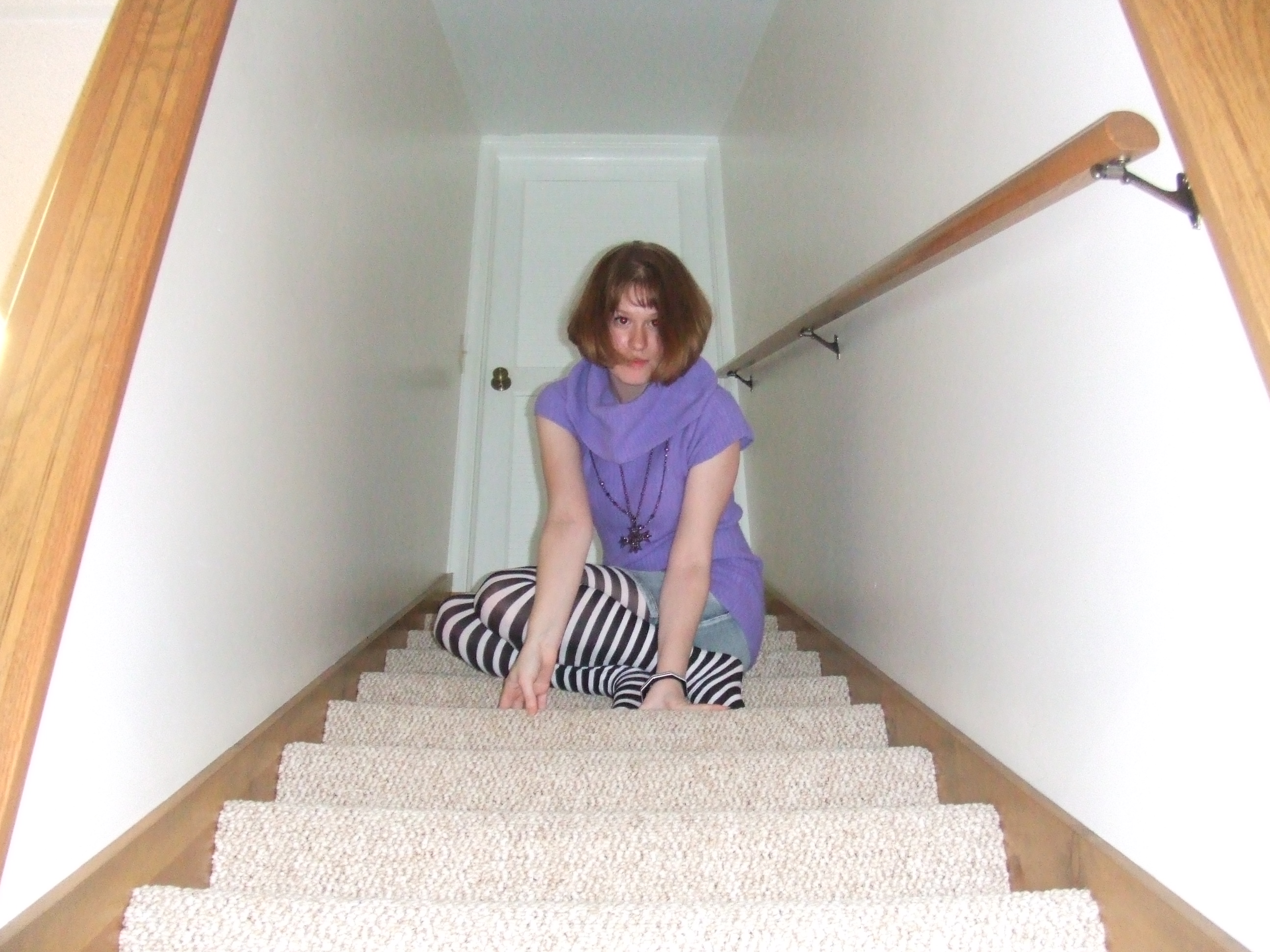
My 10 year reunion is coming up next year, and the clothes I used to wear are officially beginning to look silly. Short sleeved turtleneck sweaters for the win! And always striped tights, because The Dresden Dolls (would still rock those!)

My 10 year reunion is coming up next year, and the clothes I used to wear in high school are officially beginning to look silly. Cap sleeved turtleneck sweaters and pre-worn jean skirts for the win! And always striped tights, because Amy Brown fairies and The Dresden Dolls (I would still rock those!)

“Actually, It Is This World That’s Too Small” is a mixed media piece I based on a photo a friend took in high school while we were hanging out, playing around with cameras in my basement. I never felt that I shared much in common with “typical” teenage girls, but a desire to constantly take photos of each other was one stereotypical trait my friends and I all did share – just sometimes my photos involved face painting or cardboard masks rather than manicures and false eyelashes. I found it interesting how the angle of the photograph made it look like the door behind me was miniature, like the door the white rabbit escapes through in Alice In Wonderland. You can see how the photo serves as a guide and an inspiration, but by no means dictates what your final piece has to look like. Creative alterations are always an option, and encouraged.

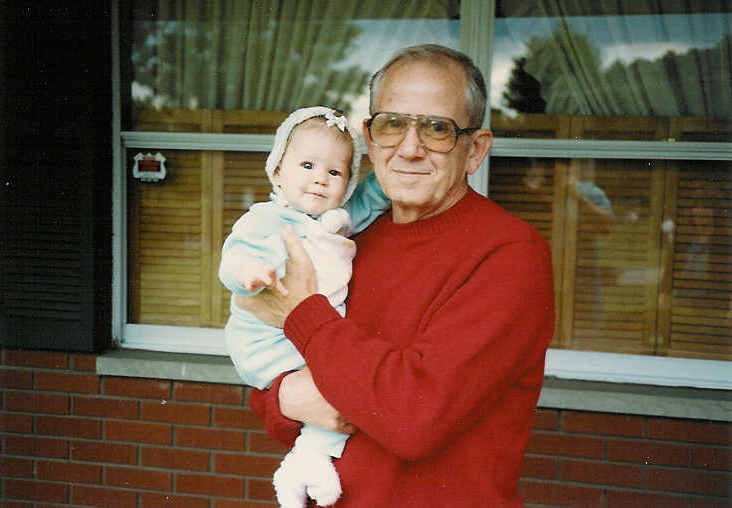
Old family photo with Grandpa (I can't believe I'm posting this, but for the sake of art ... I will publicly expose baby photos - at least the non-embarassing ones).

Old family photo with Grandpa (I can’t believe I’m posting this, but for the sake of art … I will publicly expose baby photos to the online universe – at least the non-embarassing ones).

What’s really awesome is that beyond conceptual art, you can apply this same technique to family photos, and make a truly meaningful piece of work that is entirely personal. I’m going to talk you through how I would approach this photograph above if I were going to turn it into a mixed media piece. This will give you another example that will hopefully help you solidify how to proceed on a project of your own. I would probably draw the people since I adore portraits and figures, but once again if figures are not your thing, you could print yours from an enlarged photo and collage them in – it’s totally allowed :). There is really no reason to just color in a solid red shirt, so I would probably trace a pattern to get the right shape, and then cut the sweater out of fabric and paste it over my grandpa like I did with the purple dress in the staircase piece shown previously. Remember, always look for places to add interest with different materials. Due to the light, reflective nature of the window glass, I would use a mix of ink and watercolor for that part. The bricks are definitely the most textural element in this particular photo, so for those I would mix a gritty element like sand into acrylic paint, and create a rough, uneven texture in dark red on the wall. Once dry, I would then paint the grey cement lines over with a thin brush. For the sake of my sanity and also to make it more interesting and less institutional looking, I would probably change the brick to an uneven pattern of varying size and shape as opposed to the uniformity that was there in real life. How else can we add interest? In the photo, there are no flower boxes on the windowsill, but why can’t there be? You can cut flowers out of paper or white fabric and color them with ink or watercolor, or you can glue on small ribbon rosettes available in the floral or wedding aisle of most craft stores.

I hope this post has given you some ideas, and I’d like to end with a simple (though not set in stone) guide as to when certain materials are most beneficial when creating your own mixed media wonderland.

Watercolor: overall background coverage, light or translucent forms, florals, glass, water

Ink: flowers and plants, light or translucent forms, fabric, glass, water, figures/faces/skin/hair

Colored Pencil: small details, figures/faces/skin/hair, birds or furry animals, stone or bark

Fabric: clothing, flowers and plants, ground cover (soil, grass, leaves, etc), interior wallpaper

Book Pages: trees and bark, interior wallpaper, flowers

Sand Mixed With Paint: brick, stone, dirt

Other Accoutrements: embroidery thread sewn through the paper as anything composed of thin lines: tree branches, eyelashes, veins, flower stems …; small ribbon flowers, tiny prints on photo paper as interior wall art, strung seed beads or glued on flatback rhinestones as jewelry, use your imagination and don’t be afraid to try something new!

Feel free to comment or message if you need any advice on a project you’re working on or a new one you are beginning. I’m happy to help!

Standard