Project Ideas

No Canvas, No Problem! – Using Unexpected Materials

I first discovered my love of corrugated cardboard when the movie “The Science of Sleep” came out. If you haven’t watched it, it’s an extremely visually fun movie and you should check it out. If you have, the various imaginary cardboard-based sets depicting the main character’s dream worlds, such as the car chase sequence or the cardboard cityscape, attracted me to corrugated cardboard’s simple, whimsical, DIY charm. I started using it for projects in college not only for the charm itself but for utilitarian reasons. After having to buy so many canvases and large pieces of illustration board for studio assignments, by the time I got around to my own personal projects I simply didn’t want to have to buy another damn thing! It was light and easy to transport for painting outdoors on nice days, and was readily available at no cost.

Cardboard also offers more easy textural options than canvases simply by layering or ripping away at its surface. Tearing away at the cardboard’s outer layer reveals the interesting ribbed texture beneath to be used as a design component. Layering torn edges automatically gives your piece an industrial, time weathered feel like the monochromatic cityscape below. Scraps can even be used to roll, crinkle, and fold 3D elements, such as the rosettes at the bottom of my fish bride piece. There is a story to this one; my roommates and I had 2 feeder goldfish we rescued from the tank at the grocery: Mr. Mustache and Mistress Bouffant. This is why I don’t have pets. Even the death of this tiny, normally dinner to bigger fish, goldfish caused distress, and I decided I needed to immortalize her. I used broken glass as bubbles due to the clear, reflective nature of the pieces. I still remember smashing bottles with a hammer on the front porch of our apartment. A neighbor asked what I was up to, to which my quick answer was, “Our fish just died.” I only realized in retrospect how that must have appeared, me furiously hammering away with that statement as my only explanation. No wonder they were never too chatty with us.

I’ve included some photos of my own experiments as well as some cardboard art by other artists as inspiration. The next time you get a package in the mail and have some extra cardboard laying around, I’d encourage you to give a project like these a try.
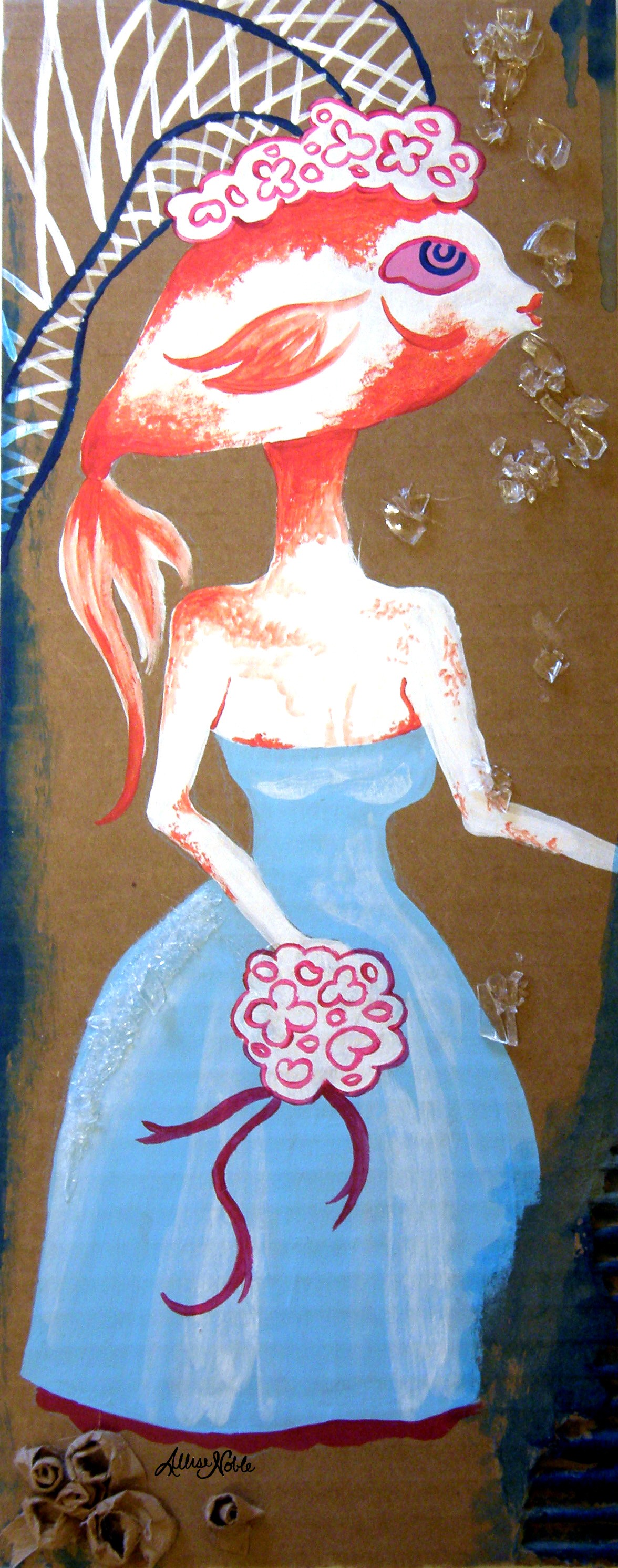
RIP Mistress Bouffant, Mr. Mustache will morn your absence. (A side note, the other goldfish really did have a black marking above his lip that looked exactly like a drawn on mustache.)

RIP Mistress Bouffant, Mr. Mustache will morn your absence. (A side note, the other goldfish really did have a black marking above his lip that looked exactly like a drawn on mustache.)

Painting on layered cardboard, using the texture of the corrugation as part of the design.

The flawless, traditional black and white portrait contrasts with a work surface left rough; with dents, tears, and even leftover paint smeared here and there as if the artist was cleaning off their brush.

Valery Koshlyakov – High-rise on Raushskaya Embankment (2006) – Tempera on Cardboard

Retro Barbies, acrylic on cardboard

My retro Barbies, acrylic on cardboard

Standard
Project Ideas

Textured Painting With Mixed Media (Or, The Upside of Hoarding)

Express Yourself Artshop, the art program I work with focusing on providing art instruction for adults with disabilities, runs mostly on donations. Because of this, I’ve gotten used to brainstorming how to transform materials not commonly used in art into something awesome. Though I appreciate sculpture, my passion definitely lies in creating 2D art. However, 2D doesn’t always have to mean “flat” – and that’s where mixed media comes in. Mixed media literally means “the combined use of 2 or more media”. Many times, it involves assembling multiple non-flat elements to a drawing or painting, working them into the overall composition. Knowing how to add all these extra elements in an effective manner, as well as recognizing when to stop so that the piece doesn’t become a massive junk pile, can be intimidating on the first go. An easy way for an artist who has never worked in mixed media before to dip their toe into the genre is by simply creating texture on their work surface, and then drawing or painting over it as they would were they using a flat canvas. The effect is something far more extraordinary that draws the viewer to come closer and really examine the finished piece, touch it even (if you allow it).

The main component you will need is a bottle of gesso; a white, thick, paste-like paint that can also be used to cover over used canvases. It can be pricey, but lasts a long time. This is the only thing you will need to purchase. Everything else used to create texture can be common household materials. Paper towel, especially if it has a pattern imprinted on it (you can use that!), is great as well as tissue paper. Are you an avocado or citrus fruit enthusiast? You know those net bags they come in at the grocery? Those are simply fantastic. Once you have your materials, lay them out on your canvas and pile on the gesso. It will act as a glue, but takes awhile to dry so don’t hesitate to manipulate, move, crinkle, your materials as you are covering them. After a few coats, you will have a paintable surface. For the octopus painting shown below, I used liquid watercolor. Watercolor is great because it will show darker on the textured areas and lighter on the flat areas, accentuating the visual texture. This next piece I’m trying with the black background I’m doing in acrylic this time. Play around, make some samples on cardboard until you find something you like (old cereal boxes work great to experiment on), and keep on the lookout for interesting textures in your everyday environment – they could come in handy for your next masterpiece!

New textured work, in progress.

New textured work, in progress.

Closeup, texture achieved using a net fruit bag and wrinkled tissue paper.

Closeup, texture achieved using a net fruit bag and wrinkled tissue paper.

Gilded Creatures, 16x20 mixed media - Behold, the wonders of gesso!

Gilded Creatures, 16×20 mixed media, and one of my more popular pieces – Behold, the wonders of gesso!

Standard