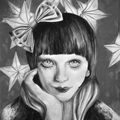
Artists To Know

Artists To Know! Installment Two.

James Jean

James Jean is a double threat Taiwanese American artist – known equally well for both his commercial (DC Comics, ESPN, Prada, and Atlantic Records to name a few) and fine art gallery work. I know James Jean most from his arresting illustrations that grace the covers of Bill Willingham’s “Fables” graphic novel series. I am not one to ever keep up with series, but I cannot stop adding more of these books to my collection. Not only is the art obviously exquisite, but the stories are gripping, and the very reason I just cannot get into that “Once Upon A Time” TV show everyone is freaking out over – Same idea, but “Fables” is just so much better. Jean’s illustrations range from the ultra colorful to the monochromatic as featured below, but they all have a transparent, ghost-like quality to them that is just made for depicting fantasy characters, not fully “real” themselves. His website features a lot of his non-fables work, which was fascinating to see since I wasn’t as acquainted with it.

James Jean

Madge Gill

Madge Gill is not a current artist, being born in the late 1800s and passing in 1961. Though I usually highlight artists still working today, her primitive ink drawings drew me in the moment I first saw them. One of my workplaces had a couple-month-long focus on outsider art over the fall, which prompted me to want to learn more about the genre. Outsider art is literally art created by outsiders or untaught artists, art created outside the boundaries of official culture. I watched a documentary about outsider artists on youtube one evening, and Madge was one of the artists highlighted. She had a life filled with more hardship than many have to face. After delivering a stillborn child in 1920, one more painful life event, Madge claimed she had become inhabited by a spirit guide named Myrninerest. This connection continued throughout her life, and she would often go into trance like states, withdrawing more and more into herself. Though her detailed drawings of characteristic females; most of which took her only minutes at a time; continue to captivate viewers, it seems she never found peace. Near the end of her life, even her art-making had become a burden, more an obsessive-compulsion than a therapy. The biography on her website asks, “Are these in a sense self-portraits, or rather: attempts to stabilize her own fragile being, as it were through fleeting snapshots? Another reading equates the faces with Myrninerest, envisaged as the artist’s otherworldly alter ego, immune to the traumas of actual life.” (In the documentary, I noticed the alter ego’s name was pronounced as “My inner rest”, which would seem to suggest that the alter ego created as an escape or explanation for behavior she could not control is a plausible hypothesis). Her story is a sobering realization that although art helps us in coping with difficult emotions and can be a vital form of self-expression to those whose voices are stifled, creation alone is sometimes not enough, especially in isolation.

Madge Gill

Yayoi Kusama

I first saw Yayoi Kusama’s work at The Mattress Factory on a school trip to Pittsburgh (shown in the photo below). Though I wasn’t familiar with her at the time, this installation was my absolute favorite. Same as with Madge Gill, I learned about Yayoi Kusama through my outsider art documentary binge. A clip of a similar installation to the one I saw was shown in the film, and I suddenly realized “Oh my gosh, I’ve walked around inside her work before!” Also similar to Madge Gill, Yayoi Kusama has wrestled with psychological issues throughout her life, though her story has a far happier ending. Kusama began creating art with polka dot motifs as early as 10 years old, one of her first pieces a drawing of her mother with dots emanating from her portrait (Her mother was physically and emotionally abusive). She also began suffering hallucinations at an early age, seeing these dots everywhere, flowing towards her, in her own words trying to “obliterate” her. To date, many of her works include the words and themes of “self-obliteration”. In 1973, she checked herself into Seiwa Hospital for the Mentally Ill and still lives there to this day by choice, her studio nearby. Kusama has reached out, and come to enjoy the residents and staff and art continues to be a source of joy and purpose in her life. A creator of all trades (and master as well), she creates paintings, sculpture, installations, clothing and accessories, fashion editorials, films, and poetry and short stories all cloaked in her trademark surreal, ultra colorful, polka dot covered world.

Yayoi Kusama

Yayoi Kusama

Martine Johanna

Martine Johanna is a Dutch artist who started out in fashion design, but left the industry desiring more freedom to devote to her own work. The fashion influence is evident in her figure’s pose, gaze, and design. What I love most is how she sometimes leaves areas of pieces less developed to draw the viewer’s eyes to where she wants them to rest. If you look through the rest of her work as well, you will also see how she uses bold, bright colors you wouldn’t think of using for skin tones like blues and yellows to render her figures’ flesh. Bringing these natural undertones to the forefront gives her work an otherworldly quality that it is impossible to look away from, and highlights her imaginative nature.

Martine Johanna

Arabella Proffer

Google+ is a great place to discover artists as far as social media goes, and that is where I found Arabella Proffer. She was born in Ann Arbor, Michigan (woohoo, shout out to my home state, where I still reside) and now lives in Ohio (second shout out to where my parents are from and where most of my extended family still lives. I guess some cool art CAN come out of the midwest, huh?) – I thought that was pretty cool. Her work combines old school, aristocratic portraiture with pure 1980s punk rock and gothic culture. She also has an interest in medical history, remnants of which find their way into her work. The contrast of all these elements creates a tension that makes me want to get to know the fabulous women in her pieces, sit down and have a cup of coffee with them in their imaginary, velvet curtained living rooms – they all seem like so much fun.

Arabella Proffer

Standard
Artists To Know

Artists to Know! Installment One.

In my first installment of Artists to Know, there are actually two digital artists, still unbelievably underrepresented in this day and age. Digital artists are highly under appreciated, and wrongly viewed as art “cheaters” in the fine art world. I myself have played around with digital work, and absolutely HATED it! Take it from me, what one can do in 10 minutes with a brush seems to take 10 hours on a computer. Digital art is used to achieve a desired effect, it is by no means a shortcut. I hope you see something new today, maybe something that sparks ideas of your own.

Ray Caesar

Ray Caesar describes his art on his website as “facing something unpleasant with calm and looking beyond what you’re viewing to see the beauty within”. His work is influenced by the time he spent working as a photographer and graphic designer at a children’s hospital, many of whom were abused or suffered from serious physical deformities. After his mother’s death, he had a dream in which she appeared to him as a child. The childlike figures in his pieces aren’t really children but the manifestation of people’s souls. His work is certainly not for everyone, and I know many who find his art too  creepy or disturbing, but it goes to show that as artists, our experiences do inform what we create. He uses digital programs to create a 3D world in which he can change poses, adjust the viewpoint angle, open and close drawers … He has said there are hidden secrets that never show up in the prints such as what are in the figure’s pockets or inside closets. If you have the time, read more in depth about the process by which these digital worlds are created because it is truly amazing and eye-opening.

Ray Caesar

Catalina Estrada

This lady does everything – Besides the typical art prints, she covers greeting cards, bedroom comforters, clothing and bags, even umbrellas with her beautiful designs; prints wallpaper; has her art made into difficult 1000 piece puzzles that I would probably end up throwing across the room in frustration! She embraces the concept that art doesn’t just have to hang on a wall, and captivating designs that make people smile and feel inspired can cover every imaginable surface. She makes her work accessible, and that is awesome.

Catalina Estrada

Elena Kotliarker

From the Ukraine, Elena classifies her work as Judaic Art. The flow from one element to the next in her pieces is so spot on, the effect is calming and dynamic at the same time. I love all the tiny details within each piece, so that you keep noticing new things the longer you look at it. Also interesting is the cultural symbolism she integrates into each work. I discovered her on ebay actually, and now have a gorgeous little ACEO prints as a souvenir.

Elena Kotliarker

Camille Rose Garcia

Camille Rose Garcia is an artist you can spot immediately. I love that all her art just GOES TOGETHER to form a cohesive body of work based on her distinctive style alone. While maintaining this continuity, she continues to keep things fresh and different with widely varying genres, stories and narratives, and color schemes. Much like Ray Caesar, I feel like her work is something you get or don’t. Being the fan of almost any form of surrealism or warped storybook illustrations that I am, I am in love.

Mia Araujo

Mia Araujo is interested in the complexities that make each individual unique, and the invisible universes that thrive inside us all. Manifesting inner landscapes through art, making the invisible visible, is something I am also passionate about as I touched on in my last post. It’s no surprise why I am so drawn to her work. Each piece has an entire fantasy story within it to absorb. For lovers of portraits, you’re in luck, because within each piece are embedded innumerable portraits, from the main subject(s) to the tiny faces embedded in the background and sometimes even within the subject’s hair or clothing. Can you tell I’m into detail?

Mia Araujo

I hope you’ve enjoyed exposing yourself to some artists you may not have heard of before. I did go heavy on the surrealism as that is what I tend to be drawn towards most, but even if the subject matter or style is not your bag, there is always something to learn by observing other artists’ technique. I’m constantly finding new artists and images that inspire me, so I will definitely be sharing more in the future – be on the lookout!

Standard
New Work

Bringing The Inside Out – Exploring Conceptual Portraits

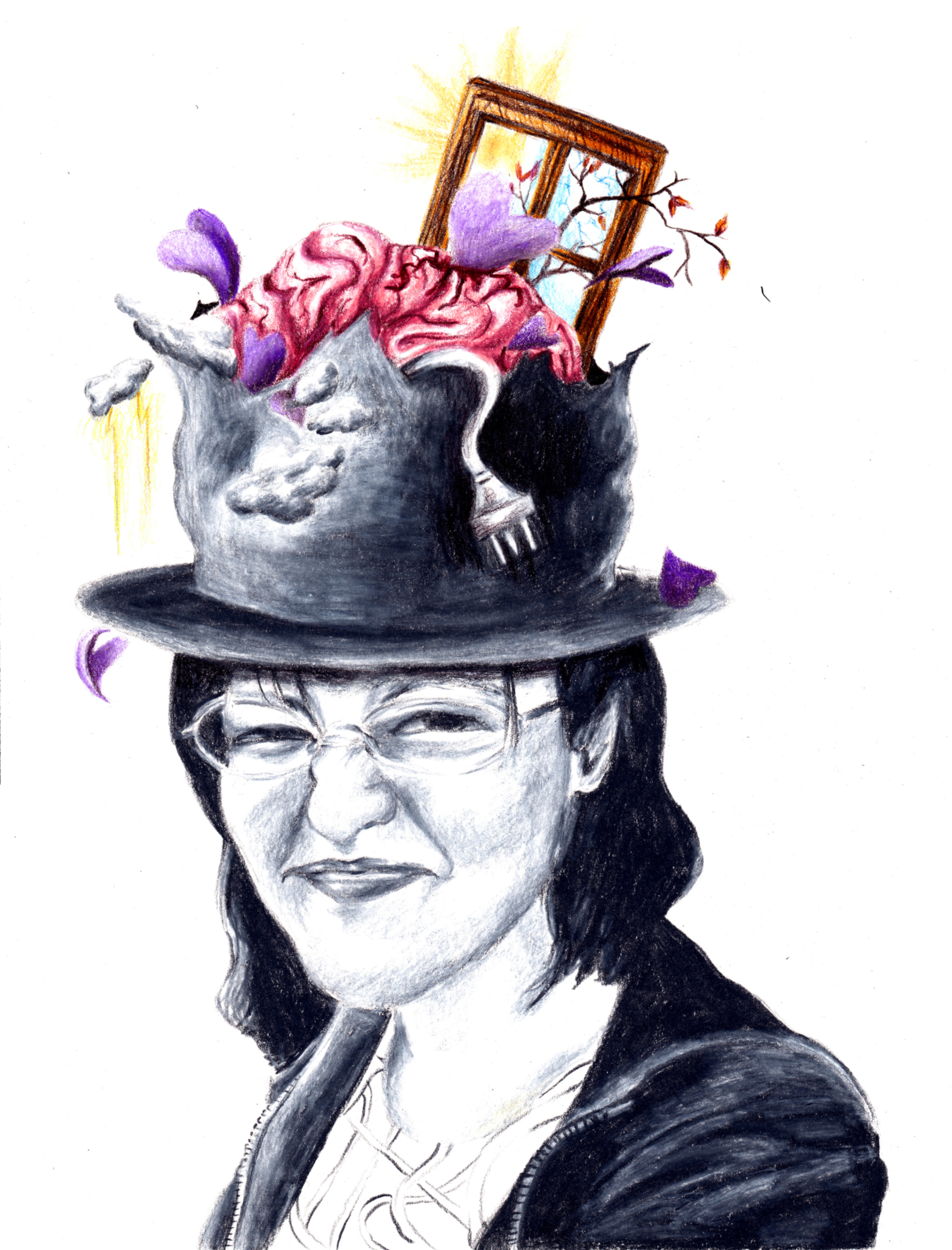
Spring seems to be the time for exhibitions, and with many deadlines coming in mid-February, I’ve been going into hyper-drive to get pieces finished and ready. This past year has been all about conceptual portraiture. My drive to expose the subject’s thoughts and emotions through visual cues outside of themselves  came in part from my interior design study in college, where visual cues in the external environment are key, and part from a conversation I had with one of my best friends coupled with my overactive imagination. We were both at different colleges, and she had had a particularly stressful couple of weeks and was unloading over the phone because that’s what best friends do. One thing you have to know about me, as people talk, I get these vivid little reels of what they are describing playing in my head. It doesn’t mean I’m daydreaming and not listening, it’s just how my brain works. I immediately got this image of her overstuffed brain protruding from out of the ripped open top of her trademark top hat, with other random objects and various debris springing out everywhere. I told her, she burst out laughing, and we went on with our evenings. I made a concept sketch the moment we got off the phone, for future reference.

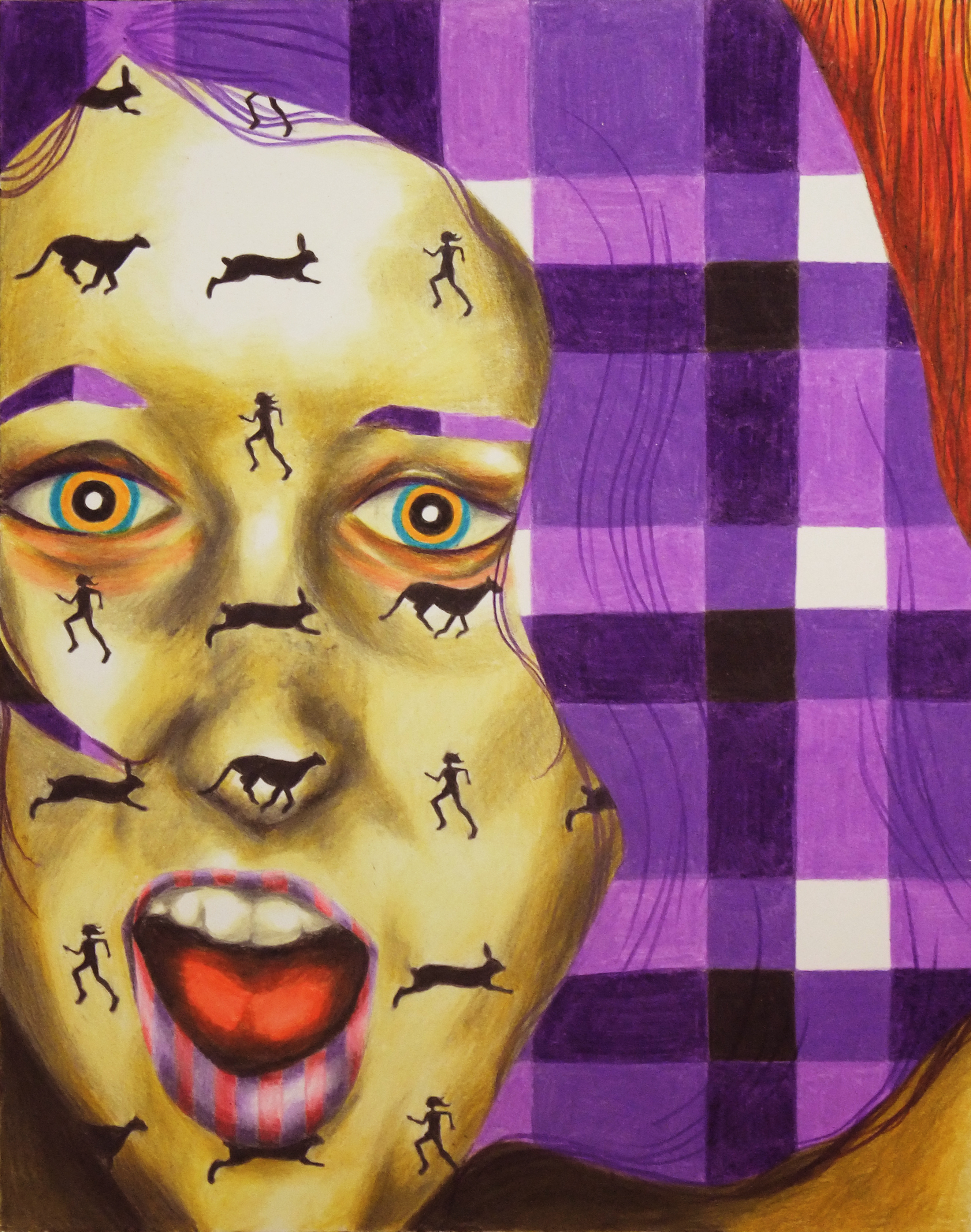
After doing a series of portraits in which visual manifestations of the subject’s emotions literally burst out of or hovered over the top of their heads (wouldn’t that make life far less more of a guessing game as far as relationships are concerned?), I began to think more about how not only literal objects but also the more subtle use of color and all over pattern could communicate about the subject’s mental state. If one’s emotions covered them like a fabric, what would it look like?

Today, my portraits are a combination of these earlier ideas. I used photos I’d taken of friends before, but now I’ve gotten really into using vintage photographs as references instead, because not knowing the people at all allows me to start with a blank slate and gives me more freedom to invent my own stories about them. Photographs of my girls are being taken, and jpegs sent or framed work dropped off to the various locations for jurying, so wish me luck in the next couple of weeks! If you’d like to see more portraits, check out my website (there is even one MAN portrait! – those of you who know me and my work know how rare this is). Prints are also for sale here!

Overaccumulation of Stimuli, Prismacolor Pencil, 2010 - The portrait that started it all.

Overaccumulation of Stimuli, Prismacolor Pencil, 2010 – The portrait that started it all.

Fight Or Flight, Prismacolor Pencil, 2011 - Through studying interior design, constructing environments for people, you learn that color and pattern SPEAK, and can affect the psychology of those who live in it (and the psychology of the viewer who looks at your art!)

Fight Or Flight, Prismacolor Pencil, 2011 – Through studying interior design, constructing environments for people, you learn that color and pattern SPEAK, and can affect the psychology of those who live in it (and the psychology of the viewer who looks at your art!)

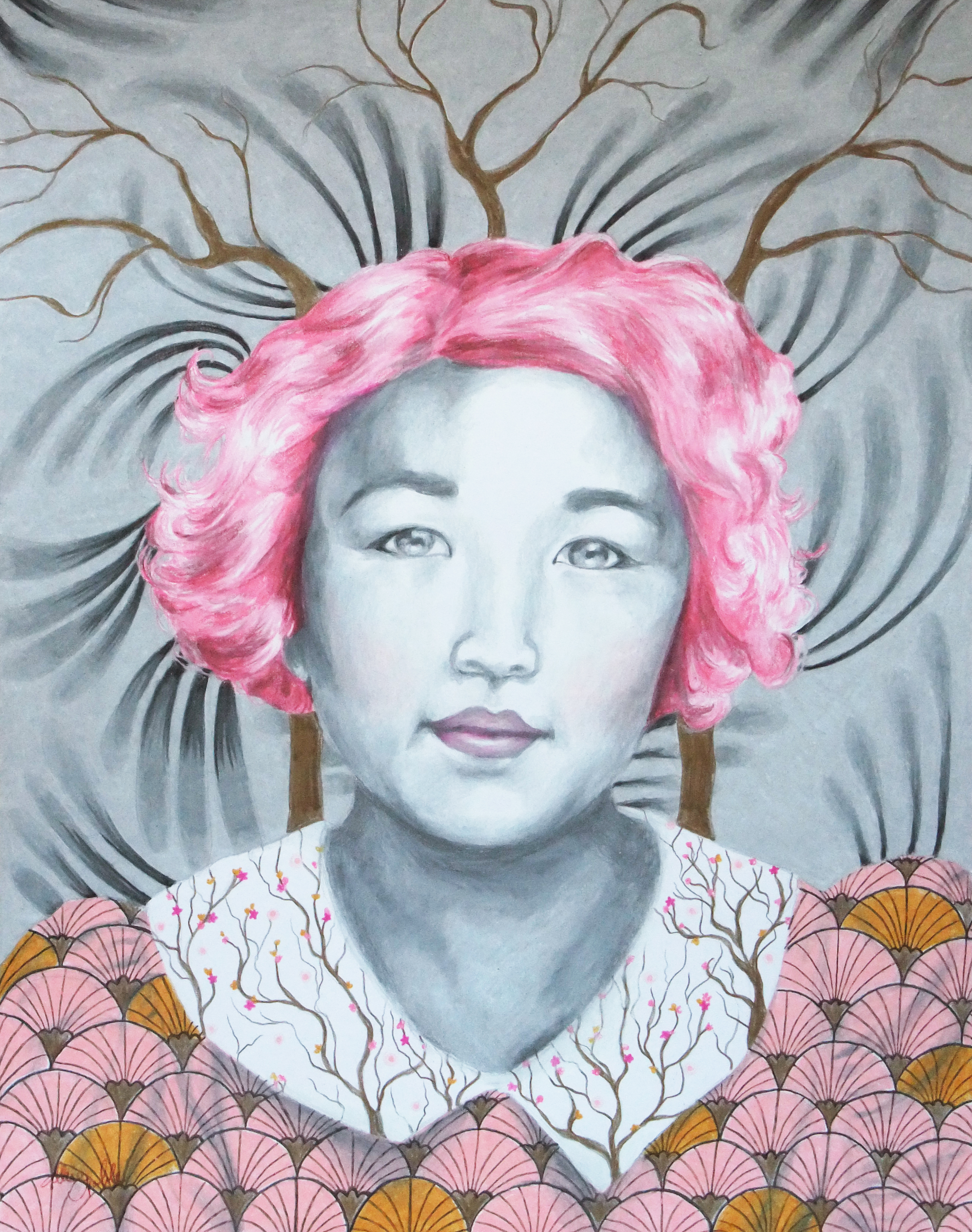
Hopeful, 11x14 Prismacolor Pencil

Hopeful, 11×14 Prismacolor Pencil

The Peacock, 11x14 Prismacolor Pencil

The Peacock, 11×14 Prismacolor Pencil

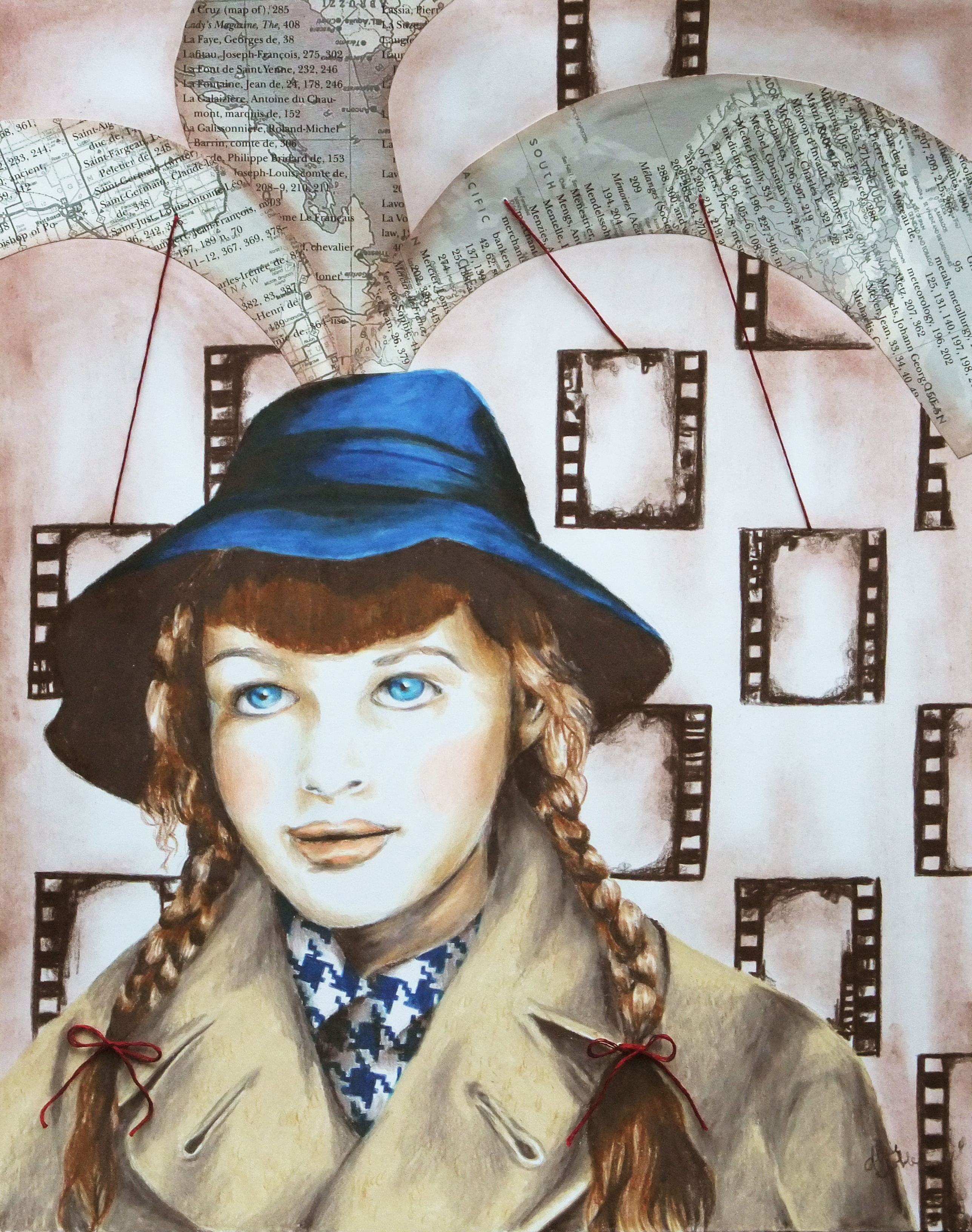
A World To See, 11x14 Prismacolor and Mixed Media

A World To See, 11×14 Prismacolor and Mixed Media

Standard